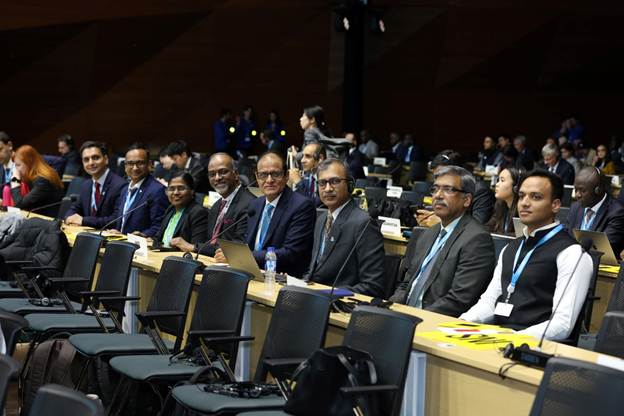
The World Telecommunication Development Conference 2025 (WTDC-25), the flagship summit of the ITU’s Development Sector, concluded in Baku on Friday with India emerging as one of the most influential contributors to the global digital agenda. The conference, held every four years, brought together nearly 2,300 delegates including more than 65 ministers and heads of agencies.
India participated under the leadership of Dr. Pemmasani Chandra Sekhar, Union Minister of State for Communications and Rural Development, who delivered India’s high-level policy statement on universal and meaningful connectivity, inclusive digital transformation and the role of emerging technologies. Referencing India’s approach of “Vasudhaiva Kutumbakam,” the Minister outlined the country’s commitment to shaping an equitable and sustainable digital future.
India held several key leadership positions during WTDC-25, with Avinash Agarwal, DDG-IR, serving as Conference Vice-Chair, APT-WTDC-25 Coordination Chair and Chair of the Ad Hoc Group on Digital Transformation and Innovation. India also secured two Vice-Chair posts for the ITU-D Study Groups for the 2026–29 cycle through officers Sunil Kumar Singhal and Sandeep Kumar Gupta.
The Indian delegation played a major role in the adoption of 19 APT common proposals at the conference. Officials held 11 ministerial-level bilateral meetings and engaged with more than 50 countries on cooperation in telecom and ICT development. India additionally introduced Ms. M. Revathi as its candidate for the post of Director of the ITU’s Radiocommunication Bureau.
India showcased indigenous telecom technologies developed by C-DOT through a dedicated exhibition stall that received strong interest from participating nations. The country also hosted a high-level networking reception to garner support for its candidature for the ITU Council (2027–2030) and to promote Ms. Revathi’s bid for Director, BR.
India made notable contributions across major resolutions adopted at the summit. Under the digital transformation agenda, the country advanced Resolution 85 to expand Smart Sustainable Cities and Communities to include smart villages, leveraging IoT and emerging technologies for rural benefits. Resolutions 89 and 90, to which India contributed substantially, strengthened global frameworks for innovation, entrepreneurship and future readiness.
On cyber security and trust in ICTs, India shaped the strengthening of Resolution 45 addressing telecom misuse, including voice spam and caller-ID manipulation, with a focus on tools to enhance SME cyber resilience. Resolution 84, which deals with mobile device theft and tampering, was also bolstered with India’s support.
India played a critical role in enhancing policy and regulatory resolutions, including Resolution 09 which emphasises flexible regulatory approaches, sandboxes for next-generation technologies such as IMT-2030 (6G) and UAVs, and improved spectrum management strategies for developing nations. India also pushed for updates to Resolution 62 to expand public awareness on EMF exposure and promote safe use of wireless devices.
In the area of disaster management, India strengthened Resolution 34 to support emerging ICT-based early warning systems, multilingual alert dissemination, GIS-enabled mapping of telecom assets and cross-border disaster information sharing. India additionally contributed to Resolution 66 on climate change and circular economy, advocating for reduced ICT carbon footprints and improved e-waste management, as well as Resolution 58 promoting accessibility and inclusion for senior citizens and vulnerable populations.
The conclusion of WTDC-25 marks a significant moment in India’s international digital diplomacy, reinforcing its status as a central player in global telecom development. ITU Secretary-General Doreen Bogdan-Martin lauded India’s long-standing association with the ITU, noting that India “has been a valuable partner and Council member since 1952.”