










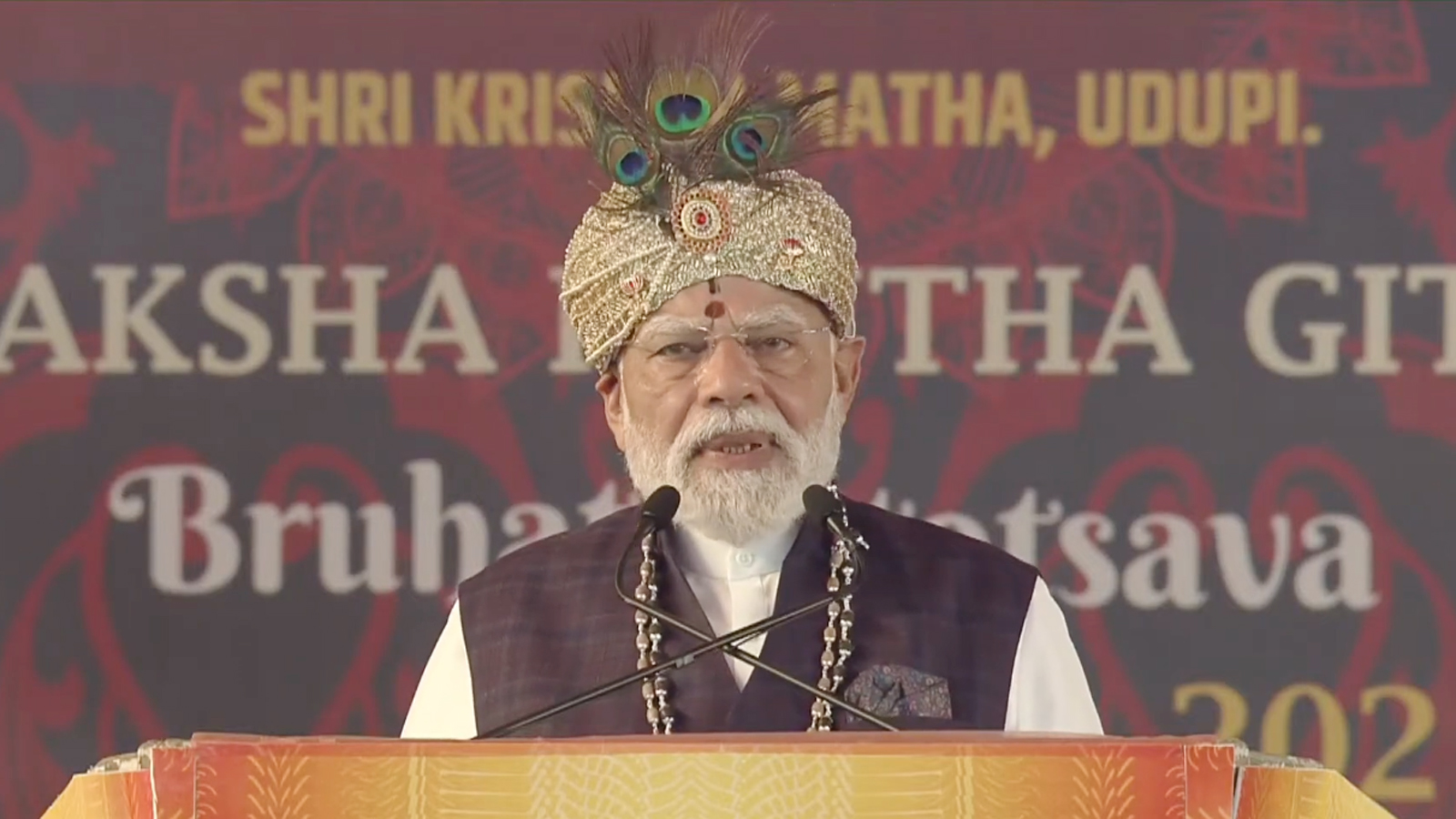
Prime Minister Narendra Modi on Friday addressed the Laksha Kantha Gita Parayana, a mass recitation programme held at Sri Krishna Matha in Udupi, where one lakh devotees chanted verses of the Bhagavad Gita in unison. The Prime Minister described the event as a “supreme blessing,” saying the spiritual atmosphere and the darshan of Lord Krishna filled him with “immense divine satisfaction.”
Highlighting the significance of the gathering, PM Modi said that the collective recitation demonstrated “the living divinity of India’s millennia-old spiritual heritage” and showcased the power of unity and spirituality.
The Prime Minister said his visit to Udupi held special importance because of the region’s historical, cultural, and spiritual legacy. He recalled the long-standing connection between Gujarat and Udupi, noting that the idol of Lord Krishna worshipped at the Matha is believed to have been earlier revered in Dwarka. PM Modi also said that his recent underwater visit to the submerged site of ancient Dwarka deepened this spiritual bond.
PM Modi also underlined Udupi’s early contribution to the BJP’s governance traditions, recalling that V. S. Acharya’s election to the Udupi municipal council in 1968 introduced several civic models – such as sanitation and water management – that later became national priorities.
During his address, PM Modi invoked verses from Ramcharitmanas and the Bhagavad Gita, saying that chanting the Lord’s name is the path to liberation in Kalyug. He said mass recitations like the one in Udupi generate a “special energy” that strengthens both spirituality and social unity.
The Prime Minister praised the efforts of Sugunendra Tirtha Swamiji, who conceptualised the Laksha Kantha Gita initiative and launched the global Koti Gita Lekhana Yajna, encouraging people to handwrite the Gita. He said the growing interest of the youth in the teachings of the Gita is a positive cultural development.
PM Modi also referred to his recent visit to Ayodhya on Vivaha Panchami, where the Dharma Dhwaja was installed at the Ram Janmabhoomi Temple. He acknowledged Udupi’s long-standing role in the Ram Mandir movement and noted with pride that the new temple features a monumental gate named after Jagadguru Madhvacharya.
The Prime Minister praised Madhvacharya’s contribution to the Dvaita philosophy, the establishment of Udupi’s Ashta Mathas, and the tradition of service, scholarship and devotion. He also recalled the influence of the Haridasa tradition and saints such as Purandaradasa and Kanakadasa, whose compositions continue to resonate deeply with people, including the youth.
Linking the Bhagavad Gita’s teachings to national policy, PM Modi said that several governance principles – such as Sabka Saath, Sabka Vikas and welfare schemes like Ayushman Bharat – draw inspiration from Lord Krishna’s message. He added that India’s security doctrine is shaped by the Gita’s teaching that establishing peace sometimes requires defeating the forces of injustice.
PM Modi said, “The Bhagavad Gita teaches that upholding peace and truth may require confronting and ending the forces of injustice. This principle lies at the heart of the nation’s security approach. The words of the Gita not only guide individuals but also shape the direction of the nation’s policies.”
“In Kaliyuga, only the chanting of the name and divine play of God is the ultimate means. By singing his kirtan one gets liberation from the ocean of life,” added PM Modi.
Referring to the recent Operation Sindoor and the response to the Pahalgam terror attack, PM Modi said that India today is firm and resolute in safeguarding its citizens. “This new India neither bows nor hesitates in performing its duty,” he said.
The Prime Minister urged citizens to adopt nine resolutions, including water conservation, plantation of trees, uplifting at least one poor person, promoting Swadeshi products, encouraging natural farming, adopting a healthy lifestyle, practicing yoga, preserving manuscripts, and visiting at least 25 heritage sites, including the newly inaugurated Mahabharata Experience Centre in Kurukshetra.
PM Modi said that the period leading to 2047 is a “duty-bound era” for every Indian to contribute to building a developed India. He said that Karnataka’s people have a major role in this national effort and expressed hope that the spiritual energy of Udupi would continue to inspire the nation.
Governor Thaawarchand Gehlot and Union Minister Pralhad Joshi were among the dignitaries present at the event.
Earlier in the day, the Prime Minister visited Sri Krishna Matha, inaugurated the Suvarna Teertha Mantapa, and dedicated the Kanaka Kavacha for the sacred Kanakana Kindi.