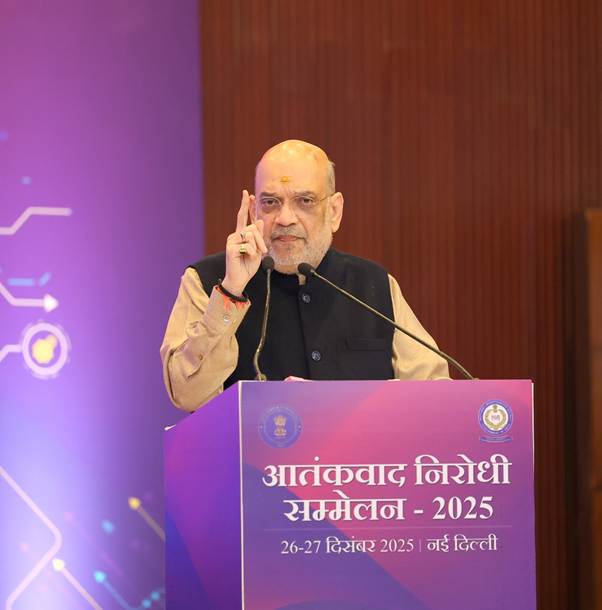
Union Home Minister and Minister of Cooperation Amit Shah on Friday inaugurated the two-day Anti-Terrorism Conference–2025 in the national capital, stressing the need to build a strong, impenetrable and technology-driven anti-terrorism grid to counter evolving security challenges.
The conference is being organised by the National Investigation Agency (NIA) under the Ministry of Home Affairs and is being attended by senior police officers from States and Union Territories, officials from central agencies and experts from the fields of law, forensics and technology.
Addressing the inaugural session, Shah said that under Prime Minister Narendra Modi’s vision of zero tolerance against terrorism, the annual conference has emerged as a key platform to identify emerging threats and strengthen India’s counter-terrorism capabilities. He said the forum is not limited to discussions, but focuses on actionable outcomes that are followed up throughout the year.
The Home Minister underlined that the nature of terrorism is rapidly changing due to the use of advanced technologies and stressed that security agencies must stay “two steps ahead” to prevent future threats. He said all terrorist incidents in India and across the world must be analysed in detail to further enhance preparedness.
During the event, Shah unveiled the updated NIA Crime Manual, the Organised Crime Network Database, and the Lost, Looted and Recovered Weapons Database. He urged state Director Generals of Police to ensure uniform adoption of these tools for investigation and prosecution.
Highlighting the growing nexus between organised crime and terrorism, Shah said criminal networks initially involved in extortion and ransom often establish links with terrorist organisations after fleeing abroad, using illicit funds to fuel terror activities. He called on states to eliminate such networks with coordinated support from NIA, CBI and intelligence agencies.
Referring to recent terror incidents, Shah said Indian security forces delivered a strong response through precise intelligence-led operations. He said those who planned a major terror attack were punished through Operation Sindoor, while those who executed it were neutralised through Operation Mahadev, sending a clear message to terror sponsors. He added that investigations into recent terror cases were conducted in a watertight manner and would be studied by agencies globally.
The Home Minister emphasised the importance of a common Anti-Terrorism Squad (ATS) structure across states to ensure operational uniformity, better intelligence sharing and coordinated counter-action. He called for mandatory use of platforms such as NATGRID and NIDAAN in specified investigations to uncover hidden linkages between cases.
Shah also stressed the need to shift from a “need to know” approach to a “duty to share” culture among security agencies, stating that data and technology developed in silos weakens national security. He said discussions should be held to create a seamless national framework for technology and data integration.
He further announced that the government is working on a plan for a 360-degree strike against organised crime and called for fearless implementation of trial-in-absentia provisions to compel fugitive criminals and terrorists to return to India.
Stressing collective responsibility, Shah urged all central agencies and state police forces to function as “Team India” for national security, stating that as India’s economic and geopolitical stature grows, security challenges will also increase.