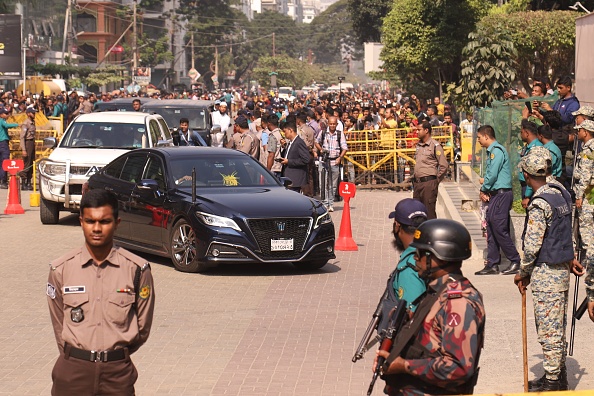
After 18 years in self-imposed exile in London, the man many call the “Crown Prince” of Bangladeshi politics is finally coming home. The Bangladesh Nationalist Party’s acting chairperson and former prime minister Khaleda Zia’s son, 60-year-old Tarique Rahman, is set to land in Dhaka on 25th December – exactly 50 days before the country goes to the polls on 12th February.
For the B.N.P., Tarique Rahman’s return is more than a homecoming. It is a lifeline. His mother, Khaleda Zia, remains in critical condition. So the party rank and file hope that Tarique Rahman can galvanise voters by standing for election and help return the B.N.P. to power after two decades.
The significance cannot be overstated. By returning now, Tarique Rahman is signalling that the legal barriers that kept him away – including multiple convictions from the Awami League era – have effectively crumbled. Following his acquittal in several high-profile cases, his physical presence in Dhaka is likely to transform the B.N.P. from a party-in-waiting to a winning electoral machine on the ground.
The 12th February election is unlike any in Bangladesh’s history. It will be the first election since the 2024 students’ uprising ousted Sheikh Hasina from power. The Interim Government led by Nobel Laureate Muhammad Yunus has banned Hasina’s party, the Awami League, from taking part in elections. On the same day, Bangladesh will hold a referendum on the July Charter, which is a set of principles aimed at amending the country’s Constitution. People will vote “Yes” or “No” on the Charter. Among other things, it proposes a bicameral legislature (adding an upper House) and a two-term limit or a 10-year cap for the Prime Minister.
The London-based Chatham House says that “whether new leadership can implement reform and deliver on promises to restructure the country’s electoral, constitutional and administrative bodies – as 25 parties agreed to in the July Charter in 2025 – is an open question. Public support for ratifying these reforms will be put to the test in a referendum in February.”
Tarique Rahman’s return is the final piece of the puzzle for the 2026 election. Whether he can convert “homecoming hype” into a parliamentary majority will determine the trajectory of Bangladesh for the next decade. He has never contested a parliamentary election though. Since 2008, he has been living in exile in the U.K. So all these years Tarique Rahman has run the B.N.P. from London. The Hawa Bhaban image of the early 2000s still haunts Tarique Rahman among older voters. Hawa Bhaban was the highly controversial political office of the B.N.P. chief between 2001 and 2006. It became widely known as an “alternate power centre” in Bangladesh under the control of Tarique Rahman, who was often referred to as the Prince of Hawa Bhaban. The location became a symbol of alleged widespread corruption, cronyism and political violence during that period. Clearly, he needs to convince the youth that he represents the future, not just a return to the past.
Also, the field is crowded. The Jamaat-e-Islami is seeing a surge in youth support. And, the National Citizen Party is positioning itself as the only true heir to the 2024 revolution. The Jamaat-e-Islami is the largest Islamist party in Bangladesh. It has been flexing muscle again after the country’s top court lifted the ban on it. It swept student union elections at Dhaka University. Then there’s the wildcard – the National Citizen Party – the new student-led outfit born out of the 2024 uprising. It claims to represent the youth who ousted Sheikh Hasina from power. Anti-corruption, youth-driven and hungry for reform, it is challenging everyone, including the old guard. However, it failed to win a single seat in the students’ body election at Dhaka University. Nahid Islam, a key figure in the anti-government protests and a former member of the Interim Government, acknowledges the party’s weaknesses. If the Jamaat-e-Islami and the National Citizen Party peel away enough urban and young voters, the B.N.P. could find itself in a hung parliament, forced into a coalition they desperately want to avoid.
Opinion polls say that the B.N.P. is the frontrunner . A December poll by a U.S.-based non-profit, the International Republican Institute, shows the B.N.P. leading with 30 per cent support followed by the Jamaat-e-Islami at 26 per cent. The N.C.P., which aims to contest all 3-hundred seats, in third place, with support of just 6 per cent. A survey by the Prothom Alo newspaper found that 47 per cent of respondents believe that Tarique Rahman will be the next prime minister.
The B.N.P is pulling out all the stops for Tarique Rahman’s homecoming. Party offices spruced up and Gulshan residence ready. However, as his party prepares a hero’s welcome, questions linger: Can Tarique Rahman deliver? Can he unite a fractured nation? Or will his return ignite a new wave of political volatility?
The Chatham House article quotes Naomi Hossain, a professor of Development Studies at SOAS University of London, as saying that the most likely outcome does seem to be that the BNP will win and that the Jamaat-e-Islami party will be the main opposition”.
Yet, politics is unpredictable. Security concerns linger. A retired Brigadier-General has been appointed Chief Security Officer to oversee overall security arrangements for both Khaleda Zia and Tarique Rahman. Reforms are incomplete and trust in the process remains fragile. One thing is clear though: When Tarique Rahman steps off that plane on 25th December, Bangladesh’s political temperature will rise sharply. A new chapter begins – one that could reshape the nation for years to come.