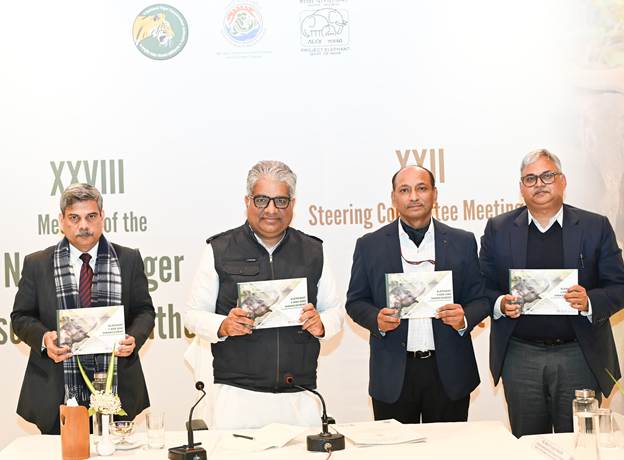
Union Minister for Environment, Forest and Climate Change Bhupender Yadav on Sunday chaired meetings of the National Tiger Conservation Authority (NTCA) and the Steering Committee of Project Elephant at the Sundarbans Tiger Reserve in West Bengal to review national strategies for the conservation of tigers and elephants.
The 28th meeting of the NTCA and the 22nd Steering Committee meeting of Project Elephant brought together senior officials, scientists and field experts from tiger and elephant range states to assess the progress of Project Tiger and Project Elephant and deliberate on future conservation measures.
Chairing the NTCA meeting, Yadav highlighted India’s globally recognised tiger conservation model and emphasised the importance of science-based management, landscape-level planning, community participation, inter-state coordination and international cooperation. The meeting reviewed action taken on decisions of the previous NTCA meeting held in April 2025 and discussed outcomes of four regional consultations that examined challenges faced by tiger reserves.
Officials reviewed measures to address human–tiger conflict, including a three-pronged mitigation strategy and the launch of a project focused on managing tigers outside designated reserves. Issues related to staff shortages, financial constraints, habitat degradation and invasive species were also discussed, with directions issued to states for follow-up action.
The NTCA meeting ratified decisions of its Technical Committee, including approval of Tiger Conservation Plans, expansion of Project Cheetah, tiger translocation initiatives, prey augmentation, landscape management planning and carnivore health management programmes. Progress on compliance with directions of the National Board for Wildlife was reviewed, including the proposed expansion of Project Cheetah to Gandhisagar Wildlife Sanctuary and the Banni Grassland in Gujarat.
The Minister also reviewed the progress of the sixth cycle of the All India Tiger Estimation, which commenced ground surveys in November 2025, along with landscape-level training programmes and international cooperation under Project Cheetah involving South Africa, Namibia and Botswana.
The Steering Committee meeting of Project Elephant reviewed action taken on earlier decisions and assessed the status of Regional Action Plans for elephant conservation in southern and northeastern India. Updates were presented on the All-India Synchronized Elephant Estimation, the Model Elephant Conservation Plan for the Nilgiri Elephant Reserve and ongoing DNA profiling of captive elephants.
Human–elephant conflict mitigation remained a key focus area, with discussions on conflict drivers, mitigation measures and compensation mechanisms adopted by elephant range states. The committee also deliberated on evaluation of elephant population estimation methods, management strategies for the Ripu–Chirang Elephant Reserve and proposed studies on elephant corridors and conflict hotspots.
The Steering Committee reaffirmed the government’s commitment to science-based, community-centric and technology-driven conservation approaches to ensure long-term sustainability of elephant habitats.
On the occasion, Yadav released six publications, including reports on Project Cheetah, India’s tiger conservation framework, the NTCA outreach journal STRIPES, Tigerverse highlighting lesser-known facts from tiger reserves, best practices in captive elephant management and the December 2025 issue of the TRUMPET quarterly journal.