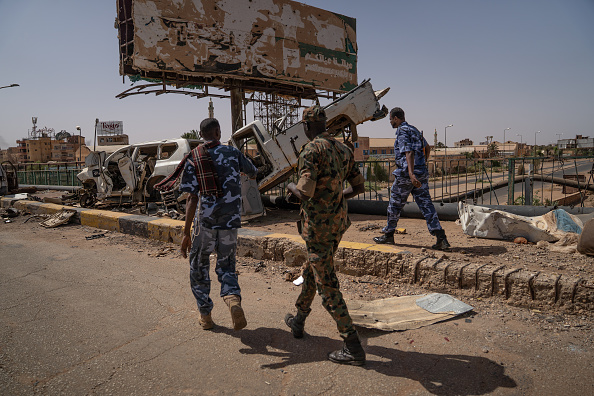
The Sudan war has torn apart one of Africa’s largest nations. It’s killed tens of thousands of people and displaced millions. However, did you know that what is happening in Sudan is a proxy war between Saudi Arabia and the United Arab Emirates? You’d be right to wonder: What do two extra-regional powers have to do with Sudan? Saudi Arabia and the U.A.E. are located outside the region; in fact outside the African continent itself. So, what are they doing in Sudan where the fight is really between the Sudanese Armed Forces and a paramilitary group called the Rapid Support Forces or the R.S.F.? This is where it gets interesting and complicated.
The U.A.E. is the R.S.F.’s top patron; it funnels weapons and money to keep it going. On the other hand, Saudi Arabia leans towards the Sudanese Armed Forces – giving them diplomatic and financial support while simultaneously pushing for mediation. Heading the Sudanese Armed Forces is Gen. Abdel Fattah al-Burhan, a career soldier who presides over Sudan’s Sovereign Council and positions himself as the guardian of the State’s institutions. Ranged against him is Gen. Mohamed Hamdan Dagalo, also known as Hemedti – a former camel trader-turned-militia boss with roots in the Janjaweed forces infamous for Darfur atrocities.
The Sudan war erupted in April 2023 over the issue of how to integrate the R.S.F. into the military after the ouster of longtime ruler Omar al-Bashir in 2019. However, what started as a dispute in Khartoum has spiralled into a nationwide catastrophe with battles raging from the capital to remote regions such as Darfur and now even along borders with Libya and Egypt where the R.S.F. scored a big win this year by seizing key territory.
Saudi Arabia says that it wants stability to return to Sudan. Sudan borders the Red Sea, which is a vital shipping lane for Saudi Arabian oil exports. The Kingdom views the ongoing fighting as a threat to Red Sea security and regional stability across the Horn of Africa. It also fears that chaos there could spark a refugee crisis, or worse, empower Islamist extremists.
The U.A.E. has a different approach towards Sudan. For the U.A.E., Sudan is a goldmine. Literally. Abu Dhabi eyes Sudan’s vast gold reserves, agricultural lands for food security and strategic ports on the Red Sea to expand its trade in Africa. The R.S.F. controls key mining areas and smuggling routes that funnel gold straight to the Emirates. By backing the R.S.F., the U.A.E. secures access to these assets.
And that has the U.N. worried. A U.N. report of 2024 says that the allegations that the U.A.E. was sending weapons and ammunition to the R.S.F. via Chad were credible. The report says that various flight-tracking experts have observed a heavy rotation of cargo-planes coming from Abu Dhabi International Airport to an airport in eastern Chad.
The same year, a B.B.C. News Arabic investigation found out that U.A.E. drones were used in the Sudan War … …
There’s more open-source literature on the U.A.E.’s alleged role in the Sudan war.
— A 2024 article published by U.K.-based The Guardian newspaper is headlined – ‘Smoking gun’ evidence points to U.A.E. involvement in the Sudan civil war. It reads that the discovery of Emirati passports in wreckage suggest covert boots on the ground. The article goes on to say that the U.A.E. supplied the R.S.F. with drones modified to drop controversial thermobaric bombs.
— Satellite imagery and U.N. experts have pointed to an airport in Chad, near the border with Sudan. While the U.A.E. claims that this facility is for a “field hospital” and aid, some investigative reports allege that it serves as a major trans-shipment point for weapons and fuel flowing into Darfur for the R.S.F.
— In early 2025, the U.S. Government sanctioned seven U.A.E.-based companies for giving financial and logistical support to the R.S.F.
— On 12th December, U.S. lawmakers called for a halt to arms sales to the U.A.E. until it ceases its alleged support for the R.S.F.
The U.A.E. Government rejects all these claims as baseless and a disinformation campaign. It says that it is a neutral mediator and a member of the A.L.P.S., also known as the “Alps Group”. (A.L.P.S. stands for Aligned for Advancing Lifesaving and Peace in Sudan.) It is an international coalition, which includes the U.S., Switzerland, Egypt, Saudi Arabia, the U.A.E., the African Union, and the U.N. It was formed to protect civilians caught in the Sudan war and push for peace. However, the U.A.E.’s Diplomatic Adviser, Anwar Gargash, does acknowledge the U.A.E.’s own past mistakes in dealing with Sudan.
On 2nd November, Gargash said that the U.A.E. had been wrong not to impose sanctions on the R.S.F. and the Sudanese Armed Forces for overthrowing Sudan’s transitional civilian government in 2021. He said: “We all made a mistake when the two Generals who are fighting the civil war today overthrew the civilian government. That was, looking back, a critical mistake. We should have put our foot down collectively. We did not call it a coup.”
Unlike the U.A.E., Saudi Arabia’s support for the Sudanese Armed Forces is primarily diplomatic, institutional and economic. The Saudi Crown Prince has set up a Saudi – Sudanese Coordination Council. It oversees a 50 billion-dollar plan for Saudi investments in agriculture, mining and energy in Sudan. The money is one of Saudi Arabia’s many leverages over the Sudanese Armed Forces; if the Sudanese Armed Forces do not play ball, Saudi Arabia could stop funding the reconstruction of Sudan. Among the current sticking points are the Sudanese Armed Forces’ refusal to sign any deal that treats the R.S.F. as an equal partner in a future government. Instead, the Sudanese Armed Forces insists that the R.S.F. must be fully integrated or disbanded.
Saudi Arabia has hosted peace talks in Jeddah, aiming to broker ceasefires, position itself as a regional peacemaker and counter the U.A.E.’s more aggressive playbook The “Jeddah Process” or the “Jeddah Platform” is the name given to the Saudi Arabia and the U.S.-brokered negotiations from 2023 onwards to get Sudan’s warring parties to end the conflict. The talks produced what is known as the Jeddah Declaration of Commitment. However, it has not made much progress on the ground. Today, the Jeddah Process is steered by a core group comprising the U.S., Saudi Arabia, Egypt, and the U.A.E.
Speaking of diplomacy, recently Saudi Arabia’s Crown Prince Mohammed bin Salman hosted the chief of the Sudanese Armed Forces in Riyadh. Their meeting focussed on security cooperation and advancing efforts to end the Sudan war. On 15th December, the chief of the Sudanese Armed Forces met with U.S. Adviser Massad Boulos in Riyadh – a meeting facilitated by the Saudis. Boulos is President Trump’s Senior Adviser for African and Arab Affairs.
A day later, on the 16th, Sudan’s foreign ministry said that the chief of the Sudanese Armed Forces has welcomed President Trump’s determination to engage in efforts to achieve peace and end the war in his country, with the participation of the Kingdom of Saudi Arabia. The statement said that General Burhan affirmed Sudan’s keenness to work with President Trump, his secretary of state, and his envoy for peace in Sudan to achieve this unquestionably noble goal. These meetings and statements come close on the heels of the Crown Prince Salman’s talks with President Trump at the White House in November, when he urged the U.S. to ramp up its involvement in ending the Sudan war.
President Trump said that he plans to put greater attention on helping find an end to the civil war in Sudan after being urged to take action by Saudi Crown Prince Salman. President Trump admitted that the conflict “wasn’t on my charts” before his conversation with the Crown Prince.
So, Saudi Arabia is pushing for peace.
Even the Sudanese Armed Forces chief is on board.
So, what is President Trump waiting for?
For someone who claims to have stopped eight wars already, the question is — Can he stop a ninth?