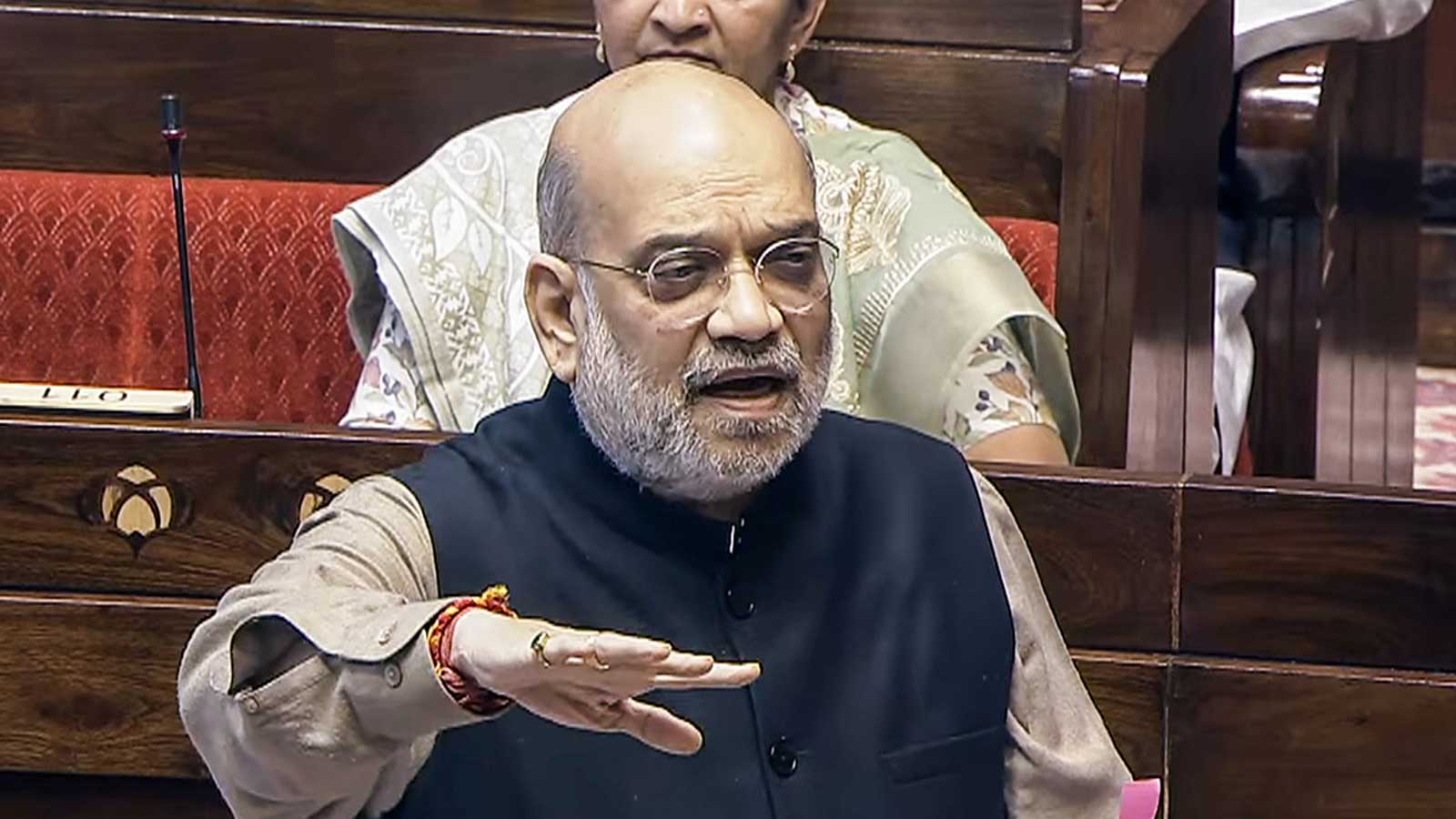
Union Home Minister Amit Shah on Tuesday accused the Congress of suppressing Vande Mataram at various points in history, saying the party’s “appeasement politics” fuelled long-standing controversies surrounding the national song. He made the remarks during debates held in both Houses of Parliament to mark 150 years of Vande Mataram.
Initiating the discussion in the Rajya Sabha, Shah said the national song played a significant role in fostering “a strong national consciousness” during the freedom struggle – something that neither the British nor their supporters could suppress. He said younger generations must understand the role Vande Mataram played in uniting the nation and inspiring freedom fighters.
Shah alleged that the Congress leadership repeatedly avoided giving the song its due recognition and suppression of the national song began during the Indira Gandhi era, when “those who spoke Vande Mataram were imprisoned” and newspapers were shut down. He said that Jawaharlal Nehru limited Vande Mataram to two stanzas in 1937, which he described as the “start of appeasement politics”. According to Shah, these decisions contributed to the eventual partition of India.
The Home Minister said, “When Vande Mataram completed 50 years, the country was not yet independent. When its golden jubilee arrived, Jawaharlal Nehru split it into two parts. When it turned 100 years old, there was no glorification because those who spoke Vande Mataram were imprisoned by Indira ji during the Emergency.”
He recalled the arrests of opposition leaders, social workers and volunteers, as well as censorship of newspapers during that period.
He added, “Many people like me believe that if Congress had not divided Vande Mataram under its policy of appeasement, the country would not have been divided, and today the country would be whole.”
Shah also criticised the absence of senior Congress leaders during Monday’s Lok Sabha discussion, saying avoiding debate on the national song was “not new” for the party.
Highlighting past parliamentary debates, Shah said, “In 1992, BJP MP Ram Naik raised the issue of restarting the singing of Vande Mataram. At that time, Leader of the Opposition L.K. Advani strongly urged the Speaker to restore the practice. The Lok Sabha unanimously approved it.”
He alleged that several leaders from the INDIA bloc have historically refused to sing Vande Mataram, saying some members even walked out of the Lok Sabha when the song was sung.
“At that time, when we were beginning to sing Vande Mataram, many from the INDIA Alliance said they would not sing it,” he said.
Shah said Vande Mataram was “a reason for making the country free” during the freedom movement and would now be a slogan for building a developed India.
“In that era, Vande Mataram became the reason for making the country free, and in Amrit Kaal, it will become the slogan for developing the country and making it great.”
Responding to opposition claims that the discussion was timed ahead of the West Bengal Assembly elections, Shah rejected the suggestion as a “misunderstanding”.
“Some people believe that because there are elections in Bengal, this discussion is being held. They want to link the glorification of Vande Mataram with the West Bengal elections. I think they need to reconsider their understanding,” he said.
He noted that the 150th anniversary fell on November 7 and that the discussions were scheduled to mark the historic milestone, not to influence elections. Shah said that although Bankim Chandra Chatterjee was from Bengal, Vande Mataram had a nationwide impact and was also sung by freedom fighters abroad during secret meetings.
Calling the song an “immortal creation that awakens devotion and duty toward Mother India,” Shah said critics of the discussion must “think afresh, with clarity.”
He said the anniversary was an important opportunity for young people to learn about the national song’s role in the freedom movement and its relevance to India’s development goals.
“Our youth and future generations must know the contribution of Vande Mataram to India’s independence, the patriotism that inspired its creation, and how that spirit will guide the making of a viksit India in 2047.”
Shah added that the spirit of Vande Mataram remains alive in the armed forces.
“When a young man of the country sacrifices his life, the only words on his lips are Vande Mataram,” he said.
He reiterated that Vande Mataram, which served as a rallying cry during the freedom movement, would continue to motivate the country in its journey towards becoming a developed nation by 2047.
(With agency inputs)