External Affairs Minister S. Jaishankar on Monday called for urgent reforms to strengthen global biosecurity and modernise the Biological Weapons Convention (BWC), warning that biological threats – whether natural, accidental, or deliberate – are becoming harder to manage in a rapidly evolving scientific landscape.
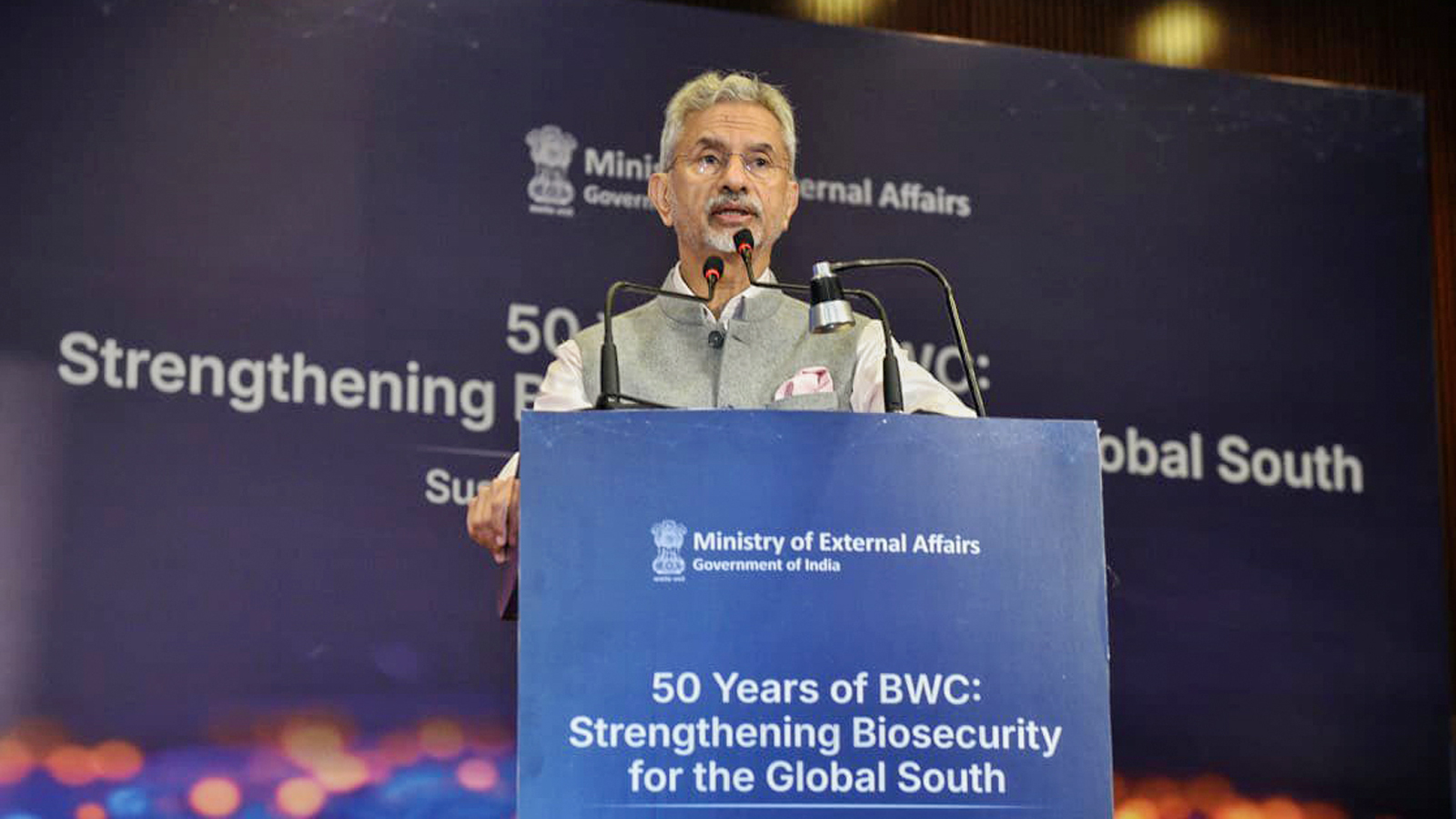
Speaking at the Conference on 50 Years of the Biological Weapons Convention: Strengthening Biosecurity for the Global South in New Delhi, Jaishankar said the misuse of biological agents by non-state actors is now a “serious concern,” and stressed that the 50-year-old convention lacks basic institutional structures.
“The BWC has no compliance system, no permanent technical body, and no mechanism to track new scientific developments. These gaps must be addressed to strengthen global confidence,” he said.
He added that the core principle of the BWC—that disease must never be used as a weapon – remains vital, but the convention must adapt to keep pace with advances such as genome editing, synthetic biology and AI-driven biological design.
Jaishankar underlined that many countries in the Global South face weaknesses in healthcare systems, surveillance, laboratory infrastructure, and emergency response capacities. These gaps, he said, pose risks not just to individual countries but to global safety.
“If biosecurity is uneven, so is global safety. The Global South is the most vulnerable and has the most to gain from stronger biosecurity. Its voice must shape the next 50 years of the BWC,” he noted.
Highlighting India’s growing strengths in biotechnology and public health, the minister said India produces 60% of the world’s vaccines; India supplies over 20% of global generic medicines, including 60% of Africa’s generics; India now has nearly 11,000 biotech startups, up from just 50 in 2014 – making it the world’s third-largest biotech startup ecosystem; and advanced facilities under ICMR and DBT, including BSL-3 and BSL-4 labs, can detect and respond to a wide range of biological threats.
Recalling India’s Vaccine Maitri initiative during COVID-19, he said the country supplied nearly 300 million vaccine doses and medical assistance to over 100 vulnerable nations. “When faced with a health crisis of such proportions, solidarity saves lives,” he said.
Jaishankar reiterated India’s long-standing support for a stronger compliance and verification system under the BWC, as well as a structured review process to monitor scientific and technological developments.
He highlighted India’s proposal for a National Implementation Framework covering: high-risk agent identification; oversight of dual-use research; domestic reporting mechanisms; incident management; and continuous skill training.
He emphasised that assistance during biological emergencies must be “fast, practical, and purely humanitarian.”
As a responsible member of international non-proliferation regimes, India is active in the Wassenaar Arrangement, Missile Technology Control Regime and the Australia Group, the latter being particularly relevant to biosecurity.
Concluding his address, Jaishankar said the next phase of the BWC will require coordinated global action.
“We must modernise the Convention, keep pace with science, and strengthen global capacity so that all countries can detect, prevent and respond to biological risks. India stands ready,” he said.
He thanked international delegates attending the conference and expressed hope that the discussions would feed constructively into upcoming BWC Working Group and State Parties meetings in Geneva.