The government has proposed a major overhaul of India’s rural employment framework with the introduction of the Viksit Bharat–Guarantee for Rozgar and Ajeevika Mission (Gramin) Bill, 2025. The Bill seeks to replace the nearly two-decade-old Mahatma Gandhi National Rural Employment Guarantee Act (MGNREGA) with a new statutory system aligned to the long-term vision of Viksit Bharat 2047.
The move signals a shift from a welfare-centric employment programme towards a model that links guaranteed work more closely with durable infrastructure, climate resilience and predictable public spending.
Why change MGNREGA?
Since its enactment in 2005, MGNREGA has provided a legal guarantee of 100 days of wage employment to rural households, helping stabilise incomes, especially during economic stress. Over the years, the programme expanded digital payments, Aadhaar-based systems and geo-tagging of assets, while women’s participation rose steadily.
The experience under MGNREGA also highlighted the critical role played by field-level staff, who ensured continuity and scale of implementation despite working with limited administrative resources and staffing. However, alongside these gains, deeper structural issues persisted. Monitoring across several states revealed gaps such as work not found on the ground, expenditure not matching physical progress, use of machines in labour-intensive works, and frequent bypassing of digital attendance systems. Over time, misappropriation accumulated, and only a small proportion of households were able to complete the full one hundred days of employment in the post pandemic period. These trends indicated that while delivery systems improved, the overall architecture of MGNREGA had reached its limits.
The Bill guarantees 125 days of wage employment per rural household in each financial year to such rural households whose adult members volunteer to undertake unskilled manual work, contributing to income security beyond the earlier 100-day entitlement, with an aggregated 60-day no-work period to ensure the availability of agricultural labour during peak sowing and harvesting season. Workers continue to receive 125 guaranteed days of employment within the remaining 305 days, ensuring that both farmers and labourers benefit. The disbursement of daily wages shall be made on a weekly basis or, in any case, not later than a fortnight after the date on which such work was done. Employment creation is integrated with infrastructure development through four priority verticals:
Water security through water-related works
Core-rural infrastructure
Livelihood- related infrastructure
Special works to mitigate extreme weather events
A blue and white sign with textAI-generated content may be incorrect.
All assets created are aggregated into the Viksit Bharat National Rural Infrastructure Stack, ensuring a unified, coordinated national development strategy. Planning is decentralised through Viksit Gram Panchayat Plans, which are prepared locally and spatially integrated with national systems such as PM Gati Shakti.
A shift in funding architecture
One of the most significant changes is the move from a demand-driven, central-sector model to a centrally sponsored scheme based on normative funding. Under this system, allocations are made using objective parameters rather than open-ended demand, improving predictability and budgeting.
The total annual outlay is estimated at about ₹1.51 lakh crore, including state contributions. The Centre’s share is projected at roughly ₹95,700 crore. Cost-sharing follows a 60:40 formula between the Centre and states, with higher central support for northeastern and Himalayan states, and full funding for Union Territories without legislatures.
The government argues that this approach preserves the employment guarantee while reducing fiscal uncertainty and strengthening Centre–State accountability.
Stronger administration and oversight
To address long-standing implementation gaps, the Bill raises the administrative expenditure ceiling from 6% to 9%, allowing greater investment in staffing, training and technical capacity. It establishes Gramin Rozgar Guarantee Councils and Steering Committees at both central and state levels, while reinforcing the role of Panchayati Raj institutions and Gram Sabhas.
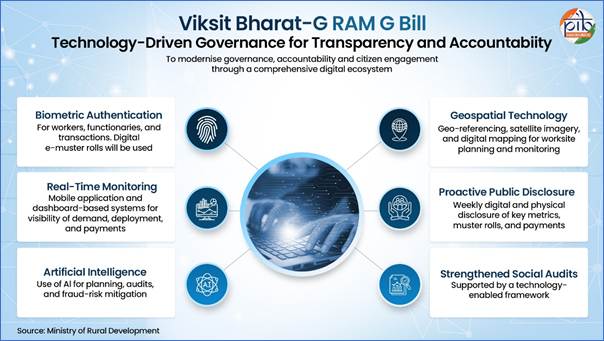
The framework expands enforcement powers for the Centre, including the ability to investigate complaints, suspend fund releases in cases of serious irregularities and mandate corrective measures. Social audits are required at least twice a year, supported by real-time dashboards, GPS-based monitoring and digital attendance systems.
What does it mean for farmers and workers?
For rural workers, the higher employment ceiling translates into greater earning potential, predictable work schedules and timely digital wage payments. If work is not provided within 15 days of demand, states are liable to pay an unemployment allowance.
Farmers are expected to benefit from improved irrigation, water conservation, storage and connectivity assets, as well as from safeguards against labour shortages during critical agricultural seasons.
The government positions the Bill as part of a broader transformation of rural India, citing sharp declines in poverty levels, rising incomes and diversified livelihoods. By linking employment guarantees with long-term asset creation and climate resilience, the new framework aims to reposition rural employment as a development tool rather than only a safety net.