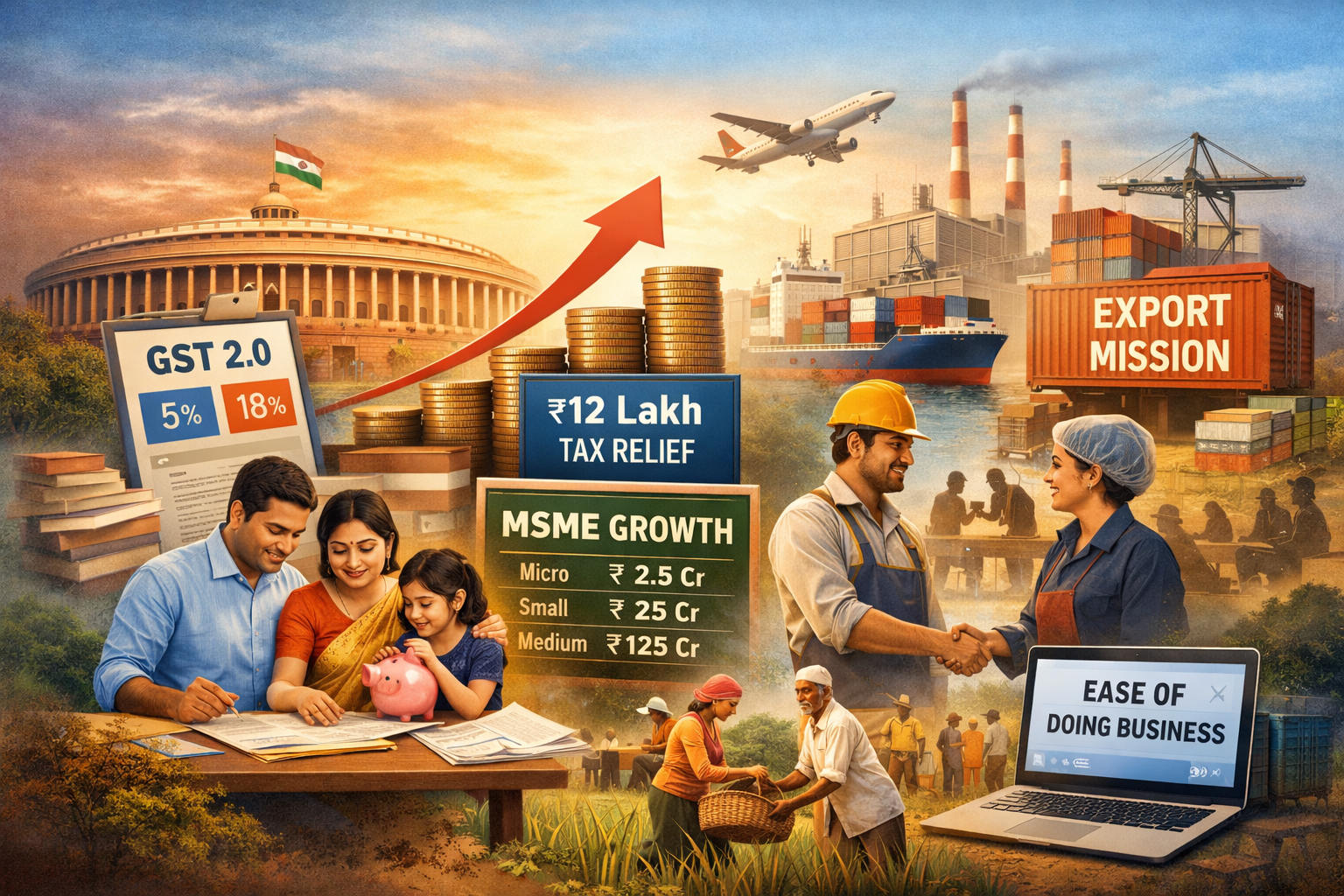
As 2025 draws to a close, India’s economic reforms tell a clear story of transition – from expanding rules to delivering outcomes. The year marked a phase where governance moved decisively towards simplifying systems, reducing everyday friction for citizens and businesses, and improving policy predictability.
Across taxation, labour regulation, rural employment, MSME support, GST, and trade, reforms in 2025 were shaped around three ideas: ease of living, ease of doing business, and long-term economic resilience. Together, they reflect a maturing policy approach aligned with India’s broader development goals.
Income Tax Reforms: Putting More Money in People’s Hands
One of the most visible changes came through direct tax reforms announced in the Union Budget 2025-26. Annual income up to ₹12 lakh was exempted from income tax under the new regime, with salaried taxpayers effectively benefiting up to ₹12.75 lakh due to the standard deduction. For millions of middle-class households, this translated into higher disposable income, supporting consumption, savings, and investment.
Alongside relief, the government initiated a structural overhaul of the Income-tax Act, 1961, resulting in the new Income Tax Act, 2025. The reform focused on simplification rather than changing tax rates or policies. Obsolete provisions were removed, language was modernised, and the law was restructured to improve clarity and reduce litigation.
A major conceptual shift was the introduction of a single “Tax Year”, replacing the earlier distinction between assessment year and previous year. This move simplified compliance and reduced confusion for taxpayers. The Act also strengthened faceless administration, consolidated TDS provisions, expanded digital enforcement, and improved dispute-resolution mechanisms – signalling a more transparent and predictable tax system.
Labour Reforms: One Framework, Wider Protection
In labour regulation, 2025 marked the operational consolidation of 29 labour laws into four Labour Codes – on wages, industrial relations, social security, and occupational safety. The objective was twofold: simplify compliance for employers while expanding protections for workers.
Uniform wage definitions and minimum wages reduced ambiguity, while social security coverage was extended to unorganised, gig, and platform workers. Workplace safety norms were strengthened, and women workers benefited from clearer leave provisions, maternity benefits, and improved safeguards.
The reforms expanded social security coverage to nearly 10 million gig and platform workers and created a unified framework covering over 50 crore workers. The shift reflected a move from rule-heavy regulation to outcome-driven labour governance.
Rural Employment: Linking Livelihoods with Asset Creation
A major change in rural employment policy came with the enactment of the Viksit Bharat – Guarantee for Rozgar and Ajeevika Mission (Gramin) Act, 2025, which replaced MGNREGA with a modernised statutory framework.
The Act guarantees 125 days of wage employment per rural household annually, ensures timely wage payments, and integrates employment generation with agriculture and community development. Emphasis was placed on creating durable assets in areas such as water security, rural infrastructure, climate resilience, and livelihood enhancement.
Decentralised planning through Viksit Gram Panchayat Plans, digitally linked with national platforms like PM Gati Shakti, ensured local decision-making while enabling inter-ministerial convergence. Administrative capacity was strengthened by increasing the expenditure ceiling to improve delivery and outcomes.
MSMEs and Ease of Doing Business: Reducing Friction, Improving Credit
Reforms for MSMEs focused on easing compliance and improving access to finance. Quality Control Orders were implemented in a phased, MSME-friendly manner, with extended timelines, exemptions for exports and R&D imports, and flexibility in certification processes.
Credit flow was strengthened through collateral-free loans, expanded credit guarantee cover, benchmark-linked lending, and improved working capital norms. The MSME definition itself was expanded in Budget 2025–26, raising investment and turnover limits to support scale, job creation, and competitiveness.
GST 2.0: Simpler, Fairer Indirect Taxation
The Next-Generation GST reforms in 2025 represented a significant recalibration of India’s indirect tax system. A move towards a two-slab structure of 5 per cent and 18 per cent reduced complexity, classification disputes, and compliance costs.
Rate reductions on essential goods and services helped lower household expenses, while faster refunds and simplified returns benefited MSMEs and startups. Improved compliance expanded the GST taxpayer base to over 1.5 crore, with collections reaching ₹22.08 lakh crore in FY 2024-25, strengthening fiscal stability.
Export Promotion and Trade Reforms: Building Scale and Competitiveness
To strengthen India’s export ecosystem, the Union Cabinet approved the Export Promotion Mission with an outlay of ₹25,060 crore for FY 2025-26 to FY 2030-31. The mission unified export support into a single, outcome-driven framework combining affordable trade finance with non-financial support such as compliance, branding, logistics, and market access.
Trade reforms during the year also focused on digitisation and decentralisation, including the National Single Window, Trade Connect, ICEGATE, e-commerce export hubs, and the District Business Reform Action Plan 2025. MSME participation in government procurement increased through platforms like GeM, while export incentives under the Foreign Trade Policy provided further support.