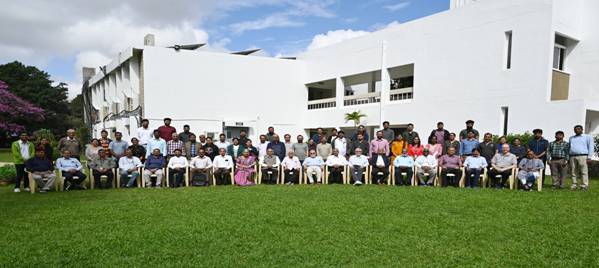
The Indian Institute of Astrophysics (IIA) on Thursday celebrated a decade of successful operation of the UltraViolet Imaging Telescope (UVIT), the primary payload aboard AstroSat, India’s first dedicated space observatory. To commemorate the milestone, IIA organised a one-day academic workshop in Bengaluru, reflecting on the instrument’s scientific achievements and outlining plans for future space-based UV missions.
AstroSat, launched by ISRO on September 28, 2015, carries five scientific payloads capable of observing the universe across ultraviolet, soft X-ray and hard X-ray wavelengths. UVIT, designed and developed by IIA at its Hosakote campus, has remained one of the mission’s standout instruments since its activation on November 30, 2015.
IIA Director and UVIT Calibration Scientist Annapurni Subramaniam noted that UV observations can only be conducted from space due to atmospheric absorption. “UVIT is India’s first UV space telescope and remains the only operational facility capable of observing in the far-ultraviolet apart from the Hubble Space Telescope,” she said.
The telescope has delivered several significant scientific discoveries over the past decade and continues to be widely used by astronomers around the world. UVIT’s unique combination of a wide field of view and high spatial resolution—better than 1.5 arcseconds—has enabled breakthroughs in the study of stars, galaxies and cosmic phenomena.
Former ISRO Chairman A.S. Kiran Kumar, recalling the contribution of Prof. K. Kasturirangan, praised the mission team for enabling new ways to study the universe. He commended IIA for bringing together experts to revisit the success of AstroSat and UVIT.
UVIT consists of two telescopes: one dedicated to near-ultraviolet and visible wavelengths, and the other to far-ultraviolet observations. The mission was realised through a national consortium led by IIA, with contributions from IUCAA, TIFR, various ISRO centres and support from the Canadian Space Agency. To handle sensitive components, IIA established a specialised clean-room facility—the MGK Menon Laboratory—at its CREST campus in Hosakote.
Following AstroSat’s launch, the UVIT Payload Operation Centre was set up at IIA for data processing, performance monitoring and proposal management. UVIT has so far observed 1,451 celestial targets and contributed to around 300 research papers and 19 PhD theses, with many more scholars using its data worldwide.
The workshop also spotlighted notable scientific results including the discovery of hot companion stars of Be stars, blue straggler stars in clusters, extended UV disks in dwarf galaxies, planetary nebulae structures, novae in the Andromeda galaxy, emission from distant galaxies at redshift 1.42, and correlations between UV and X-ray activity in active galactic nuclei.
Updated science-ready UVIT images are being uploaded to ISRO’s PRADAN archive for continued access by researchers.
Scientists at the event also discussed the roadmap for INSIST—India’s proposed next-generation spectroscopic and imaging space telescope—building on the expertise gained over more than two decades through the UVIT programme.