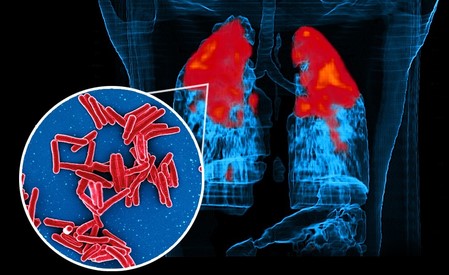
Mycobacterium tuberculosis, the bacterium that causes tuberculosis, can endure antibiotic treatment by altering its outer lipid layer, a study by researchers at the Indian Institute of Technology (IIT) Bombay has found.
Despite effective antibiotics and large-scale vaccination drives, TB remains the world’s deadliest infectious disease. In 2024, an estimated 10.7 million people developed TB globally and 1.23 million died.
The study, published in the journal Chemical Science, shows that the bacteria’s drug tolerance hinges on changes in their membrane — a complex structure made largely of lipids that shields the cell. The team grew the bacteria in two conditions: an active phase, where the cells multiplied rapidly, and a dormant phase mimicking latent infection.
When exposed to four commonly used TB drugs — rifabutin, moxifloxacin, amikacin and clarithromycin — dormant bacteria required two to ten times higher drug concentrations to suppress 50 per cent of their growth compared to active cells.
“The same drug that works effectively in the early stage of the disease needs a much higher concentration to kill dormant TB cells. This difference is not driven by genetic mutations, which typically explain antibiotic resistance,” said Prof Shobhna Kapoor of the Department of Chemistry at IIT Bombay.
The absence of resistance-linked mutations indicated that the reduced drug sensitivity stems from the dormant state and changes in the membrane rather than genetic alterations.
The researchers identified more than 270 distinct lipid molecules in the bacterial membrane, with clear differences between active and dormant bacteria. Active cells had loose, fluid membranes, while dormant bacteria developed rigid, tightly packed structures — a likely defence mechanism.
Kapoor said TB research has traditionally focused on proteins, while lipids were long considered passive components. “We now know these lipids actively help the bacteria survive and resist drugs,” she said.
The study also found that rifabutin could easily penetrate active cells but struggled to enter dormant ones. “The rigid outer layer becomes the main barrier. It is the bacterium’s first and strongest line of defence,” Kapoor said.
The findings suggest that weakening the outer membrane could significantly improve the effectiveness of existing drugs. “Even old drugs can work better if paired with a molecule that loosens the outer membrane,” Kapoor added, noting that this strategy can re-sensitise bacteria to antibiotics without encouraging permanent resistance.
(IANS)