While the West lectures New Delhi and Moscow on partnerships, the two capitals just signed the future in ink and steel.
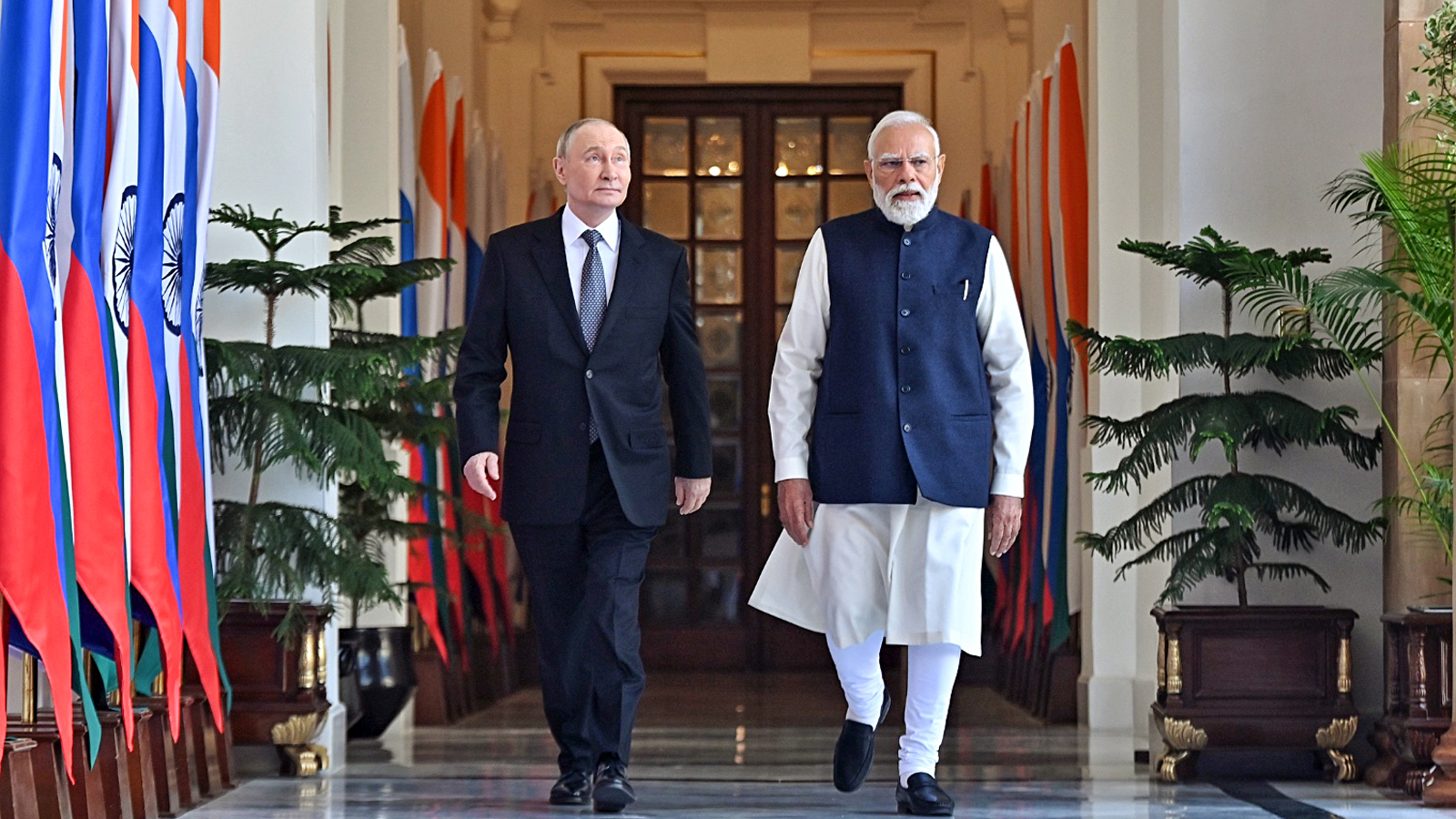
On 4 and 5 December in India, President Vladimir Putin and Prime Minister Narendra Modi did not just exchange pleasantries; they accelerated three strategic corridors that together shave more than 16,000 kilometres and up to 40 days off the journey between Indian factories and Russian resources.
PM Modi and Putin agreed to turbo-charge the International North-South Transport Corridor, the Chennai – Vladivostok Maritime Corridor and the Northern Sea Route.
Imagine a 7,200-kilometre super-highway that links Mumbai or Nhava Sheva to St. Petersburg in just 23 to 25 days, almost half the time it takes through the Suez and the Red Sea today. The route is elegantly simple: Indian ships dock at Iran’s Bandar Abbas or, if Trump plays ball, even the India-built Chabahar port; cargo moves by rail or road through Iran; crosses the Caspian into Azerbaijan; rolls straight into Russia with connections to Armenia, Kazakhstan, Turkmenistan and even Belarus. 13 countries have signed on. The missing rail link between Rasht and Astara in Iran is now financed and under construction.
Since March 2025, New Delhi has been using the Corridor to send cargo from the Mundra Port in Gujarat to Central Asia via Iran’s Bandar Abbas port. A scholar at the New Delhi-based Observer Research Foundation says that the Corridor can be a game-changer. The Corridor can boost New Delhi’s trade diversification, secure mineral supplies, and help counterbalance China’s influence in Eurasia.
In 2025, India entered into a strategic partnership with Central Asian countries focussing on rare earths and critical minerals to minimise Chinese dominance over rare earth supplies.
Just last month, that is November 2025, the first, full, Eastern-arm cargo reached Central Asia via this Corridor in record time.
On 8th November, a cargo train originating north of Moscow arrived in Iran, carrying containers through Central Asia. The 900-kilometre journey to the Aprin dry-port in Tehran took 12 days, crossing Kazakhstan and Turkmenistan before entering Iran.
On 5th December in New Delhi, Putin and PM Modi directed their teams to make the corridor stable and efficient – their exact words in the joint statement. It read: “The two sides agreed to deepen cooperation in building stable and efficient transport corridors, with the focus on expanding logistics links for improving connectivity and enhancing infrastructure capacity to support the International North South Transport Corridor, the Chennai – Vladivostok Maritime Corridor, and, the Northern Sea Route.” The joint statement went on to say: “Both Sides underscored the importance of holding regular bilateral consultations on Arctic related issues and welcomed the progress made in multi-faceted bilateral cooperation on the Northern Sea Route.”
PM Modi told the India Russia Business Forum: “We are committed to moving forward on the International North South Transport Corridor, the Northern Sea Route and the Chennai – Vladivostok Corridor. Progress will be made in this direction soon. This will reduce transit times, lower costs, and open up new markets for businesses.”
For his part, President Putin said that the International North South Transport Corridor and the Northern Sea Route would offer major opportunities for bilateral trade.
Why the hurry, you might wonder? Because the rival is watching! The India Middle East Europe Economic Corridor was announced with much fanfare on the margins of the 2023 G-20 Summit in New Delhi. It promises to link India to Europe via the U.A.E., Saudi Arabia, Jordan, Israel, Greece and Italy. However, two years on, the India Middle East Europe Economic Corridor remains a PowerPoint dream. The Gaza war and the Houthi attacks on ships in the Red Sea have frozen progress on this connectivity project. In contrast, the International North South Transport Corridor is already carrying cargo and it is in a race against time to cross the finish line first!
Now, head east to the Chennai – Vladivostok Maritime Corridor. 10,370 kilometres of blue-water highway that slashes the distance by nearly 8,000 kilometres and reduces travel or transit time by many days. First proposed in 2019, the Chennai – Vladivostok Maritime Corridor received a new lease of life at the just concluded India – Russia Summit in New Delhi. Both sides signed specific MoUs to operationalise regular liner services and insurance mechanisms for the route. For India, this is direct access to Russia’s diamond-rich Sakha Republic, timber, and, L.N.G. For Russia, it is a warm-water lifeline to 1.4 billion Indian consumers.
And finally, the crown jewel very few countries can touch – the Northern Sea Route. This is the Arctic shortcut along Russia’s northern coast – from Murmansk in the west to Vladivostok in the east. It is 40 per cent shorter than the Suez route to Europe and, when combined with the International North-South Transport Corridor and the Chennai – Vladivostok Maritime Corridor, offers India year-round access to Russian Arctic L.N.G., oil and minerals. India and Russia also signed an unprecedented agreement giving Indian ships priority icebreaker escort and access to Russian Arctic ports.
So, what does all this mean in plain numbers? India – Russia trade has already crossed 65 billion dollars in 2024-25, powered primarily by energy. The declared target is 100 billion dollars by 2030. PM Modi has ordered his commerce minister, Piyush Goyal, to remove every remaining bottleneck. “As per my conversations with President Putin, and the potential we see, I don’t think we’ll have to wait until 2030 to achieve the target of $100 billion bilateral trade. I can see it clearly. We are moving forward with the determination to achieve that goal ahead of schedule and my confidence is increasing.,” PM Modi told the India Russia Business Forum. The Prime Minister added that the 2030 economic cooperation programme with Russia will make bilateral trade and investment more diversified, balanced and sustainable.
While the West tries to isolate Moscow, India is quietly building not one, not two, but three new arteries that no Red Sea crisis, no Malacca blockade and no Arctic winter can choke. This is not nostalgia for the Soviet era. This is cold, hard, 21st-century realpolitik executed with warmth, precision and unbreakable resolve. Little wonder then that PM Modi described India’s enduring partnership with Russia as a Pole Star, which is based on mutual respect and deep trust and which has stood the test of time.
The message from New Delhi this week was crystal clear: That in a world of disrupted supply chains, the nation that controls the shortest, safest routes controls the future. India and Russia just drew the new map and they are already sailing on it.