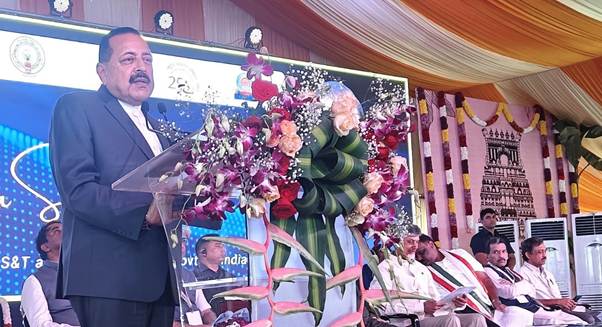
Union Minister of State (Independent Charge) for Science and Technology Dr Jitendra Singh on Friday said India has successfully bridged its civilisational heritage with cutting-edge modern technology, transforming itself into a global leader in science, innovation and strategic capabilities over the past decade.
Addressing the inaugural session of the Bharatiya Vigyan Sammelan 2025 at the National Sanskrit University, the Minister said India’s rise as a science and technology powerhouse has been driven by decisive political leadership and sustained policy support under Prime Minister Narendra Modi.
Dr Singh said science, technology and innovation have received unprecedented policy attention and budgetary backing since 2014, helping dismantle long-standing structural bottlenecks. “India always had the talent. What was missing was enabling ecosystems and political will, which have now been decisively addressed,” he said.
Highlighting India’s innovation growth, the Minister said the country’s startup ecosystem has expanded from just 300–400 startups in 2014 to nearly 2 lakh today, placing India among the top three startup hubs globally. India’s Global Innovation Index ranking has improved from 81 to 38, while the country now ranks sixth worldwide in patent filings, with over half of the patents filed by Indian residents.
Dr Singh said India’s achievements in space and strategic technologies have drawn global attention. He cited India’s lunar missions, including the first-ever landing near the Moon’s south pole and confirmation of water presence on the lunar surface. He also highlighted the growing strength of indigenous defence manufacturing, noting that defence exports have reached ₹23,662 crore, with Indian systems being supplied to nearly 100 countries.
Referring to recent global developments, the Minister said India’s indigenous missile and defence technologies have demonstrated their credibility, resulting in increased international demand. He attributed these successes to sustained investments in atomic energy, space and advanced research over the past decade.
On healthcare, Dr Singh said India has emerged as a global leader in preventive healthcare and affordable medical solutions. From developing and supplying COVID-19 vaccines worldwide to exporting medical devices and implants worth billions of dollars annually, India’s healthcare innovation ecosystem has gained global trust, he said.
The Minister also highlighted India’s growing research output, stating that the country now ranks fourth globally in scientific publications and third in citation impact, reflecting both quantitative and qualitative improvement in research.
Emphasising that science is no longer confined to laboratories, Dr Singh said technology is increasingly improving ease of living through initiatives such as smart cities, telemedicine, satellite-based communication, geotagging and digital governance platforms. He said national missions in space, nuclear energy, deep ocean exploration, Himalayan research and the Aroma Mission are opening new avenues for economic growth and youth entrepreneurship.
Dr Singh further said large-scale translation of science textbooks and curricula into regional languages has been undertaken over the past decade to democratise science education, ensuring wider public participation in India’s journey towards becoming a developed nation by 2047.
The inaugural session was attended by RSS Chief Mohan Bhagwat, Andhra Pradesh Chief Minister N Chandrababu Naidu, senior scientists, academicians and representatives from scientific institutions. The Bharatiya Vigyan Sammelan 2025 is being held in Tirupati from December 26 to 29.