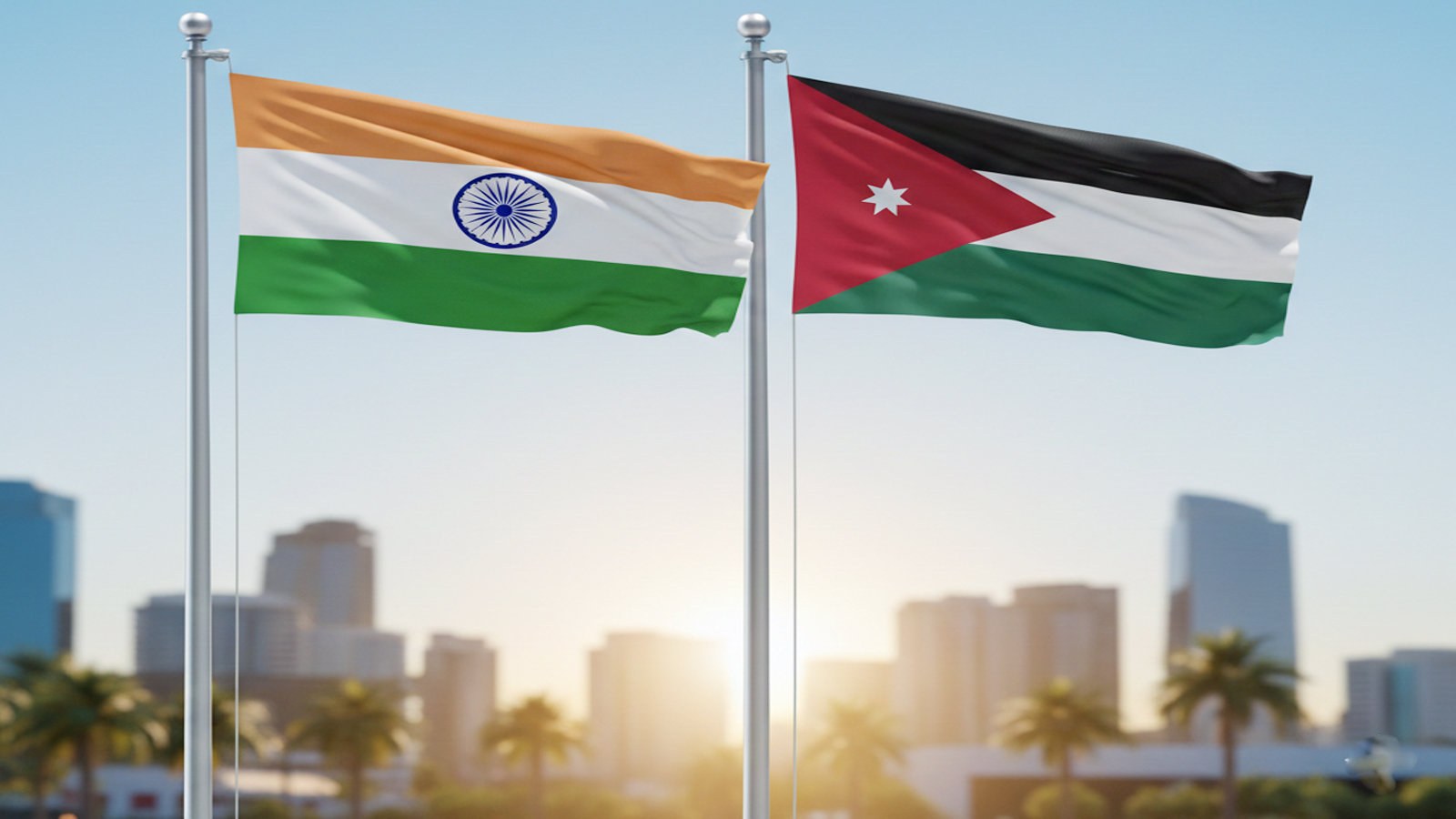
India and Jordan share a warm and steadily expanding bilateral relationship anchored in mutual respect, historic goodwill and growing strategic cooperation. India and Jordan signed first bilateral agreement for cooperation and friendly ties in 1947, which got formalized in 1950, when the two countries established full-fledged diplomatic ties. Since then, high-level political engagement, robust economic cooperation and strong people-to-people links have shaped a multifaceted partnership.
Political engagement and diplomatic exchanges
India–Jordan relations have received significant momentum through regular high-level exchanges. In October 2015, President Ram Nath Kovind’s visit to Jordan marked the first-ever visit by an Indian Head of State. Prime Minister Narendra Modi transited through Amman in February 2018, where he was received by King Abdullah II at his private residence, reflecting the close rapport between the leadership of the two countries.
King Abdullah II paid a state visit to India from February 27 to March 1, 2018, during which the two sides held delegation-level talks and signed 12 MoUs and agreements covering diverse sectors. The visit also saw India announce assistance for setting up a Centre of Excellence in Information Technology in Jordan and provide in-kind support for pharmaceuticals and vaccines worth USD 5 million.
National Security Adviser Ajit Doval’s visit to Amman in January 2020, regular telephonic interactions between the foreign ministers, and the fourth round of India-Jordan Foreign Office Consultations held in Amman in April 2025 have further strengthened political coordination. Recent engagements also include discussions on health cooperation, pharmaceuticals and digital health under a Joint Working Group framework.
Trade, investment and economic cooperation
Economic ties form a strong pillar of the bilateral relationship. India is Jordan’s third-largest trading partner, with bilateral trade valued at USD 2.875 billion in 2023-24. Indian exports to Jordan stood at USD 1.465 billion, including electrical machinery, cereals, chemicals, engineering goods and petroleum products, while India imports phosphates, fertilizers and phosphoric acid from Jordan.
Indian investments of around USD 1.5 billion, particularly in the phosphates and textiles sectors, underline the depth of economic engagement. A major joint venture, JIFCO, between IFFCO and Jordan Phosphate Mines Company, producing phosphoric acid for export to India, stands as a flagship example of cooperation. In addition, over 15 NRI-owned garment companies operate in Jordan’s Qualified Industrial Zones, exporting finished products under the Jordan-US Free Trade Agreement.
Institutional mechanisms such as the Trade and Economic Joint Committee, Joint Maritime Committee and sector-specific working groups facilitate regular dialogue. Business forums, buyer-seller meets, trade exhibitions and investment seminars held in both countries continue to open new avenues for commercial collaboration.
Science, technology and skill development
Science and technology cooperation has emerged as a key growth area. The India-Jordan Centre of Excellence in Information Technology at Al-Hussein Technical University, inaugurated in October 2021, is fully funded by the Government of India. Equipped with advanced infrastructure, including a PARAM supercomputer, the centre aims to train nearly 3,000 Jordanian professionals in emerging fields such as cybersecurity, artificial intelligence and data analytics.
India has also supported Jordan’s capacity-building efforts through the Indian Technical and Economic Cooperation (ITEC) programme. In 2024-25, Jordan utilised 37 ITEC slots, four special executive programmes and five ICCR scholarships, with the number of ITEC slots recently increased to 50.
ITEC is the flagship capacity-building programme of the Ministry of External Affairs. Instituted in 1964, it is one of the oldest institutionalised international frameworks for capacity building, having trained over 200,000 officials from more than 160 countries across both the civilian and defence sectors.
Education, culture and people-to-people ties
Educational cooperation remains vibrant, with around 2,500 Jordanian alumni of Indian universities and nearly 500 Jordanian students currently studying in India. Ten MoUs between educational institutions were signed during the 2015 presidential visit to deepen academic collaboration.
Cultural ties are strong, driven by Jordan’s enthusiasm for Indian art, music and cinema. Bollywood films enjoy wide popularity, with several Indian movies filmed in Jordan in recent years. Regular cultural exchanges, participation in Jordan’s Jerash Festival of Culture and Arts, yoga events and community-led festivals further strengthen cultural understanding.
India celebrates the International Day of Yoga annually in Jordan, with the 2025 edition held at the Royal Botanic Garden under the patronage of Princess Basma bint Ali. Cultural troupes, film festivals and handloom exhibitions organised by the Indian mission have also drawn widespread participation.
Indian community and consular cooperation
Around 17,500 Indian nationals live and work in Jordan, mainly in textiles, construction, manufacturing, healthcare and international organisations. Consular cooperation has been facilitated through agreements on manpower and visa-free entry for diplomatic and official passport holders. Jordan has extended visa-on-arrival and e-visa facilities to Indian tourists, further boosting travel and tourism.
A forward-looking partnership
With expanding trade, deepening political coordination and growing cooperation in technology, education and culture, India-Jordan relations continue to evolve into a comprehensive partnership. Regular leadership-level engagement and people-centric initiatives underscore a shared vision of mutual growth, regional stability and strengthened South-South cooperation.