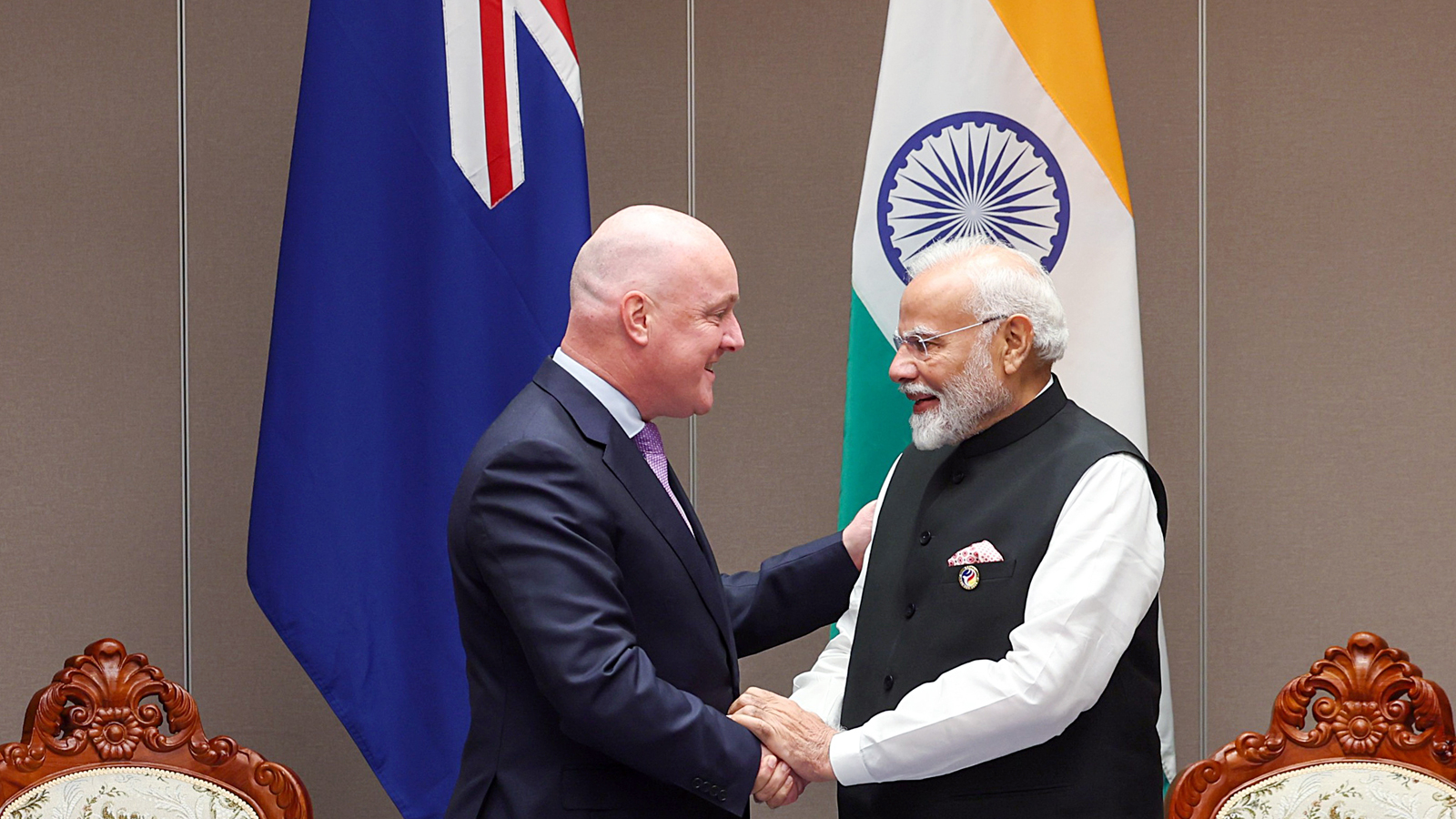
India and New Zealand on Monday announced the conclusion of a comprehensive and forward-looking Free Trade Agreement (FTA), marking a major economic and strategic milestone in India’s engagement with the Indo-Pacific region. The agreement is among India’s fastest-concluded FTAs with a developed country and is aligned with the national vision of Viksit Bharat 2047.
The negotiations were formally launched on March 16, 2025, during a meeting between Union Commerce and Industry Minister Piyush Goyal and New Zealand’s Minister for Trade and Investment Todd McClay. The talks were concluded within nine months after five formal negotiation rounds, along with several in-person and virtual intersessional discussions.
The FTA provides zero-duty market access on 100 per cent of New Zealand’s tariff lines, granting duty-free access for all Indian exports. India has offered tariff liberalisation on about 70 per cent of tariff lines, covering nearly 95 per cent of bilateral trade. To protect farmers and domestic industry, market access excludes sensitive sectors such as dairy, coffee, milk and milk products, sugar, spices, edible oils, rubber and onions.
The agreement is expected to boost India’s labour-intensive sectors, including textiles, apparel, leather, footwear, marine products, gems and jewellery, handicrafts, engineering goods, automobiles, pharmaceuticals and agricultural products. India’s manufacturing sector will also benefit from duty-free access to key inputs such as wooden logs, coking coal, and metal waste and scrap.
In services, India has secured New Zealand’s most ambitious offer in any of its FTAs so far. Commitments cover 118 services sectors, including computer-related services, professional services, audio-visual services, telecommunications, construction, tourism and travel-related services. Most-Favoured Nation (MFN) commitments have been extended across around 139 sub-sectors, opening new opportunities for Indian service providers and high-skill employment.
The FTA places strong emphasis on mobility and people-to-people ties. It boosts student mobility through post-study work visas and professional pathways in New Zealand, with no numerical caps. Indian students will be eligible for post-study work rights of up to three years for STEM bachelor’s and master’s graduates and up to four years for doctoral scholars. A dedicated Temporary Employment Entry visa pathway has been created with a quota of 5,000 professionals at any given time, along with 1,000 Work and Holiday visas.
The agreement also establishes Agricultural Productivity Partnerships through Centres of Excellence for apples, kiwifruit and honey. These initiatives will focus on productivity enhancement, technology transfer, research collaboration, quality improvement and value-chain development to support farmer incomes. Market access for these products will be linked to quotas and minimum import prices to safeguard domestic producers.
New Zealand has committed to facilitating investments worth USD 20 billion in India over the next 15 years, supporting manufacturing, infrastructure, services, innovation and employment under the Make in India initiative. Indian enterprises are also expected to benefit from greater access to New Zealand and the wider Pacific Island markets.
The FTA provides a boost to pharmaceuticals and medical devices by enabling faster regulatory access through acceptance of GMP and GCP inspection reports from comparable regulators, including the US FDA, EMA and UK MHRA. This is expected to reduce compliance costs and speed up product approvals. Commitments have also been extended on Geographical Indications, including amendments to New Zealand law to facilitate registration of Indian wines, spirits and other goods under defined timelines.
Additional cooperation has been agreed in areas such as AYUSH, culture, fisheries, audio-visual tourism, forestry, horticulture and traditional knowledge systems. The pact also includes provisions to address non-tariff barriers through enhanced regulatory cooperation, transparency, streamlined customs procedures, and strengthened sanitary, phytosanitary and technical standards.
Piyush Goyal said the agreement is “about building trade around people and launching opportunities – for our farmers, entrepreneurs, students, women and innovators.” He said the FTA would boost agricultural productivity, raise farmer incomes, open new markets for Indian businesses and give Indian youth opportunities to learn and work globally.
Commerce Secretary Rajesh Agrawal described the pact as “a new generation trade agreement built on tariffs, agricultural productivity, investment and talent, with complementarity at the core.” He said India’s strengths in labour-intensive manufacturing and services would expand exports, while New Zealand would gain deeper and more predictable access to India’s large and growing market.
Bilateral merchandise trade between India and New Zealand reached USD 1.3 billion in 2024–25, while total trade in goods and services stood at around USD 2.4 billion, with services trade accounting for USD 1.24 billion. Officials said the FTA provides a stable and predictable framework to unlock the full potential of this relationship.
The India-New Zealand FTA is the third trade agreement concluded by India this year and is seen as a key step towards building a people-centric, jobs-driven strategic partnership under the vision of Viksit Bharat 2047.