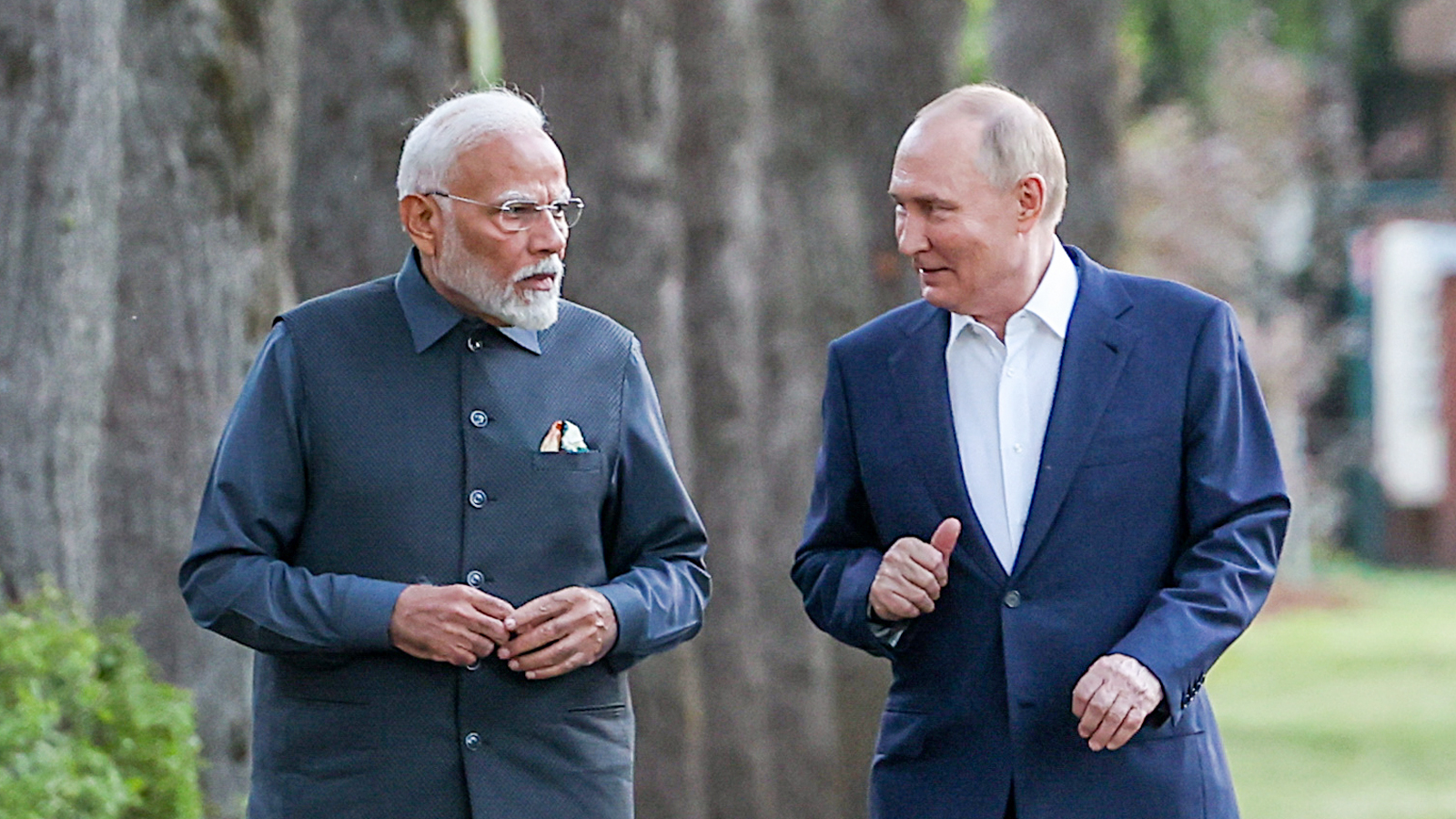
As Russian President Vladimir Putin prepares to visit India on December 4-5, 2025 for the 23rd Annual Summit, India-Russia relations continue to advance across political, economic, defence, cultural and multilateral domains. The Special and Privileged Strategic Partnership – established in 2010 and built on decades of cooperation – has maintained steady momentum through 2024–25 despite shifting global geopolitics.
Since the signing of the India-Russia Strategic Partnership in 2000 and its elevation in 2010, bilateral cooperation has expanded across politics, defence, energy, trade, science and technology, and people-to-people ties. The India‑Russia Intergovernmental Commission (IRIGC) remains the primary institutional mechanism for managing this engagement through Trade, Economic, Scientific, Technological and Cultural Cooperation division (IRIGC‑TEC) and Military & Military-Technical Cooperation division (IRIGC‑M&MTC) divisions. A 2+2 Dialogue format, launched in 2021, further strengthens coordinated policymaking.
Political exchanges between the two sides have remained frequent. Prime Minister Narendra Modi and President Putin met in Moscow during the 22nd Annual Summit in July 2024, issuing a joint statement titled India-Russia: Enduring and Expanding Partnership and another on strategic economic cooperation through 2030. PM Modi was also awarded Russia’s highest state decoration for his role in strengthening bilateral ties. The leaders met again during the BRICS Summit in October 2024 and the SCO Summit in September 2025, alongside regular telephone conversations, including discussions on counterterrorism after the Pahalgam attack.
External Affairs Minister S. Jaishankar visited Moscow in August 2025 to co-chair the 26th IRIGC-TEC with First Deputy Prime Minister Denis Manturov. The two sides worked on accelerating progress toward the USD 100 billion bilateral trade target by 2030, including strengthening payment mechanisms, addressing logistics barriers, and finalizing the India–EAEU Free Trade Agreement. India raised concerns about Indian nationals serving in the Russian Army. Discussions also covered developments in Ukraine, West Asia, the Middle East, and Afghanistan, with India reiterating support for dialogue and diplomacy.
High-level defence contacts continued through 2024-25. Defence Minister Rajnath Singh met Russian Defence Minister Andrey Belousov on the margins of the SCO Defence Ministers’ Meeting in June 2025, after co-chairing the IRIGC-M&MTC in Moscow in December 2024. India commissioned two frigates – INS Tushil in 2024 and INS Tamal in July 2025 – built in Russian shipyards. Defence cooperation has increasingly shifted from a buyer-seller model to joint research, development, and manufacturing, including programmes such as BrahMos, Su-30MKI production, T-90 tank assembly, and AK-203 rifle manufacturing. India continues to procure major systems like the S-400 and relies on Russia for engines, components, and spare parts.
Military engagements in 2025 reflected operational continuity. The INDRA-2025 joint military exercise was held in Rajasthan in October, while naval exercises took place earlier in the Bay of Bengal and Chennai. Indian personnel also participated in Russia’s Zapad-2025 exercise. A delegation visited Moscow in October for the Working Group Meeting on military-technical cooperation.
Economic engagement has grown rapidly, driven largely by energy imports. Bilateral trade reached a record USD 68.7 billion in FY 2024-25, with Indian exports at USD 4.9 billion and imports at USD 63.8 billion, primarily crude oil, petroleum products, fertilizers, coal, and edible oils. Both countries aim for USD 50 billion in mutual investments by 2025 and USD 100 billion in annual trade by 2030. The IRIGC-TEC meeting in August 2025 focused on tariff and non-tariff issues, connectivity, and quick finalisation of the Programme of Economic Cooperation till 2030.
Science and technology cooperation remains a strong pillar, from basic sciences to advanced fields including space and nuclear energy. Russia remains India’s key partner in the Kudankulam nuclear power project and in the Gaganyaan human spaceflight programme, for which Indian astronauts trained in Russia. A new roadmap for Science, Technology and Innovation guides joint work in commercialisation and applied research.
Education cooperation continues to grow, with around 20,000 Indian students – mostly in medicine – studying in Russia. Academic exchange programmes such as EEP, RIN, SPARC, and GIAN support institutional partnerships. Several Russian nationals also participate in India’s ITEC courses.
Cultural ties between the two nations remain deep, shaped by historical links and a strong mutual interest in each other’s traditions. Cultural exchanges, yoga events, and film festivals have expanded in recent years. The Second Indian Film Festival in 2025 and the large-scale Bharat Utsav in Moscow drew significant public participation. India was the Guest of Honour at the 2025 Moscow International Book Fair, and relics of Lord Buddha were displayed in Kalmykia.
People-to-people interactions are supported by institutions such as the Jawaharlal Nehru Cultural Centre in Moscow, which offers regular training in Indian performing arts and collaborates with Russian universities. Russian cultural delegations and officials continue to engage actively with India, including through events such as WAVES 2025.
The two countries also coordinate closely at multilateral platforms including the UN, G20, BRICS, and SCO. Russia supports India’s bid for a permanent seat on the UN Security Council. India will chair BRICS in 2026 and plans to focus on institutional strengthening.
Connectivity and regional cooperation are gaining prominence in the bilateral agenda. Both sides are working to enhance inter-regional links, especially with the Russian Far East, and scale up connectivity projects such as the International North-South Transport Corridor, the Chennai–Vladivostok Maritime Corridor, and the Northern Sea Route.
Diplomatic relations between India and Russia were established on 13 April 1947 – four months before India’s independence. As the two nations now approach 79 years of diplomatic ties, the partnership continues to evolve with changing global dynamics while retaining its strategic depth. President Putin’s upcoming visit in December is expected to offer a comprehensive review of ongoing cooperation and help chart the course for the next phase of the relationship.