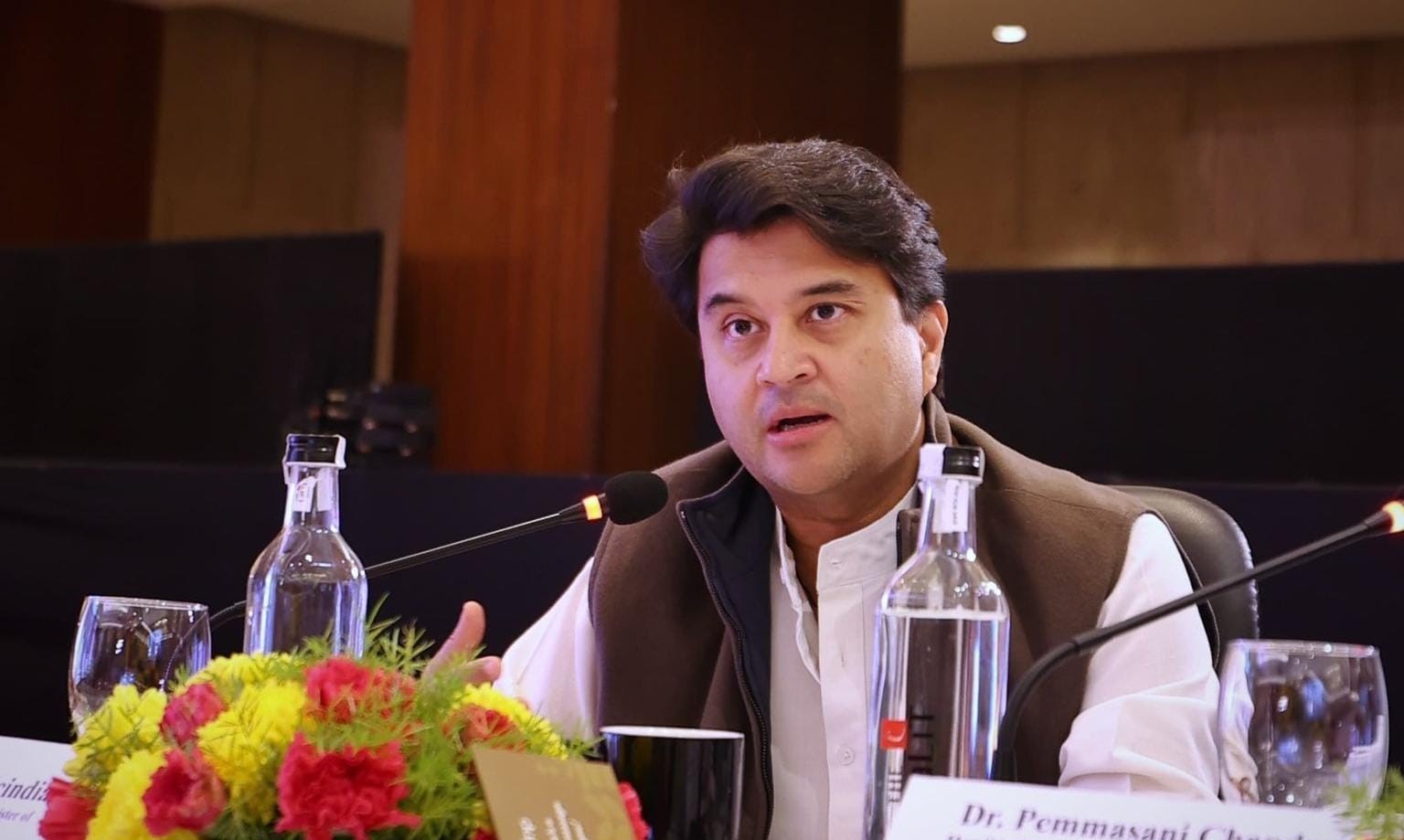
Union Minister for Communications Jyotiraditya M. Scindia on Tuesday chaired the Apex Council meeting under the Bharat 6G Mission in New Delhi, reviewing the progress of the Bharat 6G Alliance and calling for a focused roadmap to position India as a global 6G leader by 2030.
The meeting was attended by Minister of State for Communications Dr Chandra Sekhar Pemmasani, Secretary (Telecom) Dr Neeraj Mittal, Principal Scientific Adviser Prof. Ajay Sood, senior government officials, telecom operators, R&D institutions, and industry leaders, along with members of the Bharat 6G Alliance.
Scindia reaffirmed the government’s commitment to accelerating indigenous innovation across next-generation communication technologies. He stressed the need for stronger synergy among the seven working groups of the Alliance, regular progress oversight, and measurable quarterly deliverables. He said India must not just follow global technology trajectories but contribute to shaping them through research, standards, and intellectual property. The Minister added that inclusive connectivity would remain central to the 6G mission, ensuring benefits reach citizens across both urban and rural India.
The government’s research push received further momentum with reference to the recently approved Rs 1-lakh-crore Research, Development and Innovation Fund under the Department of Science and Technology. Anchored within the national ANRF framework, the fund is expected to boost work in AI-native networks, semiconductors, photonics, cybersecurity, sensing, and satellite–terrestrial integration, all of which form critical pillars of future 6G infrastructure.
During the session, Scindia released three booklets showcasing the progress and impact of 100 5G Use Case Labs set up across the country. The publications track the journey from infrastructure deployment to experimentation and prototype development, highlighting real-world applications emerging through the academic innovation ecosystem. The Minister also conferred Gradation Awards to the best-performing labs. Punjab Engineering College, Banasthali Vidyapith, IIT Roorkee (AMRIT) and Thapar University were recognised for research contributions, innovation, and industry-oriented solutions across multiple sectors including agriculture, safety, connectivity and automation.
The Bharat 6G Alliance presented an update on developments across spectrum research, sustainability frameworks, device and component innovation, use case studies, outreach efforts, and technology development. The Alliance has grown from 16 founding members to more than 84 organisations spanning startups, academia, research institutions and industry, indicating strong national participation in indigenous 6G advancement. The council was also briefed on India’s expanding international collaborations and joint research engagements with global 6G alliances.
Members of the Apex Council offered recommendations for the next phase of the mission, covering standards development, deployment of 6G testbeds, IPR generation, device ecosystems, and integration across research and implementation pipelines.
The Bharat 6G Alliance continues to serve as a collaborative platform uniting industry, academia, startups and public institutions. With increased R&D support, widening global engagement and an ecosystem-driven roadmap, India is moving toward establishing a strong presence in next-generation communication technologies and standard-setting for 6G.