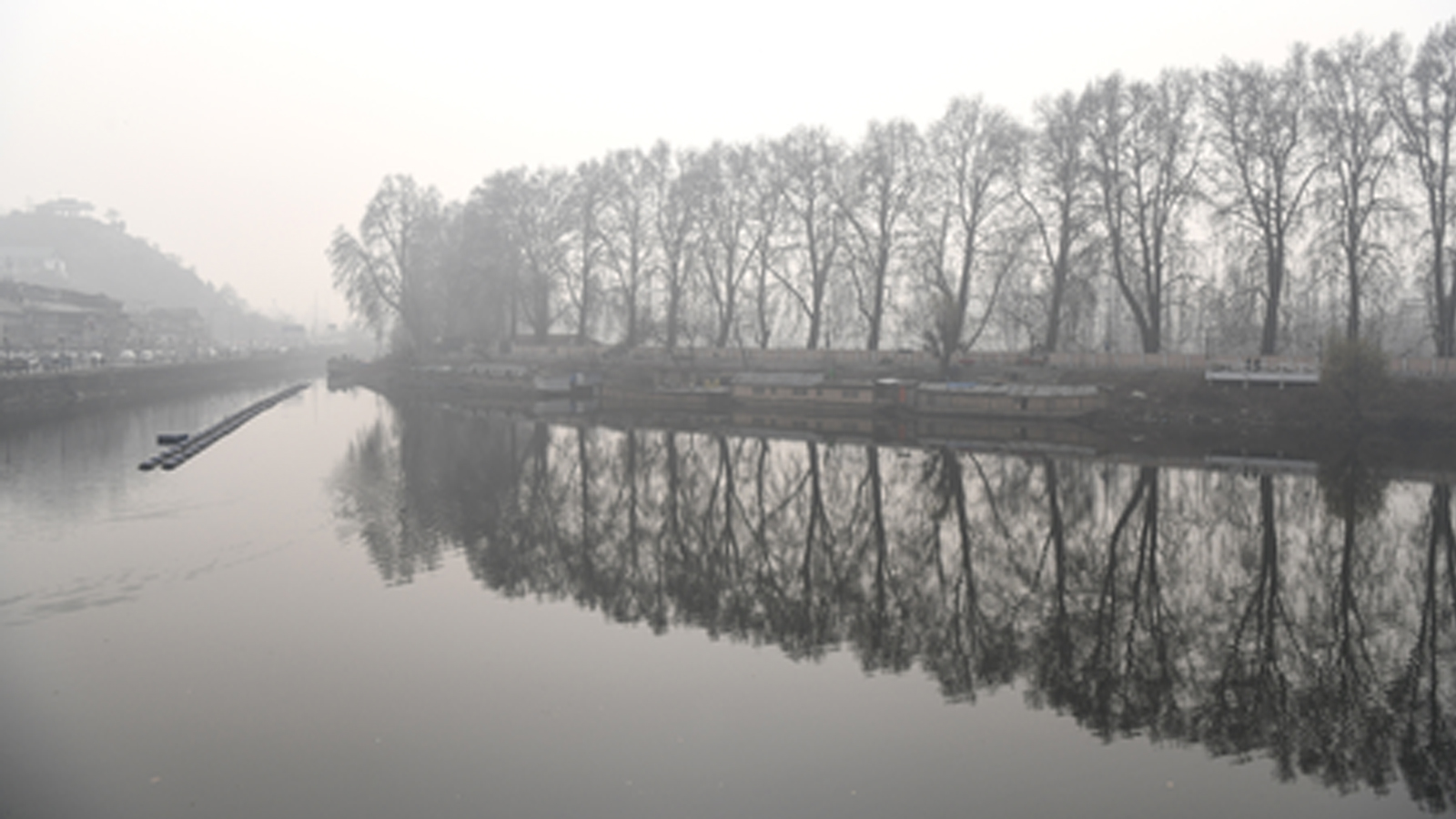
An intense cold wave continued to sweep across the Kashmir Valley on Thursday, with minimum temperatures staying several notches below the freezing point.
Dense morning fog and clear night skies added to the chill in Srinagar, where pedestrians and motorists moved cautiously on slippery roads. According to the Meteorological Department, Srinagar recorded a minimum temperature of –4°C, while Pahalgam registered –4.8°C and Gulmarg –1°C.
In the Jammu region, Jammu city recorded 8°C, Katra 8.4°C, Batote 4.7°C, Banihal 2.1°C and Bhaderwah 0.4°C. MeT officials said that apart from a weak western disturbance expected to bring light snowfall to higher reaches, there is little likelihood of rain or snow in Jammu and Kashmir until December 10. They added that minimum temperatures are expected to drop further in the coming days.
In Srinagar, the sun struggled to provide relief from the biting cold, with residents experiencing particularly harsh conditions in the mornings and evenings. Most people on the streets were seen wearing the traditional Pheran, a long tweed garment commonly used in winter. In rural areas, many continued to rely on the kangri—an earthen firepot encased in a wicker basket—kept under the Pheran to stay warm. The charcoal used in kangris is typically made from dried Chinar leaves.
While affluent households now use electric or fuel-based heating systems, for most Kashmiris the Pheran and kangri remain the most reliable means of keeping warm.
The harshest phase of winter, known as Chillai Kalan, begins on December 21 and lasts until January 30. During this 40-day period, temperatures often fall between –5°C and –7°C at night, while daytime temperatures rarely rise into double digits. Water bodies routinely freeze and residents struggle each morning to thaw frozen water taps.
(IANS)