Prime Minister Narendra Modi on Friday called for accelerated global action to restore balance in health and well-being at the closing ceremony of the 2nd WHO Global Summit on Traditional Medicine at Bharat Mandapam in New Delhi.
Addressing the event, the Prime Minister underscored India’s growing leadership in advancing traditional medicine as an evidence-based, integrated and people-centred component of global healthcare systems. Describing the summit as a powerful platform for international cooperation, he said the deliberations reflected serious engagement among global leaders, policymakers, scientists and practitioners from across the world.
The PM expressed pride over the establishment of the WHO Global Centre for Traditional Medicine in Jamnagar, Gujarat, noting that the responsibility was entrusted to India by the global community in 2022. The Centre, he said, has rapidly emerged as a hub for collaboration, research, regulation and capacity building, reflecting rising global trust in India’s leadership.
Referring to the summit theme, “Restoring Balance: The Science and Practice of Health and Well-being”, the Prime Minister said balance lies at the heart of holistic health as articulated in Ayurveda. He observed that many contemporary health challenges, including lifestyle disorders and chronic diseases, stem from various forms of imbalance, making restoration of balance a global urgency. The PM called for faster and coordinated international action, especially in the context of rapidly changing lifestyles driven by technological transformation.
Stressing the need to build global trust, the Prime Minister said traditional medicine must be evidence-based, safe and supported by globally accepted regulatory standards. He highlighted the role of digital innovation in strengthening credibility and pointed to initiatives such as the Traditional Medicine Global Library, launched during the summit, which will ensure equitable global access to scientific data and policy resources.
Addressing concerns regarding safety and evidence, Prime Minister Modi said India is actively working to validate traditional medicine through research. He cited Ashwagandha as a time-tested herb that gained global attention during the COVID-19 period and said India is advancing its global acceptance through research on safety, quality and usage. He added that the country is committed to integrating traditional medicine with modern healthcare, including efforts in integrative cancer care and the development of evidence-based guidelines, expanding its role beyond wellness into critical public health domains.
WHO Director-General Tedros Adhanom Ghebreyesus praised the Prime Minister for championing traditional medicine at the highest global level. Recalling the Prime Minister’s call for global collaboration during India’s G20 Presidency, he said it generated unprecedented international response. He noted that the vision of One Earth, One Health closely aligns with the principles of traditional medicine, which emphasise balance, prevention and harmony with nature.
Tedros lauded India for transforming traditional medicine from heritage into evidence-informed practice. He highlighted landmark initiatives such as the creation of the Ministry of AYUSH and the establishment of the WHO Global Centre for Traditional Medicine in Jamnagar, saying these efforts have helped integrate traditional medicine into health systems, research and policy worldwide. He also welcomed the adoption of the Delhi Declaration, stating that India has demonstrated that traditional medicine is not confined to the past or to the margins but is a living and evolving science central to modern healthcare systems.
Health and Family Welfare Minister J.P Nadda credited the Prime Minister’s leadership for positioning traditional medicine as a credible and globally accepted healthcare system. He said India is advancing AYUSH through scientific and evidence-based approaches and integrating it with modern medicine to strengthen preventive, promotive and holistic healthcare.
The Health Minister noted that AYUSH has been integrated into premier medical institutions such as AIIMS through dedicated AYUSH blocks, enabling synergy within healthcare systems and delivering measurable public health outcomes.
Minister of State (Independent Charge) for AYUSH Prataprao Jadhav thanked global leaders, WHO representatives, experts and Member States for their participation. He said the summit marked a decisive shift in global health discourse, firmly positioning traditional medicine as an essential pillar of people-centred and preventive healthcare.
Jadhav described the WHO Global Centre for Traditional Medicine in Jamnagar as a historic milestone for global collaboration, research and innovation, and urged countries to translate summit outcomes into concrete national action.
During the event, the Prime Minister and the WHO Director-General jointly inaugurated the WHO South-East Asia Regional Office building in New Delhi, which will also house the WHO India Country Office. The new complex is envisioned as a hub for advancing research, strengthening regulatory cooperation and building capacity across the South-East Asia region.
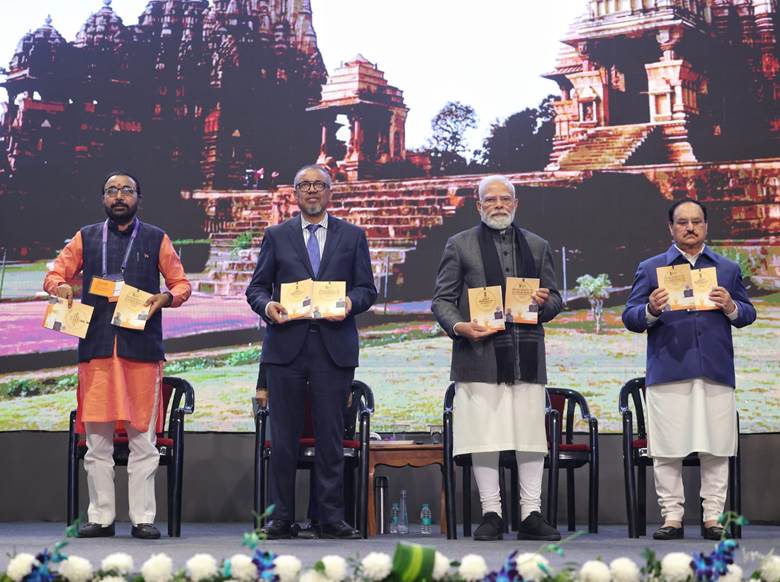
The Prime Minister also launched the Traditional Medicine Global Library, a global platform designed to preserve and provide equitable access to validated traditional medicine knowledge. He visited the Traditional Medicine Discovery Space, an exhibition showcasing the diversity and contemporary relevance of traditional medicine systems from India and across the world.
Recognising excellence in yoga promotion, the Prime Minister presented the Prime Minister’s Awards for Outstanding Contribution to the Promotion and Development of Yoga. He also launched several key AYUSH initiatives, including the My Ayush Integrated Services Portal as the master digital portal of the Ayush Grid, the Ayush Mark as a global quality benchmark for AYUSH products and services, a commemorative postal stamp on Ashwagandha, the WHO technical report on training in yoga, and the book “From Roots to Global Reach: 11 Years of Transformation in Ayush”.
The summit concluded with the adoption of the Delhi Declaration, reaffirming traditional medicine as a shared biocultural heritage and committing Member States to strengthen evidence, regulation, integration and cross-sector collaboration in line with the WHO Global Traditional Medicine Strategy 2025–2034. The declaration marked a shift from dialogue to action, reinforcing a shared global commitment to safe, effective, equitable and sustainable healthcare.