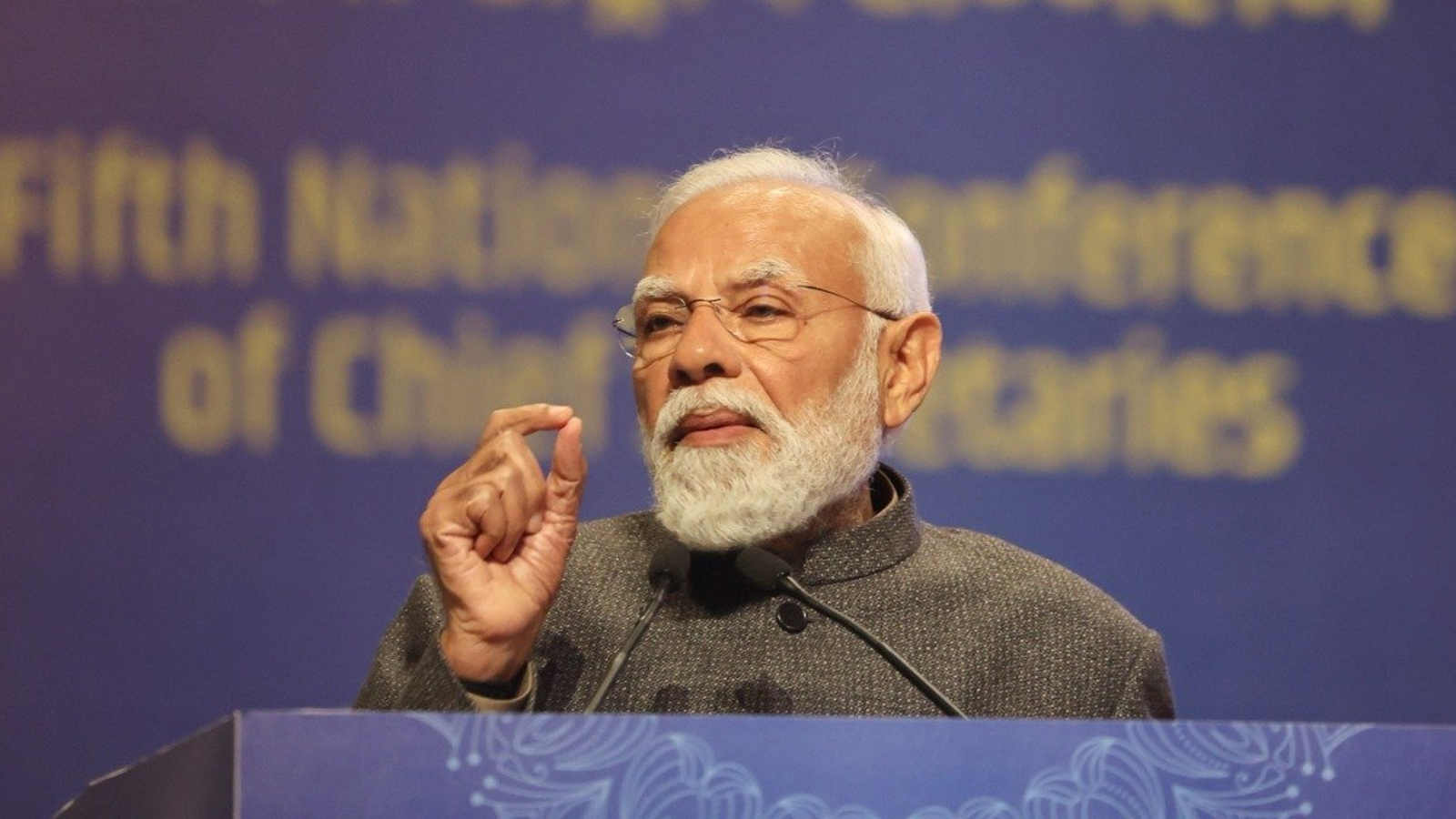
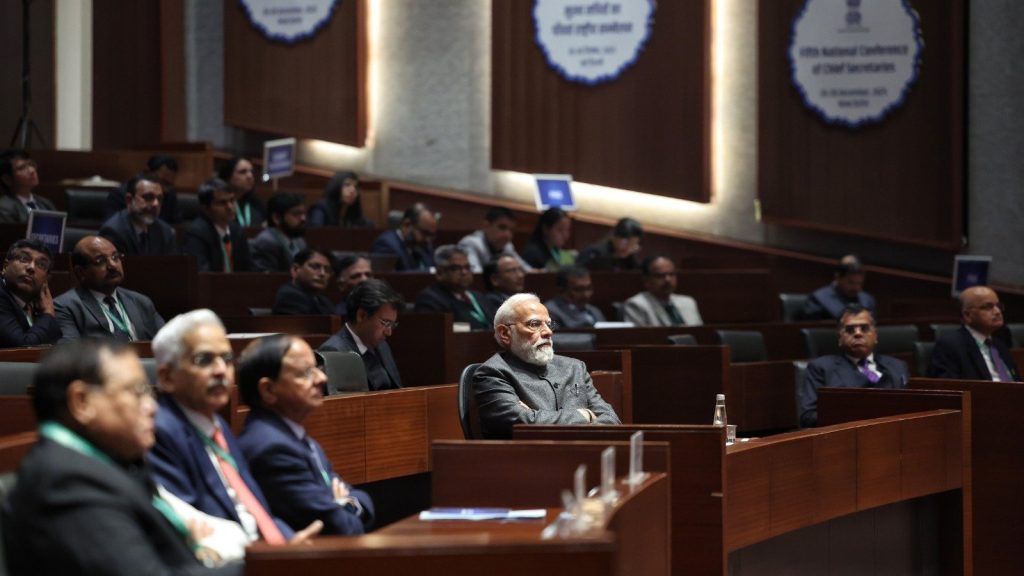
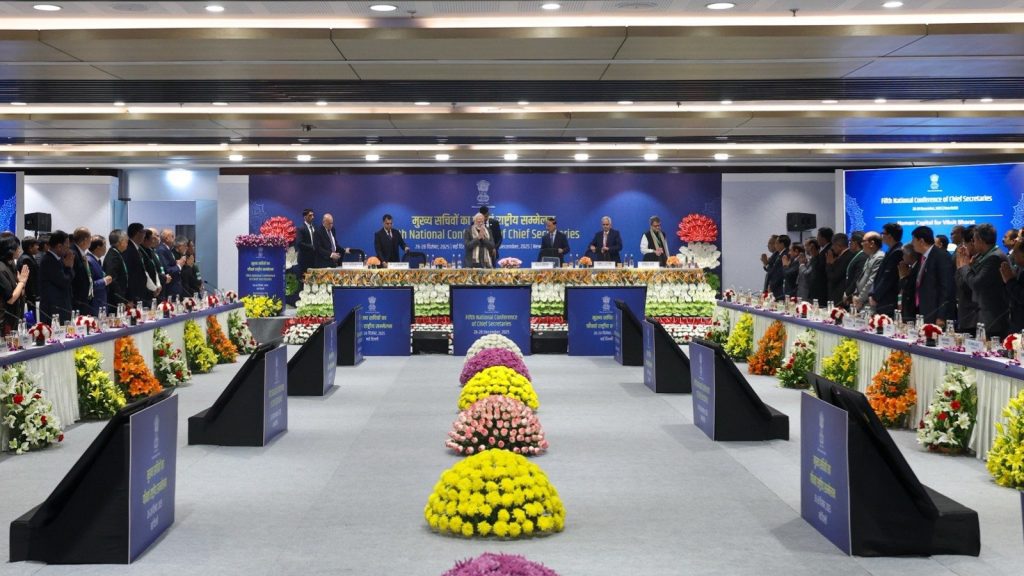
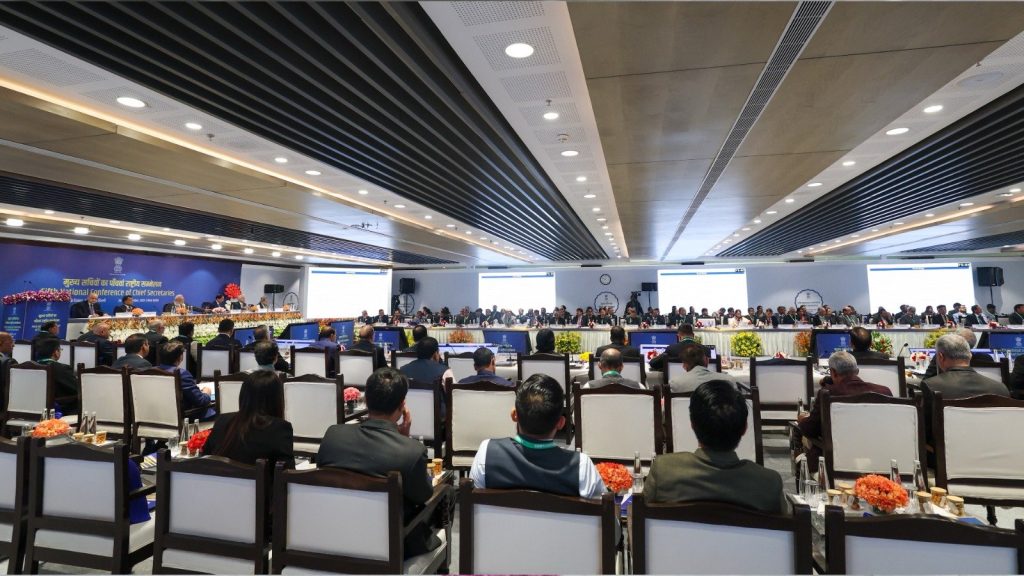
Prime Minister Narendra Modi on Sunday chaired the fifth National Conference of Chief Secretaries in Delhi, underscoring the role of human capital, quality governance and cooperative federalism in achieving the vision of a Viksit Bharat. The three-day conference was held at Pusa in Delhi, from December 26 to 28.
The conference was attended by Chief Secretaries and senior officials from all states and union territories, along with domain experts and senior officers from the Centre.
Addressing the gathering, the Prime Minister said the conference marked another important step in strengthening Centre-State cooperation and collective decision-making. He stressed that human capital – encompassing knowledge, skills, health and capabilities – remains the key driver of economic growth and social progress and must be developed through a coordinated whole-of-government approach.
The conference focused on the overarching theme of ‘Human Capital for Viksit Bharat’. Highlighting India’s demographic advantage, PM Modi noted that nearly 70 per cent of the country’s population is of working age, presenting a unique opportunity to accelerate India’s development journey if effectively harnessed.
The Prime Minister said India has boarded the “Reform Express”, driven by the energy and aspirations of its youth, and observed that the country is witnessing a phase of next-generation reforms while moving steadily towards becoming a major global economic power. He emphasised that Viksit Bharat is synonymous with quality and excellence, calling upon all stakeholders to move beyond average outcomes in governance, service delivery and manufacturing.
Stressing the importance of self-reliance, PM Modi said that ‘Made in India’ must become a global symbol of quality, competitiveness and reliability. He reiterated the need to strengthen Aatmanirbharta with a commitment to ‘Zero Defect, Zero Effect’, ensuring high-quality products with minimal environmental impact. He urged the Centre and States to jointly identify 100 products for domestic manufacturing to reduce import dependence and enhance economic resilience.
The Prime Minister also highlighted the need to align skill development with current and future demand at both State and global levels. He said closer collaboration between academia and industry is essential to create high-quality talent, particularly in higher education.
On employment and livelihoods, PM Modi said tourism has significant potential to generate jobs, given India’s rich heritage and cultural diversity. He urged States to prepare roadmaps for developing at least one global-level tourist destination, along with a supporting tourism ecosystem. He also emphasised aligning India’s sports calendar with global schedules, noting that preparations for hosting the 2036 Olympics would require long-term investment in sports infrastructure and talent development.
The Prime Minister said that India would soon launch the National Manufacturing Mission and urged States to accord it top priority. He said States must focus on improving Ease of Doing Business, particularly in areas such as land availability, utilities and social infrastructure, to attract global investments. He also called for strengthening the services sector, including healthcare, education, transport, tourism, professional services and artificial intelligence, to position India as a global services hub.
Highlighting agriculture’s role in economic growth, PM Modi said India must shift towards high-value agriculture, dairy and fisheries with a focus on exports to realise its ambition of becoming the food basket of the world. He referred to the PM Dhan Dhanya Scheme, under which 100 districts with lower productivity have been identified, and urged States to similarly focus on districts with weak learning outcomes.
The Prime Minister also encouraged States to leverage the Gyan Bharatam Mission for digitisation of manuscripts, noting that once digitised, artificial intelligence could be used to synthesise the knowledge contained in these texts. He emphasised the growing importance of technology, artificial intelligence and cybersecurity in governance and called for capacity-building plans in coordination with the Capacity Building Commission.
Concluding his address, PM Modi said all States and Union Territories should prepare 10-year actionable plans with short-, medium- and long-term targets, using technology for regular monitoring and effective implementation.
The conference included deliberations on early childhood education, schooling, skilling, higher education, sports and extracurricular activities, recognising their role in building a future-ready workforce. Special sessions were also held on themes such as deregulation, technology in governance, smart agriculture supply chains, tourism development, Aatmanirbhar Bharat and strategies for a post-Left Wing Extremism future.