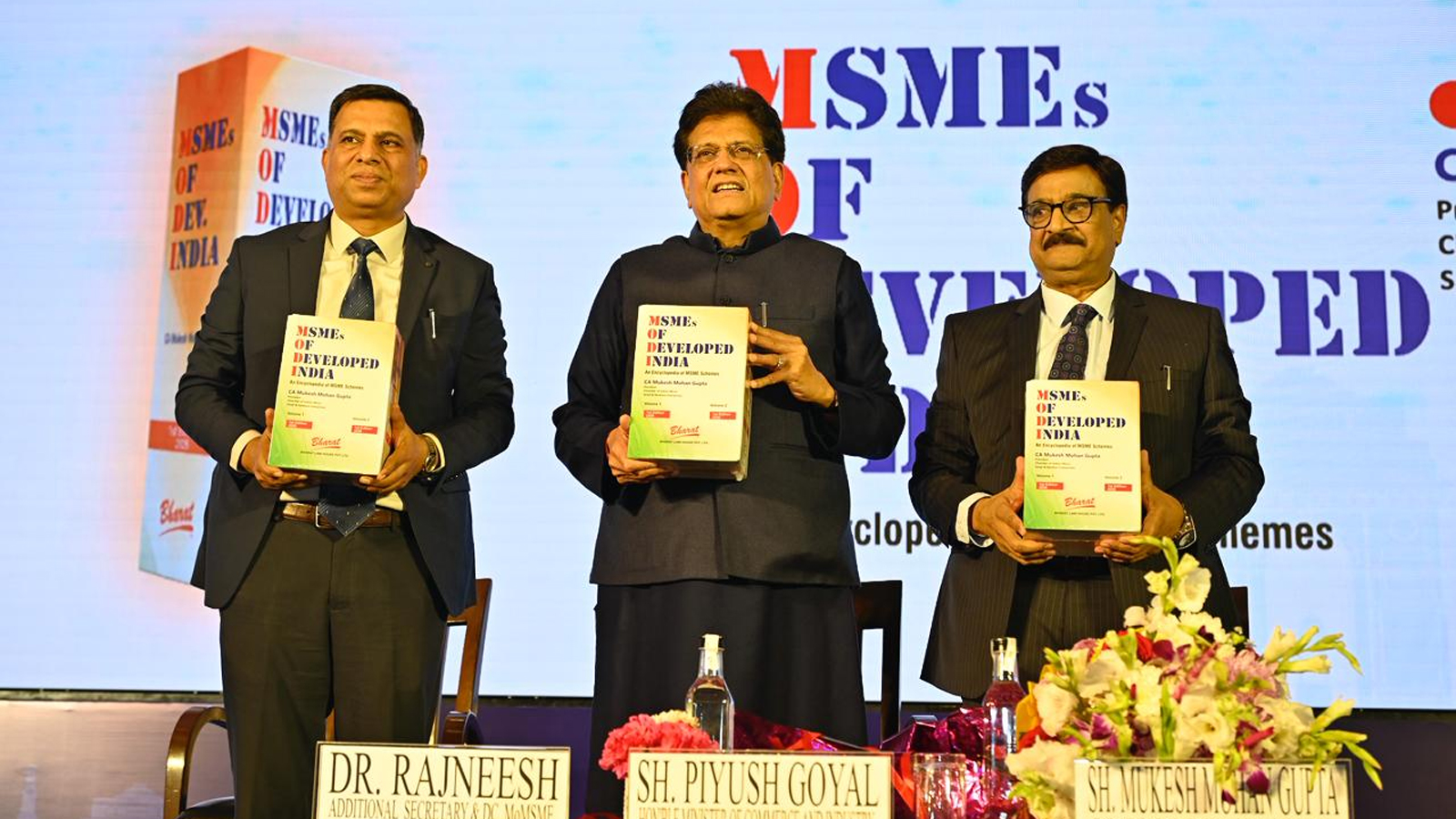
Union Minister of Commerce and Industry Piyush Goyal on Monday said public sector banks are today competing on an equal footing with private and foreign banks, reflecting the strengthening of India’s banking system and its growing role in supporting economic growth.
Addressing the MSME Banking Excellence Awards in New Delhi, Goyal said public sector banks have emerged as strong and competitive institutions, standing shoulder to shoulder with private and foreign lenders in financing India’s development. He underlined that access to timely and adequate credit has been critical for micro, small and medium enterprises (MSMEs), enabling small entrepreneurs to move away from informal sources of finance and expand their businesses.
Highlighting the role of banks in India’s growth story, the minister said institutional credit has helped MSMEs start operations, scale up and improve livelihoods. He noted that government initiatives such as the Mudra loan scheme and the PM SVANidhi programme have significantly widened access to credit, especially for small borrowers and street vendors. Nearly 70 per cent of Mudra loans, he said, have been extended to women entrepreneurs.
Referring to the India-New Zealand Free Trade Agreement announced earlier in the day, Goyal said it was the seventh FTA concluded under the leadership of Prime Minister Narendra Modi and reflected India’s shift towards trade partnerships with developed economies. He said India’s recent FTAs go beyond market access and include technical collaboration, investment commitments and support for innovators, farmers and entrepreneurs.
On the India-New Zealand pact, the minister said New Zealand has made a binding commitment to invest USD 20 billion in India over the next 15 years, a significant increase compared to the USD 70 million invested over the past 25 years. He added that the agreement includes enforceable provisions, including the possibility of withdrawing concessions if investment commitments are not met, making it a substantive and accountable arrangement.
Goyal said the agreement is expected to attract investments in innovation, manufacturing and exports, with India emerging as a manufacturing base not only for New Zealand but also for global markets. He added that the MSME sector is likely to be among the biggest beneficiaries of the FTA.
Calling for coordinated efforts to fully realise the potential of the agreement, the minister said there is scope to double, triple and even quadruple bilateral trade in goods and services. He also noted that the India–New Zealand FTA was negotiated by a team that was almost entirely women officers, calling it the first such agreement finalised by women negotiators, and pointed out that India’s ambassador to New Zealand is also a woman.
Goyal also recalled measures taken to ease credit flow to MSMEs, including credit guarantee schemes introduced during the COVID-19 pandemic, under which the government acted as guarantor for loans without additional collateral. He said the PM SVANidhi scheme, which began with loans of Rs 10,000 and was later expanded to Rs 20,000 and Rs 50,000 based on repayment performance, has helped street vendors avoid exploitative moneylenders.
Noting that banks recorded profits of around Rs 3 lakh crore last year, the minister said this demonstrated their capacity to lend more to genuine borrowers. He added that MSME credit has grown at a compound annual growth rate of about 14 per cent in recent years and is set to expand further as India deepens its global trade engagement while safeguarding the interests of farmers, fishermen, MSMEs and the dairy sector.
Urging banks to lend responsibly and proactively, Goyal called for faster and more transparent loan approvals, adequate capital for working and expansion needs, and greater hand-holding of MSMEs to help them benefit from government schemes and capital markets.
Stating that many of today’s large corporates began as MSMEs, the minister said the future growth of the Indian economy would depend on the strength of the MSME sector. He described banks and MSMEs as partners whose combined growth would be central to achieving the goal of Viksit Bharat by 2047.