As the U.S. inches towards a war with Venezuela, comes an ominous Russian warning: Don’t make the fatal mistake of further escalating the situation.The Kremlin spokesperson said: “We see tensions escalating in the region. We see it as potentially very dangerous.”
As for President Maduro of Venezuela, he’s in no mood to give up without a fight. “No to blood for oil. No to interventionism. Respect the sovereignty of nations!” he told a rally. He’s urging the American people to see reason. “The people of the United states, not war – Merry Christmas! Don’t worry, be happy. Be happy, be happy!”
President Lula of Brazil is offering to mediate; to prevent what he calls a fratricidal war.
It’s all happening thick and fast. China has voiced support for Venezuela and criticised U.S. pressure. The United Nations Secretary-General has urged restraint. Mexico’s President has warned against bloodshed. And, in an unusual development, Belarus’ President Alexander Lukashenko has said that President Maduro would be welcome in his country if the Venezuelan leader ever chose to leave office.
What happens next will shape not just Venezuela’s future but stability across the entire Caribbean region and possibly global energy markets as well.
What began as American strikes on vessels in the Caribbean and eastern Pacific, allegedly linked to drug-trafficking networks connected to Venezuela, quickly morphed into a massive U.S. military build-up in the Caribbean. In recent months, the U.S. has dramatically increased military pressure. 11 U.S. warships have been deployed to the Caribbean, including the world’s largest aircraft carrier, amphibious assault ships, cruisers and destroyers. Thousands of U.S. military personnel are operating in the region. American Naval aircraft and surveillance planes have been flying missions from bases, including Puerto Rico, directly along Venezuela’s coastline. And then came another dramatic escalation. President Trump announced, what he calls, a total and complete blockade of sanctioned oil-tankers entering and leaving Venezuela. Edward Fishman, a former U.S. State Department sanctions specialist, tells The New York Times newspaper that “once you impose a Naval blockade, you’re only a stone’s throw away from using kinetic force.”
The oil blockade directly targets Venezuela’s main lifeline. Although it has huge reserves, years of corruption and mismanagement have crippled production. Output collapsed from over three million barrels a day in the early 2000s to just 350,000 barrels per day by 2020. It has since recovered to around one million barrels per day. Still, a small fraction of global supply, but vital for Venezuela’s survival. Because of U.S. sanctions imposed in 2019, Venezuela has relied on a shadow network of oil tankers which are often called ghost ships. The tanker which was seized recently is a classic example.It is around 20 years old and operated under multiple names. It was already under U.S. sanctions for allegedly moving Iranian oil. Experts say that this ghost fleet has allowed Venezuela to quietly sell discounted oil, mainly to China, which buys about 80 per cent of its exports. However, President Trump has not pressured China to curb those purchases. Instead, he has been focussed on a planned summit with China’s leader in Beijing in April.
Washington, D.C. has secured regional cooperation. Trinidad and Tobago has agreed to allow the U.S. to use its airports in the coming weeks. The Caribbean nation says that this is for security cooperation and crime prevention, not for launching attacks. President Maduro has since ordered his Navy to escort ships carrying petroleum products from port, risking a confrontation with the U.S. on the high seas as he defied President Trump’s declaration of a “blockade” aimed at the country’s oil industry.
So, why is President Trump ratcheting up tensions in Latin America? He has been unusually blunt about his motives. He claims that Venezuela took U.S. oil assets after nationalising its energy sector under the late Venezuelan President Hugo Chavez. “We’re getting land, oil rights, whatever we had. They took it away because we had a President that maybe wasn’t watching. But they’re not going to do that. We want it back. They took our oil rights. We had a lot of oil there. As you know, they threw our companies out and we want it back.” Under Chavez and later Maduro, Venezuela nationalised several foreign-owned oil projects, including those run by ExxonMobil and ConocoPhillips. President Trump blames previous U.S. Governments for not securing compensation. He has vowed to reverse those losses.
President Maduro has reacted angrily, calling the U.S. actions colonial and war-like. “The U.S. Government says that it belongs to them and that the Venezuelans are stealing their oil. So Venezuela’s oil belongs to them; the Venezuelan minerals, gold, and all minerals, belong to them; and what we’ve never heard before, that the Venezuelan lands belong to them and that we must give them back to them immediately. Honestly, it’s a warlike and colonial intention.”
There’s another reason why President Trump is concentrating his energies on Venezuela. The just-released 33-page new National Security Strategy, which U.S. presidents usually release once in their term, has an unusually heavy focus on the Western Hemisphere. (The Western Hemisphere is the half of Earth west of the Prime Meridian, and east of the Antimeridian, primarily encompassing North and South America.) President Trump intends for the U.S. to keep a bigger military presence in the Western Hemisphere going forward to battle migration, drugs and the rise of adversarial powers in the region. The document says: “The United States must be pre-eminent in the Western Hemisphere as a condition of our security and prosperity – a condition that allows us to assert ourselves confidently where and when we need to in the region.”
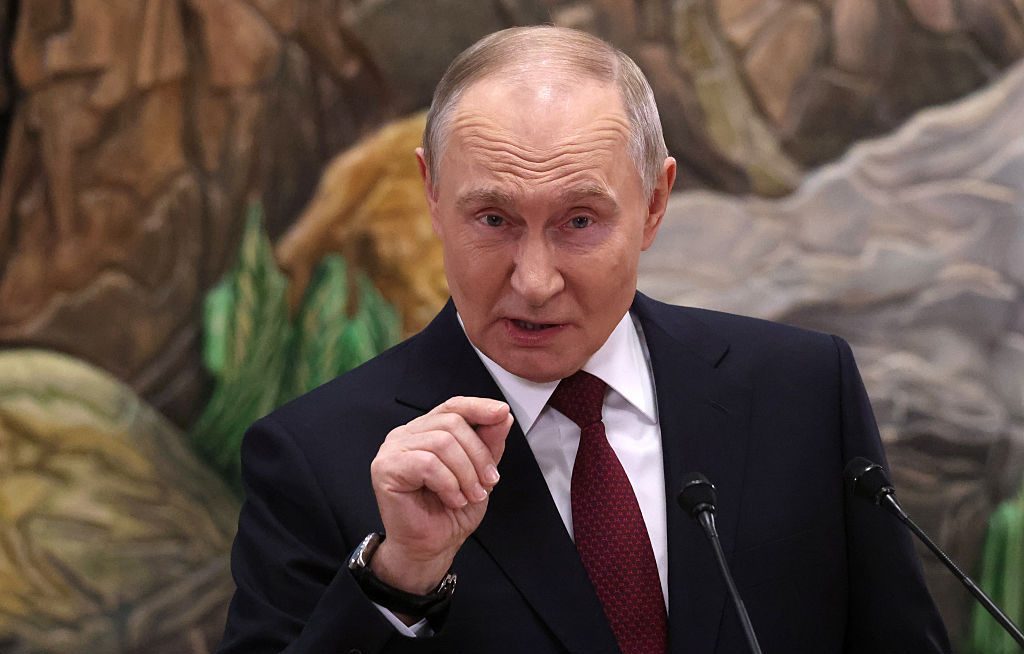
However, Russia and China are not exactly worried. On the contrary, both would be salivating at the prospects of the U.S. getting tied down in a conflict of its own making, in its own backyard, allowing them to cement their footholds in the region. Moscow says it is in constant contact with its ally Caracas. President Vladimir Putin reaffirmed his support to President Maduro in a phone call a few weeks ago. President Maduro is a friend of the Kremlin’s and has been a regular guest in Moscow for years. The Kremlin has, in the past, helped prop up Venezuela’s struggling economy. In fact, Venezuela and Russia recently extended their joint oil ventures until the year 2041. This 600-million-dollar deal cements Russian control over energy assets and aims to make U.S. policy changes nearly irrelevant.
As for China, President Trump’s decision to impose a partial blockade on Venezuela risks undermining a top U.S. policy goal – deterring a potential Chinese naval encirclement of Taiwan.