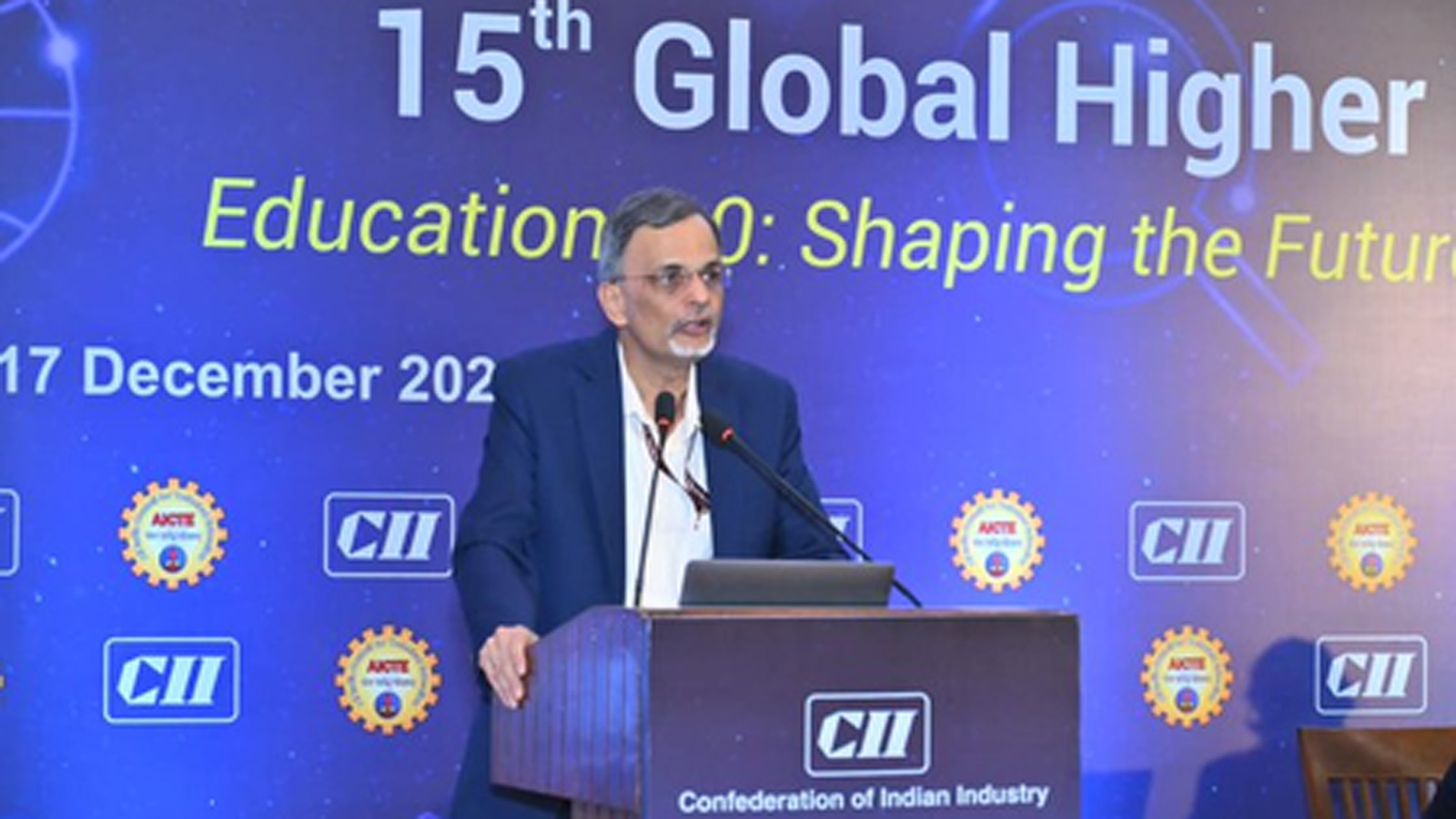
Chief Economic Adviser (CEA) V. Anantha Nageswaran on Wednesday said the next phase of reforms in India’s higher education sector must be led by states, while underscoring that the country continues to remain a bright spot in the global economy despite external uncertainties.
Speaking at the CII Global Higher Education Summit in New Delhi, Nageswaran said states have a critical role to play in strengthening higher education by shifting from a model of control to one of stewardship. He emphasised the need to urgently address faculty shortages, including through mechanisms such as appointing professors of practice, and called for a move from input-based to outcome-based regulation.
He noted that adopting an entrepreneurial approach in public administration and financing institutions based on differentiated roles and outcomes would help scale reforms. The CEA also highlighted the importance of deeper industry engagement in curriculum design, research and governance.
“Industry can co-design curricula, offer credit-bearing internships, support applied research, share infrastructure, and participate meaningfully in governance,” Nageswaran said, adding that collaboration among the Centre, states, industry and citizens could help India emerge as a global hub for learning, research and ideas.
According to him, the present moment is uniquely suited for ambitious reforms due to four converging factors: India’s demographic and economic inflection point, structural changes in the global higher education landscape, the rise of AI-enabled pedagogy, and policy shifts under the National Education Policy (NEP) 2020 alongside evolving regulatory thinking.
At the same event, Prof Anil Sahasrabudhe, Chairman of the National Education Technology Forum, said recent reforms are creating a future-ready, student-centric higher education ecosystem focused on quality, flexibility and innovation. He noted that a proposed new regulatory framework aims to bring all higher education regulators under a single umbrella with a single-window approval system, enabling institutions to offer multidisciplinary programmes more easily.
Dr Naushad Forbes, Past President of CII and Chairman, highlighted that long-term economic resilience depends on the quality of human capital built through education and skills. He called for a substantial increase in public research funding within universities and advocated greater autonomy and competition, arguing that universities should primarily be seen as creators of talent.
Separately, addressing a Bombay Stock Exchange (BSE) event titled “Resilient Markets, Growing India: The Road Ahead for 2026 and Beyond”, Nageswaran said India remains a bright spot amid global uncertainty, supported by a robust growth rate of around 6.5 per cent, improved fiscal health, strong domestic demand and ongoing structural reforms.
He said India is well-positioned for sustained growth despite global headwinds, leveraging technology, infrastructure development and demographic advantages.
BSE Managing Director and CEO Sundararaman Ramamurthy said India’s economy has shown remarkable resilience, supported by progressive government measures that have strengthened fundamentals and boosted confidence. He added that capital markets remain a pillar of long-term wealth creation, driven by regulatory efforts to ensure transparency and stability.
Motilal Oswal Financial Services Chairman and Co-founder Raamdeo Agrawal echoed the optimism, saying India is entering a multi-trillion-dollar growth phase in which both the economy and equity markets are expected to compound strongly. He said rising household financial assets, deeper participation and strong market institutions are helping build one of the world’s most robust capital markets.
The discussions at both events highlighted the central role of reforms – in education, markets and governance – in sustaining India’s growth momentum and advancing its long-term development goals.
(IANS)