What started as a border skirmish between Thailand and Cambodia has exploded into airstrikes, artillery barrages and a full-blown humanitarian crisis, all while shredding a hard-won peace-deal brokered by U.S. President Donald Trump. The two South-East Asian neighbours have been at odds for centuries but the modern-day conflict boils down to a messy border, drawn up more than a hundred years ago.
Back in the early 1900s, when Cambodia was under French colonial rule, treaties between France and what was then Siam — now Thailand — set boundaries that left ambiguities, especially around ancient temples such as Preah Vihear.
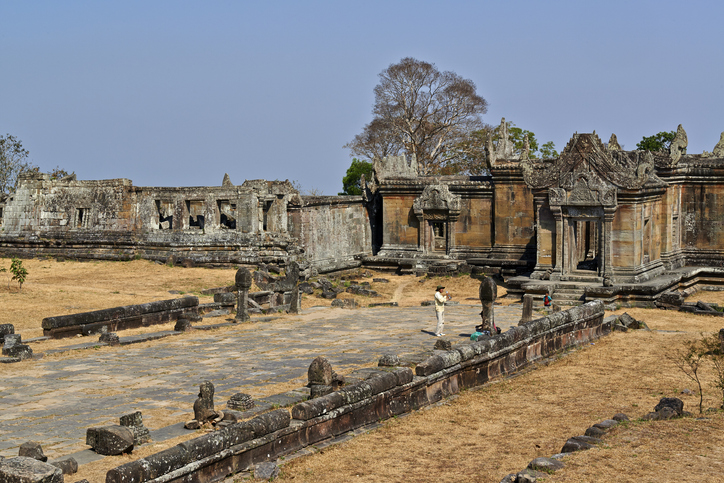
Preah Vihear is an ancient Khmer temple complex that was originally a Hindu temple dedicated to Lord Shiva. Over a period of time, the Hindu temple also saw Buddhist usage, with a small monastery still active there today. The International Court of Justice ruled in 1962 that Preah Vihear belongs to Cambodia but the surrounding land remains disputed to this day. Tensions simmered, erupting into deadly clashes in 2008 and 2011, killing dozens and displacing thousands.
It’s a classic tale of nationalism, history and unresolved grudges. This year, 2025, has been particularly challenging. In July, things escalated dramatically. Cambodian forces fired rockets into Thailand, prompting a Thai retaliation. Full-on battles were fought near contested temples and military posts. Casualties mounted quickly. Soldiers and civilians alike were caught in the crossfire; 48 deaths were reported and 300,000 people were displaced.
Enter President Trump, who jumped in with his signature deal-making flair. On 28th July, after high-stakes talks, Thailand and Cambodia agreed to an unconditional ceasefire. President Trump was quick to hail it as a win. It was a rare, bright spot in a region prone to flare-ups. And it held for a bit. However, President Trump wasn’t done. In October, he pushed further, overseeing the Kuala Lumpur Peace Accord on the sidelines of the ASEAN Summit. Signed on 26th October, this expanded truce promised to restore bilateral ties, demilitarise certain areas, and even, tackle economic issues such as border trade.
Expectedly, President Trump took credit for it, attending the signing ceremony and touting it as proof of his peace-brokering prowess. For a moment, it looked like the cycle of violence was broken. Diplomats breathed a sigh of relief and civilians started to rebuild their lives.
However, it all changed on 7th and 8th December. Clashes erupted along the disputed border. Thailand, which had already called time on the truce after a landmine blast maimed its soldier a few weeks ago, used the U.S.-made F-16 fighter-jets to carry out airstrikes on Cambodian positions. Cambodia claims that its forces waited for a while, in the interest of peace, before returning fire.
Both sides accused each other of provoking the latest round of conflict. Thailand claimed that on 9th December, Cambodian forces carried out drone attacks in several areas of Thailand’s Ubon Ratchathani province. Cambodia’s military, in turn, claimed that Thailand had used artillery fire and armed drones to launch attacks in Pursat province, fired mortars into civilian residences in Battambang province and Thai F-16 fighter jets had entered Cambodian airspace and dropped bombs near civilian areas.
Soon, reports emerged of damage to the Preah Vihear temple India was quick to voice its concern. It said that the UNESCO World Heritage Site of Preah Vihear temple is a shared cultural heritage of humanity. India has been closely involved in its preservation. It hoped that all measures will be taken to fully safeguard the site and related conservation facilities.
By Friday, 12th December, 20 people had died — nine Thai soldiers and 11 Cambodian civilians. Up to 600,000 people were evacuated to safety. Friday also saw Thailand’s Government dissolve the country’s parliament amid the chaos, triggering a snap election.
A perfect storm, some would say. So, what went wrong? Why after such significant diplomatic heavy lifting, have we witnessed a return to conflict? And why now? Analysts point to a confluence of factors. Domestic political pressures in both Bangkok and Phnom Penh may have played a role. Nationalistic sentiments often flare up around these border disputes and leaders can find themselves in a delicate balancing act between international commitments and internal political imperatives. The precise spark for this latest round of fighting is still under investigation but initial reports suggest a localised incident quickly spiralled out of control.
The Thai Government, which was in a minority, feared that the the Opposition could bring a no-confidence motion against it, which it was not likely to win. So, the best of bad options was to call a snap election. “Since the administration is a minority government and domestic political conditions are fraught with multiple challenges, the government cannot continue administering state affairs continuously, efficiently, and with stability,” the Royal Gazette said, citing a report received from the now-caretaker prime minister Anutin Charnvirakul. “Therefore, the appropriate solution is to dissolve the House of Representatives and hold a new general election”, it read … …
The fact remains that the latest flare-up directly undermines President Trump’s personal commitments. He staked his reputation on that July ceasefire and October truce, even attending ASEAN events to seal the deal. Now, with fighting defying U.S. calls to stop, it’s a slap in the face. Thailand says that it won’t honour the pause in fighting until Cambodia apologises. It even cautions President Trump against using tariffs to force peace with Cambodia!
Thailand’s foreign minister Sihasak Phuangketkeow said: “We don’t think tariff should be used to pressure Thailand to get back to the joint declaration, to get back to the dialogue process. No, I think the situation regarding Thailand and Cambodia has to be solved on the basis of its own dynamic. And tariffs – they’re part of the trade negotiations. It should be confined to trade negotiations.”
The Thai minister maintains that resolving the border conflict should remain separate from the ongoing trade negotiations. Remember — In October, the U.S. and Thailand had announced a reciprocal trade framework that maintains a 19 per cent tariff on Thai products while identifying areas for potential tariff-cuts. Prof. Chong Ja Ian from the National University of Singapore says that “Bangkok’s resistance is a test for Trump’s tariff play, but the tariff has always been a blunt instrument. Whether it can get a lasting ceasefire over longstanding and deep-seated animosities has been and is doubtful.”
President Trump, in his quest for the Nobel Peace Prize, has sought to mediate in a number of conflicts in recent months, with mixed results, while also alienating some countries in the process. For instance, President Trump claims to have used sky-high tariffs as leverage to halt fighting between India and Pakistan in May. India denies that tariffs played any role whatsoever in ending hostilities but President Trump’s insists otherwise and that has strained relations between New Delhi and Washington, D.C,. threatening a strategic partnership between two powerful democracies. President Trump’s mixed record on ending wars can also be seen in Africa. On 4th December, President Trump and the leaders of Rwanda and the Democratic Republic of Congo signed an agreement to end one of the world’s longest-running conflicts that has claimed hundreds of thousands of lives over several decades. But, the deal crumbled on 9th December as Rwanda-backed M-23 fighters entered the key eastern Democratic Republic of Congo city of Uvira near the border with Burundi.
President Trump spoke with Thai and Cambodian leaders on Friday. Afterwards, he wrote on Truth Social that “they have agreed to CEASE all shooting effective this evening, and go back to the original Peace Accord” agreed in July.
However, Thailand said On Saturday that it was continuing military strikes against Cambodia despite President Trump claiming that Thailand and Cambodia had agreed to stop fighting. Thai fighter jets struck Cambodian targets on Saturday. A Thai Defence Ministry spokesperson, Rear Admiral Surasant Kongsiri, told journalists that clashes had taken place across seven border provinces and that Cambodia had fired heavy weapons, making it necessary for Thailand to retaliate.
Cambodia’s Information Ministry countered by saying that Thai forces had struck bridges and buildings overnight and fired artillery from a Naval vessel.
Adding insult to injury, the Thai leader dismissed comments by President Trump that a “roadside bomb” that wounded Thai soldiers was accidental. He said: “It’s definitely not a roadside accident. Thailand will continue to perform military actions until we feel no more harm and threats to our land and people. I want to make it clear. Our actions this morning already spoke.”
He added that there was no ceasefire. He said that it was definitely not a roadside accident.
This isn’t just another border spat. It has its own complications. Thailand and the U.S. are Treaty allies. Thailand is also Major Non-NATO Ally of the U.S. On the other hand, Cambodia enjoys close ties with China. Clearly, the Thailand — Cambodia border dispute is a test of President Trump’s global influence. So, what’s next?Malaysia is urging talks. ASEAN is on edge. Trade’s halted, costing billions. And — like in every other conflict — civilians continue to pay the price.
This conflict isn’t just about lines on a map.
It’s about pride, power and whether diplomacy can ‘Trump’ firepower — if you get the pun!