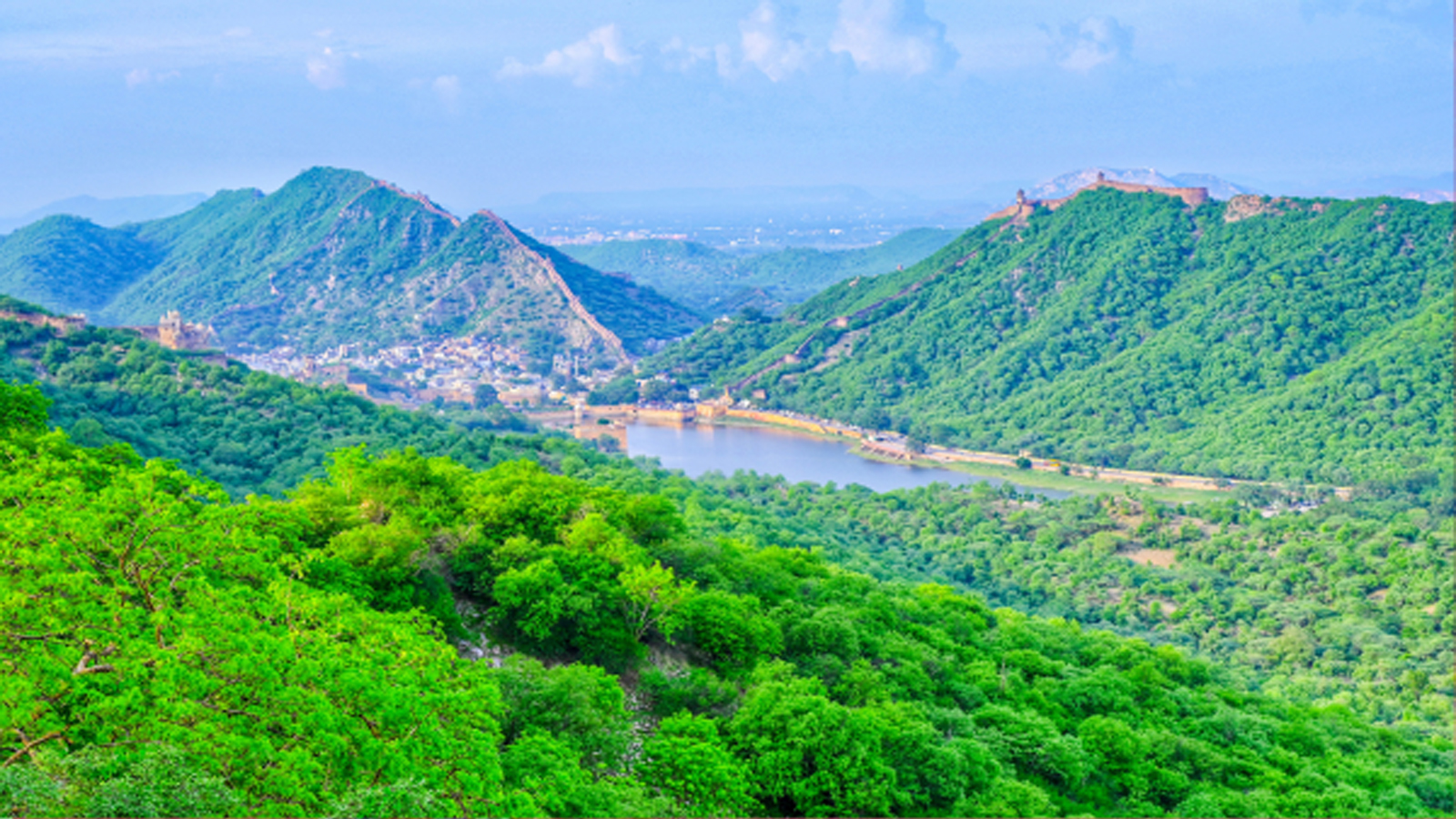
The Aravalli Range, a significant geographical feature spanning across several states in India, has recently been the subject of important legal and environmental discussions.
This ancient mountain range plays a vital role in the region’s ecology, acting as a natural barrier that helps prevent the spread of desert conditions from the west and supports biodiversity, water resources, and climate stability.
In recent times, there has been attention on a uniform definition for the Aravalli Hills and Range, which aims to ensure consistent protection and management across the areas it covers. This development stems from a Supreme Court judgment that seeks to balance conservation needs with sustainable use of resources.
At the heart of these discussions are two related definitions: one for individual Aravalli Hills and another for the broader Aravalli Range.
An Aravalli Hill is defined as any landform in the designated districts that rises 100 meters or more above the surrounding local level, which is determined by the lowest contour line around it. This definition includes not just the peak but the entire area, encompassing the hill itself, its slopes, and any connected features, without regard to how steep the slopes are. The idea is to protect the complete structure of the hill as a single unit.
The definition for the Aravalli Range builds on this by considering groups of such hills. If two or more hills that meet the 100-meter height criterion are within 500 meters of each other—measured from the outermost points of their base contours—they form a range.
This includes the space between them, which is calculated using buffers and connecting lines to enclose the area properly. These definitions help in identifying protected zones clearly and consistently, using tools like geographic information systems, which are computer-based methods for mapping and analysing land features.
These definitions were incorporated into a Supreme Court judgment on November 20, 2025. The court adopted recommendations from a committee established earlier that year, following its order in May 2024.
The committee was led by the Secretary of the Ministry of Environment, Forest and Climate Change and included representatives from the forest departments of Delhi, Haryana, Rajasthan, and Gujarat, as well as experts from organizations like the Forest Survey of India, the Central Empowered Committee, and the Geological Survey of India.
While the suggestions came from this government-led group, the Supreme Court made them official by including them in its ruling, stating that it accepted the Ministry’s proposed definitions for the Aravalli Hills and Range.
The need for a uniform definition arose from long-standing challenges in managing the Aravalli region. Without a common understanding, efforts to conserve the area varied across states, leading to issues such as unauthorised mining and environmental harm.
The range covers parts of Delhi, Haryana, Rajasthan, and Gujarat, and inconsistencies in how it was defined allowed for uneven protection. This has contributed to problems like the potential eastward expansion of desert areas from the Thar Desert, affecting local climates and ecosystems.
The Supreme Court’s intervention aligns with India’s commitments under international agreements, such as the United Nations Convention to Combat Desertification, which India joined in 1996, and domestic programs like the Aravalli Green Wall Project, aimed at enhancing green cover and sustainability.
The push for clarity on these definitions has roots in earlier legal cases. Two key public interest litigations have been influential: one initiated in 1985 concerning mining in Haryana, and another from 1995 addressing broader forest conservation, including in Rajasthan.
Over the years, these cases highlighted the gaps in regulation. By May 2024, the court emphasized the urgency of a standardized approach.
In August 2025, it reiterated this, noting that only Rajasthan had a formal definition in place since 2006, which left other areas more vulnerable to unregulated activities. Rajasthan’s definition, based on a 2002 committee report and earlier geological studies, identifies hills as landforms rising 100 meters above the local base and protects both the hills and their slopes from mining.
It is worth noting that in 2011, certain aspects related to mining in Rajasthan were paused by the court, but this was not a rejection of the definition itself. Instead, the focus was on halting new mining permissions until comprehensive environmental assessments could be completed.
This approach drew from a precedent in a Karnataka case, where large-scale environmental impact studies were required for mining districts to ensure no irreversible damage occurred. Similar requirements were extended to the Aravalli areas, emphasizing the importance of thorough evaluations before any approvals.
In its 2025 judgment, the Supreme Court outlined several steps to guide future management. It directed the Ministry of Environment, Forest and Climate Change to develop a Management Plan for Sustainable Mining through the Indian Council of Forestry Research and Education.
This plan will cover the entire Aravalli region, from Delhi to Gujarat, and will identify zones where mining can occur sustainably, as well as areas that need strict protection for ecological reasons. The plan will include assessments of the region’s overall environmental impact and its capacity to handle activities without harm. It will also detail measures for restoring and rehabilitating areas after any mining, ensuring long-term health of the landscape.
Until this management plan is ready, no new mining leases will be issued in the Aravalli region. Once finalized, mining will only be allowed in designated sustainable areas, following the plan’s guidelines.
For existing mining operations, the court stressed the need for full compliance with environmental recommendations to continue responsibly. This phased approach aims to prevent abrupt disruptions while prioritizing conservation.
Concerns have been raised about the potential impact on the vast area of the Aravalli Range, which spans approximately 144,000 square kilometers. However, the judgment does not automatically allow widespread mining. The definitions include safeguards, such as the 500-meter proximity rule for connecting hills into protected ranges. Additionally, many parts of the range are already designated as ecologically sensitive zones, including national parks, wildlife sanctuaries, and tiger reserves like Sariska in Rajasthan.
States like Gujarat and Haryana also have protected areas that restrict activities. Historical sites, monuments, reserved forests, and wetlands further limit where interventions can occur, as these are preserved under various laws.
The management plan will be modeled after similar efforts in other regions, such as the Saranda Forest in Jharkhand, where detailed studies identified suitable areas for activities while protecting sensitive ones.
For the Aravalli’s 37 districts, individual assessments will determine permissible zones, ecologically important areas, and those needing restoration. This means that assumptions about large portions of the range being opened up overlook these layered protections and the upcoming detailed planning.
To provide some initial insights, the government collaborated with the Survey of India to analyse four districts as examples. In Rajasthan’s Rajsamand and Udaipur districts, preliminary findings suggest that 97 to 99 percent of the areas would remain off-limits for mining under the new framework.
In Haryana’s Mahendragarh district, about 75 percent falls outside permissible mining zones. In Gujarat’s Sabarkantha district, around 89 percent is protected. These figures indicate a strong emphasis on conservation. Currently, before the full management plan is in place, only a small fraction—about 278 square kilometers, or 0.19 percent of the total Aravalli area—is available for mining activities.
No mining is permitted in Delhi, regardless of location within the range. This underscores the commitment to safeguarding urban and sensitive environments. The overall goal is to foster a scientific and balanced approach that supports both environmental health and necessary resource use.
In summary, the recent Supreme Court judgment represents a step toward unified and effective management of the Aravalli Range. By establishing clear definitions and mandating a comprehensive plan, it addresses longstanding inconsistencies and promotes sustainability.
This framework encourages collaboration among states and central authorities, ensuring that the range continues to serve as an essential ecological asset for future generations. As the management plan progresses, it will provide more detailed guidance, helping to maintain the delicate balance between development and preservation in this important region.