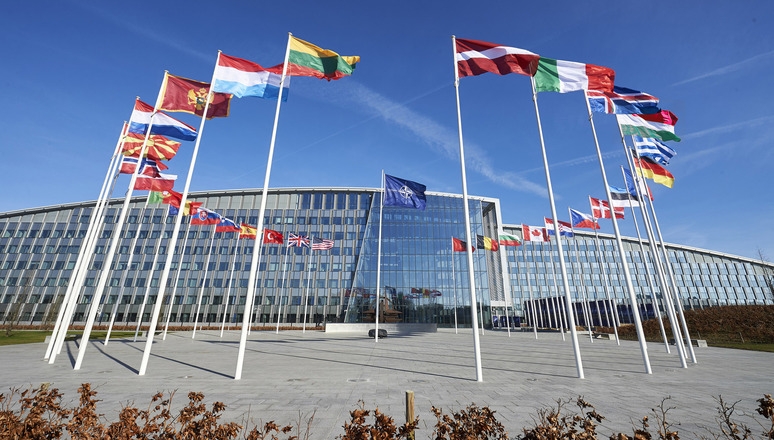
As the final session began at last month’s Berlin security conference, U.S. ambassador to NATO Matthew Whitaker said he looked forward to the day when Germany would volunteer to take over the role of Supreme Allied Commander Europe, the officer who would lead the alliance in a major conflict.
It prompted some consternation on the panel, and even more beyond. The senior German speaker, NATO Lieutenant General Wolfgang Wien, Berlin’s military representative to the EU, was taken aback.
While Germany was prepared to take on more responsibility, he said, he and his nation wanted to see the U.S. remain in charge.
Yet the publication of the Trump administration’s National Security Strategy last Friday suggests that may not be an option. In its stridently right-wing “America first” approach, it excoriates allies, particularly in Europe.
U.S. DISMANTLES THE POSTWAR ORDER THAT IT SHAPED
That raises questions for many traditional U.S. partners – but it is the decisions made by Germany and Japan – the powers defeated in World War Two who found new roles in a world order shaped by the U.S. victors – that may well prove the most important.
The last few weeks have seen a relentless diplomatic backlash from a furious China after Japan’s new prime minister, Sanae Takaichi, told parliament last month that a Chinese attack on Taiwan might pose an “existential challenge” to Japan that required military action.
It is a confrontation that the United States initially appeared to avoid engaging with or making significant comment on – even after Chinese fighter jets locked targeting radar onto Japanese counterparts last weekend, and one Chinese official suggested Takaichi should have her head cut off.
The U.S. finally broke its silence on Wednesday to criticise Beijing, and sent nuclear-capable bombers to patrol alongside Japanese aircraft, but the new Security Strategy left plenty of questions about how far U.S. support might go.
GERMANY AND JAPAN FACE SIMILAR DILEMMAS
Both Germany and Japan must confront that issue amid deep sensitivities both at home and abroad about anything that smacks of renewed militarism.
Such qualms do nothing to resolve the fundamental realities: that if the U.S. no longer wishes to anchor a continental military alliance in Europe, only Germany really has the industrial and human strength to do so; and that China is doing nothing to dispel the notion that it could invade Taiwan, with immediate strategic consequences for Japan.
In the first years of the last Cold War, the initial remilitarisation of both nations was controversial among their neighbours: one French minister whose son had been shot by the Nazis told a NATO meeting in 1950 that West Germany would only re-arm “over my dead body”, while Japan’s military Self-Defense Forces, shaped by the spectre of imperialism, have been restricted in weaponry and mission.
In both cases, though, the perceived threat from Moscow and Beijing – and from abandonment by Washington – is already prompting rearmament and changes of strategy.
Alongside longer-term plans to boost the size of its army, Germany is tripling the size of the force it has based in Lithuania as part of NATO’s efforts to protect the Baltic states, soon to become a full armoured brigade.
In the event of conflict, there is talk that it might be tripled again to a full division – while the Wall Street Journal this month reported the scale of wider German war planning, including a 1,200-page document outlining how the government would turn the nation into the logistical and industrial heartland of a NATO fightback against any Kremlin assault.
That plan, however, assumed the U.S. would remain engaged in Europe – indeed, parts of it specifically involved the transport of tens of thousands of incoming U.S. personnel.
TOUGH CHOICES FOR BERLIN IN NEW WORLD ORDER
Like several European nations, Germany is also working to be able to reintroduce conscription in a crisis – although that remains domestically contentious.
If Germany can implement major plans to scale up defence expenditure, it could become one of the largest military buyers in the world after the U.S., China, India and Russia. Its industrial strength already makes its decisions on what weapons it might share with Ukraine – not least its long-range Taurus missiles – arguably more important than those of any other country beyond the United States.
But whether its appetite would extend to leading NATO’s military planning is a very different question – not least because successive U.S. commanders since Dwight D Eisenhower in 1951 have also had responsibility for use of nuclear weapons in any European war, primarily with the U.S. arsenal.
Under NATO’s “nuclear sharing”, some German pilots have long been quietly trained to drop U.S. nuclear bombs in time of catastrophic war – but there is little enthusiasm in the military establishment or society for Germany to have its own nuclear deterrent.
Even in NATO-led military missions of recent decades in the Balkans and elsewhere, Berlin has tended to be more hesitant than France or Britain – and continues to be so on participating in any post-war stabilisation or protection force into Ukraine.
More pragmatically, beyond that squeamishness rooted in history lies the fear that an end to U.S. military leadership of NATO might significantly reduce Washington’s commitment to use its own nuclear weapons to defend Europe.
Developing and maintaining a nuclear weapons programme is very expensive. Britain and France have their own, but their arsenals pale compared to those of the U.S. and Russia, while still accounting for a large share of defence budgets.
But that is not even the largest challenge facing Germany’s political establishment.
The new U.S. National Security Strategy suggests the U.S. administration intends to double down on comments already made by Vice President JD Vance supporting Germany’s AfD party, part of a wider deliberate embrace of Europe’s anti-migrant right.
How that might sit alongside military alliance is anybody’s guess – as is the kind of strategy towards Russia and beyond that might be pursued by a future U.S. Republican administration if right-wing parties, often perceived as pro-Kremlin, take power in Germany, France or other European nations.
JAPAN’S PROBLEM WITH OLD ADVERSARY CHINA
Japan’s centre-right government has fewer direct political differences with Washington but, if anything, its strategic position brings even greater challenges.
Japan, which invaded China in the run-up to World War Two, has its own mutual defence treaty with Washington and growing links with other regional powers including South Korea, Australia and the Philippines that feel similarly nervous about China’s growing regional assertiveness.
Yet the Pacific lacks the kind of binding alliance structure that NATO provides in Europe.
Japan’s previous prime minister, Shigeru Ishiba, was unusually open in his belief that Japan should find a way to join NATO or a similar alliance, focused on constraining Chinese ambitions. But so far, there are few signs that the Japanese establishment would like to see Tokyo leading such an effort.
Japan has based its military thinking about a “Taiwan contingency” on the assumption that it would fight China alongside U.S. forces – particularly after the previous U.S. president, Joe Biden, asserted several times that Washington would fight if the island were attacked.
The new Trump administration, however, has been much more non-committal, returning to the previous U.S. policy of “strategic ambiguity”.
The National Security Strategy offers little clarity, although it does state that deterring a Chinese invasion remains a top priority, “ideally through military overmatch”, and that the U.S. would not support a “unilateral change in the status quo”.
That wording has been welcomed in Taiwan and angered Beijing – but the fact that the wider document appears to prioritise a U.S. approach primarily aimed at securing the Americas will likely leave many U.S. allies still nervous that Washington remains potentially open to letting Moscow and Beijing carve out their own effective spheres of influence.
WOULD U.S. HELP TO DEFEND TAIWAN AGAINST CHINA?
The fact that North Korea went entirely unmentioned raises wider questions over how seriously the new administration is taking the Pacific region.
Japan, however, would face particularly awkward questions if China moved against democratically-ruled Taiwan.
Several Chinese-language military manuals produced by the People’s Liberation Army have explicitly argued that “reunification” with the island – which Beijing views as a rogue province – would make it much easier for China to blockade Japan if needed, potentially cutting it off from raw materials and supplies including food and fuel.
Japan’s ability to intervene against a Chinese invasion of Taiwan without U.S. support would be relatively limited. But Tokyo has announced it is stepping up military preparations including deploying surface-to-air missiles on the closest piece of Japanese territory, the island of Yonaguni, 106 km (66 miles) from Taiwan.
Japan has also allowed U.S. forces to use Yonaguni in recent years, and might well do so in any larger war. But without Washington’s help, Tokyo might struggle to deter a Chinese invasion without having its own nuclear weapons – something Japan’s liberal establishment, like Germany’s, has been hugely reluctant to discuss given the traumatic memory of the devastation of Hiroshima and Nagasaki in 1945.
Whether that debate is reopened more publicly most likely depends on what the U.S. does. Eight decades after the end of World War Two, both Germany and Japan are finding that their “holiday from history” is ending – and there may be no easy choices.
(Reuters)