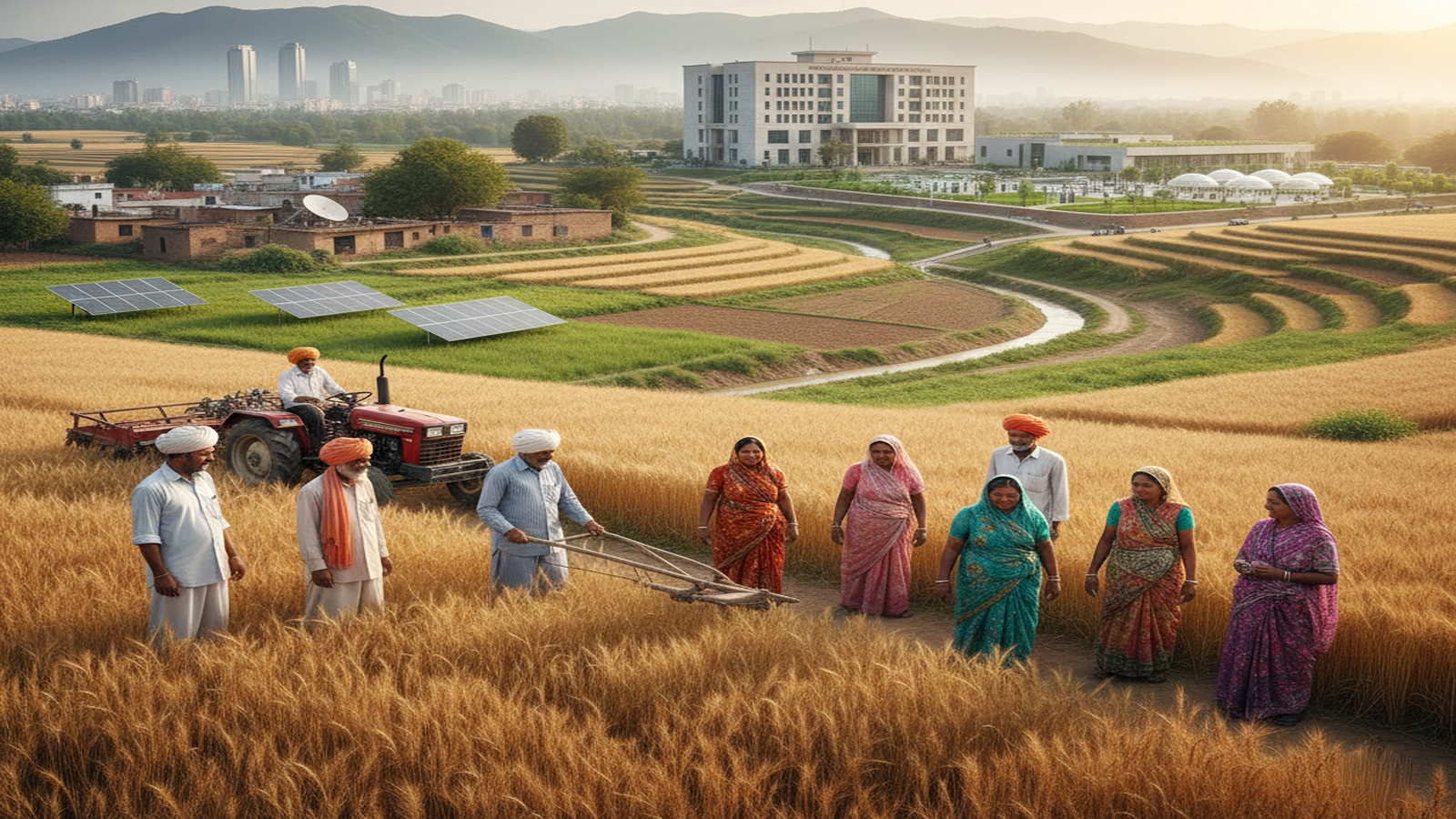
The year 2025 marked a defining phase for India’s agricultural sector, reflecting the cumulative outcomes of sustained policy focus, public investment and institutional reforms over the past decade. Agriculture and allied activities continued to remain the backbone of the rural economy, contributing nearly 16 per cent to India’s Gross Domestic Product in FY 2024-25 and providing livelihoods to more than 46 per cent of the population. During the year, the sector demonstrated resilience amid climate variability, while achieving record production levels, expanding farmer incomes and strengthening market and infrastructure ecosystems.
India recorded its highest-ever foodgrain production of 357.73 million tonnes in 2024-25, reflecting an increase of nearly eight per cent over the previous year and a historic rise of over 106 million tonnes compared to 2015–16. This growth was driven by record output of rice and wheat, along with strong performance in pulses, oilseeds, maize and millets. Rice production reached 150.184 million tonnes, while wheat output stood at 117.945 million tonnes. Pulses and oilseeds production also registered significant gains, supported by targeted missions, assured procurement and improved seed and extension support. The steady rise in “Shree Anna” (millets) production reaffirmed India’s leadership in climate-resilient cereals.
Minimum Support Price policy remained a key pillar of income assurance in 2025. MSP was fixed at a minimum of 50 per cent return over the cost of production for all mandated crops. Since 2014, procurement operations have ensured large-scale income support to farmers, with MSP payments for paddy (Rs 14.16 lakh crore) and wheat (₹6.04 lakh crore) alone exceeding ₹20 lakh crore. Pulses and oilseeds procurement expanded sharply compared to pre-2014 levels, supported by MSP assurance for tur, urad, chana and moong. The government’s continued focus on remunerative prices and timely procurement strengthened farmer confidence and production planning.
Direct income support under PM-Kisan Samman Nidhi remained a cornerstone of farmer welfare. As of August 2025, ₹3.90 lakh crore had been transferred directly to farmers through 20 instalments, benefiting more than 11 crore farmers nationwide. Institutional credit access expanded further through the Kisan Credit Card scheme, with cumulative agricultural credit exceeding ₹10 lakh crore to 7.71 crore farmers and enhanced coverage for small and marginal farmers, livestock and fisheries sectors.
Risk mitigation mechanisms continued to protect farmers against production losses. Under the Pradhan Mantri Fasal Bima Yojana (PMFBY), claims worth ₹1.83 lakh crore have been paid since 2016, with enrolment expanding significantly in 2024-25. Participation by non-loanee farmers rose steadily, reflecting improved trust in the scheme. Irrigation coverage also expanded under the Pradhan Mantri Krishi Sinchai Yojana, with accelerated completion of irrigation projects and wider adoption of micro-irrigation systems, enabling farmers to shift towards high-value crops while improving water-use efficiency.
Investment in agricultural infrastructure remained a major focus area in 2025. The Agriculture Infrastructure Fund continued to strengthen post-harvest management, storage and processing capacities, with more than one lakh projects sanctioned across the country. Custom Hiring Centres, warehouses, cold storage units and food processing facilities reduced post-harvest losses and distress sales, while generating rural employment. Parallelly, the establishment of PM Kisan Samriddhi Kendras improved access to quality inputs, advisory services and agri-solutions at the village level.
Market reforms further enhanced price discovery and transparency. The e-NAM platform expanded its footprint across mandis, enabling farmers to access wider markets and better prices. Trade volumes and values increased steadily, supported by farmer and FPO onboarding. The formation and strengthening of 10,000 Farmer Producer Organisations emerged as a major institutional reform, enabling collective marketing, input procurement and value addition, particularly benefiting women farmers and smallholders.
Allied sectors recorded strong growth, significantly contributing to income diversification. India retained its position as the world’s largest milk producer, accounting for nearly one-fourth of global output. Milk production crossed 239.30 million tonnes in 2023-24, supported by schemes such as the Revised National Programme for Dairy Development and Rashtriya Gokul Mission. Fisheries production touched 195 lakh tonnes in 2024-25, driven by rapid growth in inland fisheries and enhanced budgetary support. Horticulture production continued its upward trajectory, with substantial growth in fruits and vegetables, while food processing exports crossed USD 49.4 billion as of July 2025, reflecting rising value addition.
Sustainability and climate resilience remained integral to agricultural policy in 2025. Natural and organic farming expanded under dedicated missions, while the Soil Health Card scheme promoted balanced nutrient management through widespread soil testing and farmer training. The ethanol blending programme reached 19.05% blending levels (as of 31 July 2025), delivering substantial foreign exchange savings, reduced crude oil imports and additional income for sugarcane farmers. Renewable energy adoption under PM-KUSUM expanded solar pump coverage and promoted decentralized solar power generation on farmlands.
Capacity building and skill development emerged as one of the most transformative aspects of agricultural governance in 2025. Krishi Vigyan Kendras trained millions of farmers through hands-on demonstrations and vocational programmes. ATMA, STRY and PMKVY strengthened rural skilling ecosystems, while sector-specific initiatives under horticulture, livestock, mechanization and food processing embedded skill development across the value chain. These efforts empowered farmers, women and rural youth to adopt modern practices, establish enterprises and integrate with agri-markets.
The impact of these policies was visible in numerous field-level success stories, where convergence of income support, irrigation, training, infrastructure and market access translated into higher incomes, reduced migration and improved quality of life. Women farmers, FPOs and rural entrepreneurs played an increasingly prominent role in shaping local agricultural economies.
Conclusion
In 2025, India’s agricultural sector stands more productive, diversified and resilient than ever before. From record foodgrain production to rising farmer incomes, from infrastructure creation to skill empowerment, the year reaffirmed that effective governance in agriculture is not merely about output growth, but about securing livelihoods, building confidence and creating sustainable futures for millions of farming households across the country.