The year 2025 marked a phase of steady consolidation and expansion for India’s petroleum and natural gas sector, with the Ministry of Petroleum & Natural Gas focusing on affordable energy access, infrastructure strengthening, cleaner fuels and long-term energy security. Through targeted welfare schemes, regulatory reforms and large-scale infrastructure development, the sector continued to support India’s growing economy while aligning with national priorities of sustainability and inclusion.
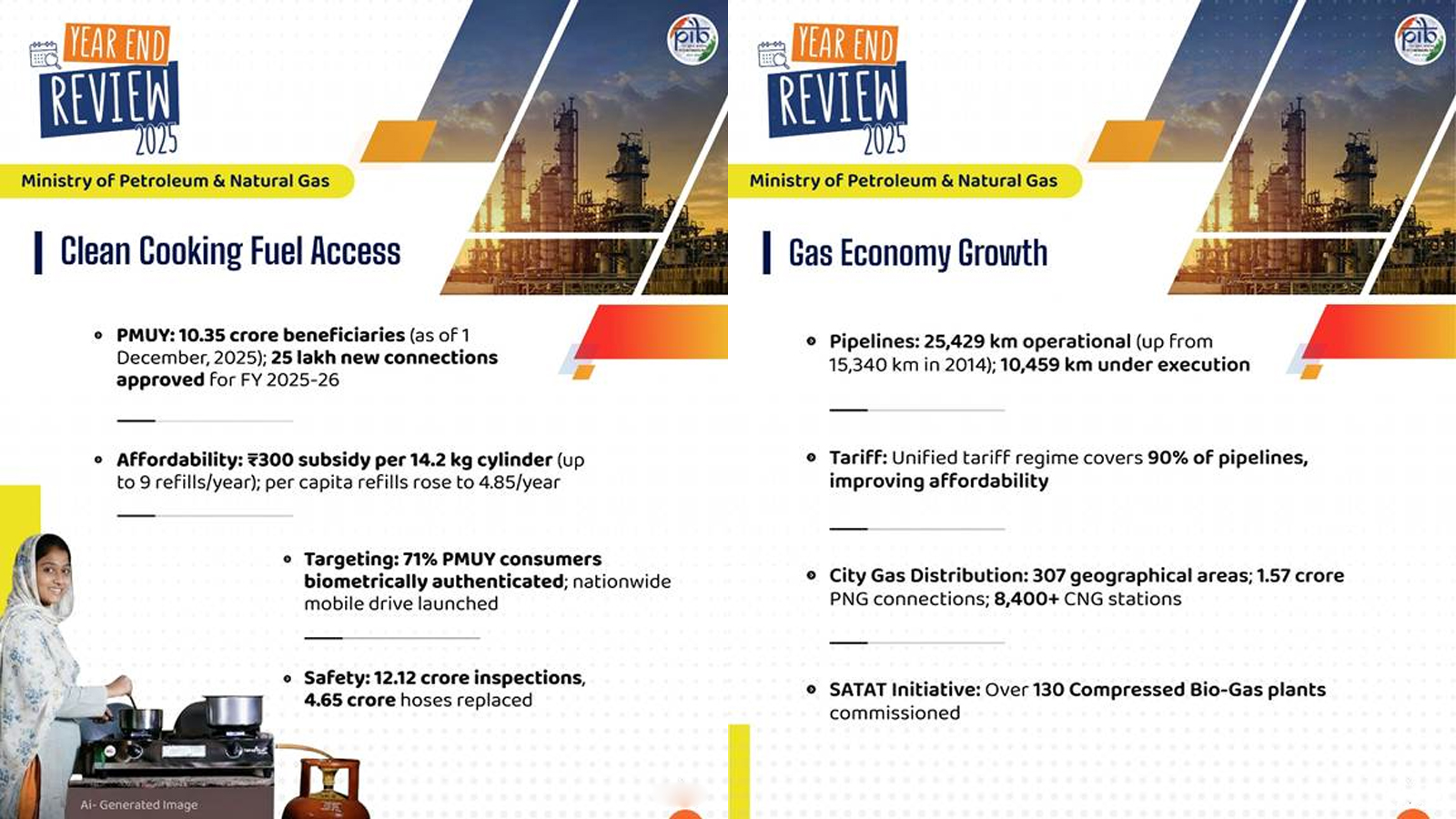
A major thrust during the year remained universal access to clean cooking fuel. Under the Pradhan Mantri Ujjwala Yojana (PMUY), the number of beneficiaries reached around 10.35 crore by December 1, 2025. To move closer to saturation, the government approved the release of an additional 25 lakh LPG connections during FY 2025–26. The process of eligibility was simplified through a single Deprivation Declaration, replacing the earlier multi-point system and making access quicker and more inclusive. Affordability was reinforced through a targeted subsidy of ₹300 per 14.2 kg cylinder for up to nine refills annually for PMUY beneficiaries. This support translated into higher and sustained LPG usage, with average per capita consumption rising steadily to a pro-rated level of about 4.85 refills per year in FY 2025–26.
Efforts to improve transparency and targeting of subsidies continued with the expansion of biometric Aadhaar authentication. By December 2025, 71 per cent of PMUY consumers and 62 per cent of non-PMUY consumers had completed biometric verification. A nationwide drive launched in November further simplified the process through mobile-based authentication, offered free of cost. Alongside access and affordability, consumer safety received renewed attention. Under the nationwide Basic Safety Check campaign, over 12.12 crore free safety inspections were conducted at consumer premises, and more than 4.65 crore LPG hoses were replaced at subsidised rates, strengthening household safety standards.
Fuel retail infrastructure also saw notable upgrades. Over 90,000 petrol pumps were enabled with digital payment facilities supported by more than 2.71 lakh POS terminals, improving convenience and transparency. Door-to-door fuel delivery expanded through the commissioning of over 3,200 bowsers, improving access in remote and underserved areas. Under the Swachh Bharat Mission, toilet facilities were ensured at nearly all retail outlets, with many providing separate amenities for men and women. The APNA GHAR initiative gained momentum, with more than 500 wayside amenities for truck drivers established across highways, contributing to road safety, better working conditions and rural employment.
Electric mobility infrastructure expanded rapidly during the year. Under the FAME-II scheme, 8,932 EV charging stations were installed at fuel retail outlets, while oil marketing companies added over 18,500 more using their own resources. Public sector oil companies also progressed with the development of integrated Energy Stations. As part of the plan to set up 4,000 such stations between 2024–25 and 2028–29, 1,064 Energy Stations had been commissioned by November 2025, offering petrol, diesel, alternative fuels such as CNG and biofuels, and EV charging facilities at a single location.
Significant progress was made in expanding the gas-based economy. India’s operational natural gas pipeline network grew from 15,340 km in 2014 to 25,429 km by June 2025, with another 10,459 km under construction. Completion of these projects is expected to fully connect the national gas grid, improving regional access and supporting balanced development. To address regional cost disparities, the Unified Pipeline Tariff regime under the “One Nation, One Grid, One Tariff” mission continued to be implemented, covering nearly 90 per cent of operational pipelines and replacing the earlier distance-based tariff system.
City Gas Distribution expanded further, covering 307 geographical areas by September 2025. Domestic PNG connections increased to around 1.57 crore, while the number of CNG stations crossed 8,400. Revised domestic gas allocation guidelines improved alignment with actual consumption and reduced exposure to price volatility for consumers. The SATAT initiative also advanced, with over 130 compressed biogas plants commissioned by November 2025. Mandatory blending obligations for CBG in CNG and PNG came into effect from FY 2025–26, supported by financial assistance for pipeline connectivity and biomass aggregation.
Biofuels remained a key pillar of the clean energy transition. Ethanol blending in petrol reached an average of 19.24 per cent in the Ethanol Supply Year 2024–25, contributing to cumulative foreign exchange savings of over ₹1.55 lakh crore and significant reductions in carbon emissions. The Pradhan Mantri JI-VAN Yojana supported the promotion of advanced biofuels, with second-generation ethanol plants at Panipat and Numaligarh becoming operational milestones. Biodiesel blending also expanded during the year through higher procurement volumes and diversified feedstocks.
New initiatives in Sustainable Aviation Fuel (SAF) took shape in 2025. The government announced indicative blending targets of 1 per cent, 2 per cent and 5 per cent SAF for international flights from 2027, 2028 and 2030, respectively. In line with this roadmap, Indian Oil Corporation Limited became the first Indian company to receive ISCC CORSIA certification for SAF production at its Panipat refinery, followed by an MoU with Air India for supply of SAF.
The upstream sector underwent important structural reforms with the enactment of the Oilfields (Regulation and Development) Amendment Act, 2025 and the notification of the Petroleum and Natural Gas Rules, 2025. Under the Hydrocarbon Exploration Licensing Policy, 172 blocks covering more than 3.78 lakh square kilometres were awarded, attracting committed investments of around USD 4.36 billion. Exploration activity intensified through seismic surveys, drilling programmes and government-supported initiatives such as Mission Anveshan. Strategic petroleum reserves were strengthened through progress under Phase-II facilities and renewed international partnerships, while overseas investments by Indian oil and gas PSUs continued to diversify supply sources.
Overall, 2025 saw the petroleum and natural gas sector advance on multiple fronts—expanding clean cooking access, modernising fuel retail infrastructure, strengthening the gas grid, accelerating biofuels and electric mobility, and reforming upstream exploration. These efforts collectively reinforced energy access, affordability, sustainability and security, supporting India’s transition towards a resilient and inclusive energy system.