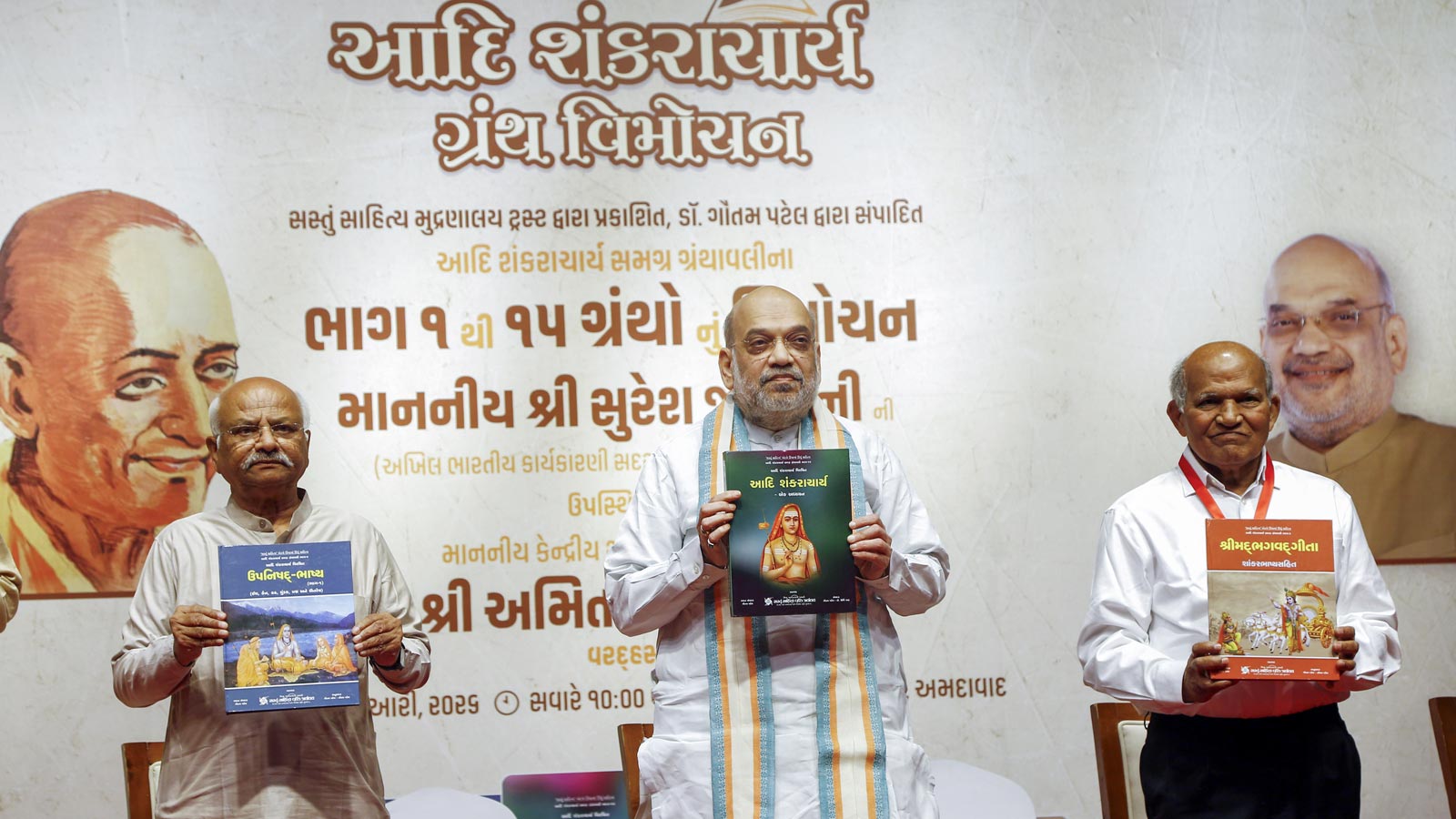
Union Home Minister Amit Shah on Thursday released the Gujarati edition of the collected works (Granthavali) of Adi Shankaracharya, published by the Sastu Sahitya Mudranalaya Trust, at an event held in Ahmedabad, Gujarat. Several scholars and dignitaries were present at the event.
Addressing the gathering, Shah said the availability of Adi Shankaracharya’s Gyan Sagar, originally composed in Sanskrit, in Gujarati is a moment of pride for the state. He described the 24-volume Gujarati publication as a “precious intellectual treasure” for the youth of Gujarat, noting that such efforts would be remembered whenever discussions on meaningful and accessible literature take place.
The Home Minister highlighted the contribution of Swami Akhandanand Ji, founder of the Sastu Sahitya Mudranalaya Trust, recalling that people themselves had come to refer to him as “Bhikshu Akhandanand” because of his ascetic life and dedication. Shah said Akhandanand Ji had devoted his life to making high-quality literature on Ayurveda, Sanatan Dharma and moral philosophy available to common people at affordable prices. During his lifetime, the institution published numerous seminal texts, including the Bhagavad Gita, Mahabharata, Ramayana, Yoga Vasistha and works on ethics and values.
Shah said the trust played a significant role in shaping Gujarat’s collective character by presenting the essence of Sanatan Dharma in simple Gujarati, drawing from the teachings of sages and seers. He noted that the publication of works such as Kautilya’s Arthashastra and inspirational narratives had helped awaken ethical and spiritual awareness among young readers.
Referring to Adi Shankaracharya’s philosophical legacy, the Home Minister said his interpretations of the Upanishads were simple, precise and closest to the truth. He observed that at a time when doubts and distortions had arisen around Sanatan Dharma, Shankaracharya addressed them through reasoned arguments, hymns and debates, providing clarity and intellectual confidence to society.
Shah urged young readers to study Vivekachudamani at least once, now that Gujarati translations and interpretations are available. He described Adi Shankaracharya as a “walking university” who travelled extensively across the country, integrating ideas, institutions and traditions, and strengthening India’s cultural unity.
Highlighting Shankaracharya’s institutional contributions, Shah said he established four Mutts in the four directions of the country and ensured the preservation and propagation of the Vedas and Upanishads by assigning them to these centres. He also credited Shankaracharya with reviving the tradition of Shastrarth (scriptural debate), laying the foundation for resolving differences through dialogue, and presenting an integrated vision where Moksha is attainable through Bhakti, Karma and Gyan.
Concluding his remarks, Shah said that by making such classical works accessible in regional languages, institutions like the Sastu Sahitya Mudranalaya Trust are ensuring that Sanatan Dharma remains vibrant, relevant and rooted in the lives of common people, especially the younger generation.