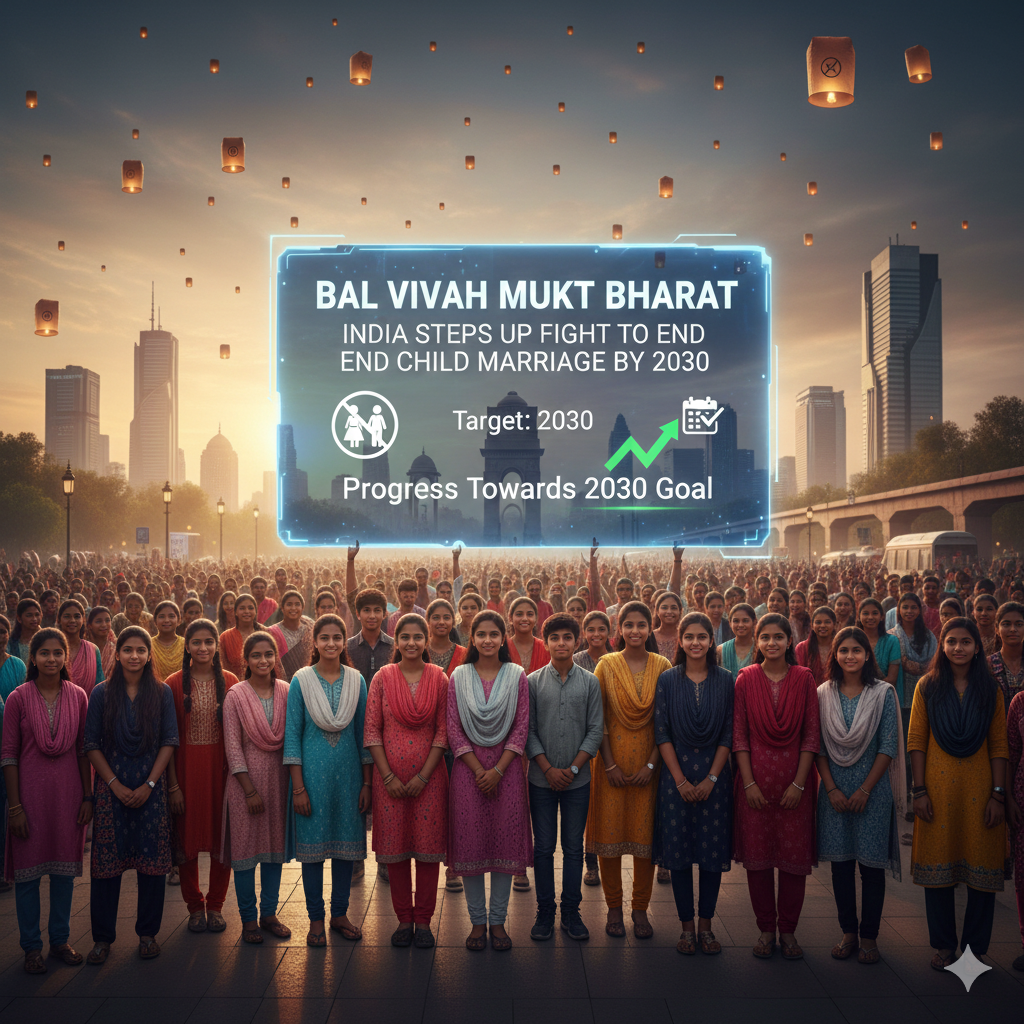
India has steadily strengthened its legal, social and administrative response to child marriage, combining decades of reform with a renewed national mission to eliminate the practice by 2030. While child marriage is prohibited by law, the government recognises that deep-rooted social practices require sustained awareness, enforcement and community participation. According to the National Family Health Survey-5 (2019–21), 23 per cent of women aged 20–24 were married before the age of 18, a figure that reflects the scale of the challenge but also underscores the urgency behind India’s current push to decisively end the practice. Incidents have historically been concentrated in certain states, including West Bengal, Uttar Pradesh and Bihar, though cases have been reported across rural, tribal and urban regions, prompting a nationwide response.
How Indian law defines and addresses child marriage
The Prohibition of Child Marriage Act (PCMA), 2006 clearly defines child marriage as any marriage where the girl is below 18 years of age or the boy is below 21 years. Indian law treats such marriages as serious violations of child rights rather than mere social transgressions. The Bharatiya Nyaya Sanhita, 2023 reinforces this position by classifying any sexual act by a man with his wife below 18 years as rape. The Supreme Court of India has further clarified that when a husband commits penetrative sexual assault on a child bride, the offence constitutes aggravated penetrative sexual assault under the Protection of Children from Sexual Offences (POCSO) Act, 2012, attracting enhanced punishment. Together, these provisions establish a strong legal deterrent and prioritise the protection of children.
A long reform journey rooted in India’s social awakening
India’s resolve to end child marriage dates back to the 19th century, when social reformers such as Raja Rammohan Roy, Ishwar Chandra Vidyasagar and Mahatma Jyotirao Phule mobilised society against regressive practices. Their efforts led to the Age of Consent Act, 1891, and later the Child Marriage Restraint Act (Sarda Act), 1929, which set minimum marriage ages at 14 for girls and 18 for boys. After Independence, Parliament strengthened the law through amendments in 1948 and 1978, ultimately raising the minimum age to 18 for girls and 21 for boys. This reform trajectory culminated in the Prohibition of Child Marriage Act, 2006, marking a decisive shift from restraint to prohibition.
What the Prohibition of Child Marriage Act, 2006 provides
The PCMA, 2006 empowers children and authorities alike. It allows a child marriage to be declared voidable at the option of the minor, who can approach a district court within two years of attaining majority. In cases involving force, trafficking, deception or immoral purposes, the law treats such marriages as void ab initio. The Act prescribes penalties of up to two years of rigorous imprisonment and fines up to Rs 1 lakh for adult men marrying children and for anyone who performs, promotes, abets or facilitates such marriages, including parents and guardians. States appoint Child Marriage Prohibition Officers (CMPOs) to prevent violations, collect evidence, raise awareness and support victims, while magistrates can issue injunctions to stop impending marriages, with violations rendering the marriage void.
Launch of Bal Vivah Mukt Bharat: A national mission
Building on this strong legal foundation, the Ministry of Women and Child Development launched the Bal Vivah Mukt Bharat (BVMB) campaign on November 27, 2024. Also known as Child Marriage-Free India, the mission aims to reduce child marriage prevalence by 10 per cent by 2026 and eliminate it entirely by 2030. The initiative aligns with Sustainable Development Goal 5.3 and draws strength from Article 21 of the Constitution and the PCMA, 2006. The campaign adopts an integrated, technology-driven and prevention-focused strategy, with particular attention to high-burden and marginalised communities.
Supreme Court’s 2024 judgment strengthens prevention
In a landmark ruling delivered on October 18, 2024, in Society for Enlightenment and Voluntary Action vs Union of India, the Supreme Court issued comprehensive directions to strengthen prevention nationwide. The court prohibited child betrothals, recognising that they undermine personal autonomy and often culminate in forced marriages. It directed states and Union Territories to appoint full-time, dedicated Child Marriage Prohibition Officers at district and sub-district levels and to establish Special Child Marriage Prohibition Units for coordination and monitoring. The judgment emphasised proactive prevention through mandatory awareness campaigns involving schools, Anganwadis, NGOs and religious leaders, along with training for police, judiciary, teachers and health workers, technology-enabled reporting systems and the creation of databases to identify high-risk areas. The ruling firmly repositioned India’s approach towards prevention, protection and empowerment.
The 100-day national drive and performance recognition
To translate policy into action, the government launched a high-intensity 100-day nationwide campaign on December 4, 2025, with each month dedicated to focused outreach activities. The initiative introduced performance-based recognition to encourage community participation. Villages and panchayats maintaining zero child marriage cases over a sustained period receive Child Marriage-Free Village Certificates. The top 10 performing districts, assessed on reporting efficiency, prevention outcomes and reduction in cases, earn the Bal Vivah Mukt Bharat Yodha Award and national recognition. The campaign began with a national launch at Vigyan Bhawan, New Delhi, accompanied by a synchronised pledge-taking ceremony across the country.
States, districts and the BVMB portal
States play a central role in execution. Chief Secretaries have constituted district-level task forces involving CMPOs, NGOs and Panchayati Raj Institutions, with weekly monitoring and geo-tagged reporting through the BVMB portal. The portal serves as a central public platform listing CMPOs nationwide, enabling real-time reporting, tracking awareness campaigns and monitoring enforcement actions. The Ministry of Women and Child Development has committed full financial support, prioritising 257 high-burden districts identified using NFHS-5 data.
Enforcement gains and global cooperation
Since its launch, the BVMB mission has delivered measurable gains. CMPOs have conducted door-to-door awareness drives, coordinated rapid-response interventions with Child Helpline 1098 and intensified vigilance during culturally sensitive periods such as Akshaya Tritiya. A special 2025 directive led to heightened monitoring, preventing hundreds of child marriages through injunctions, counselling and FIRs. Integrated with Beti Bachao Beti Padhao, these efforts have improved enforcement outcomes and created “no child marriage” zones in multiple villages. International organisations, including UNICEF, have supported the initiative through technical assistance and capacity building, aligning India’s efforts with the UN Convention on the Rights of the Child and SDG 5.3.
Chhattisgarh shows the way
Chhattisgarh has emerged as a national example of successful implementation. Balod district became India’s first child marriage-free district in 2025, recording zero cases for two consecutive years across 436 gram panchayats and nine urban local bodies. Building on this success, the state aims to eliminate child marriage entirely by 2028–29. In Surajpur district, the administration declared 75 village panchayats child marriage-free on September 17, 2025, coinciding with Poshan Maah, after recording zero cases for two consecutive years. These achievements now serve as replicable models for other states.
The path forward
India’s determined campaign against child marriage reflects a continuum of reform — from 19th-century social movements to modern legal frameworks, judicial intervention and mission-mode governance. The Bal Vivah Mukt Bharat campaign marks the most comprehensive national effort so far, combining law, technology, community mobilisation and sustained awareness. As citizens, institutions and governments work together, the mission aligns with India’s broader vision of Viksit Bharat, ensuring that every child grows up with access to education, health, dignity and opportunity.