People across the world observe World Braille Day on January 4 to commemorate the birth anniversary of Louis Braille, the inventor of the Braille script. Born in Coupvray near Paris, France, Louis Braille lost his eyesight at the age of three after accidentally injuring his eye with a sharp tool in his father’s workshop. Despite receiving the best medical care available at the time, the infection spread to his other eye, leaving him completely blind for life.
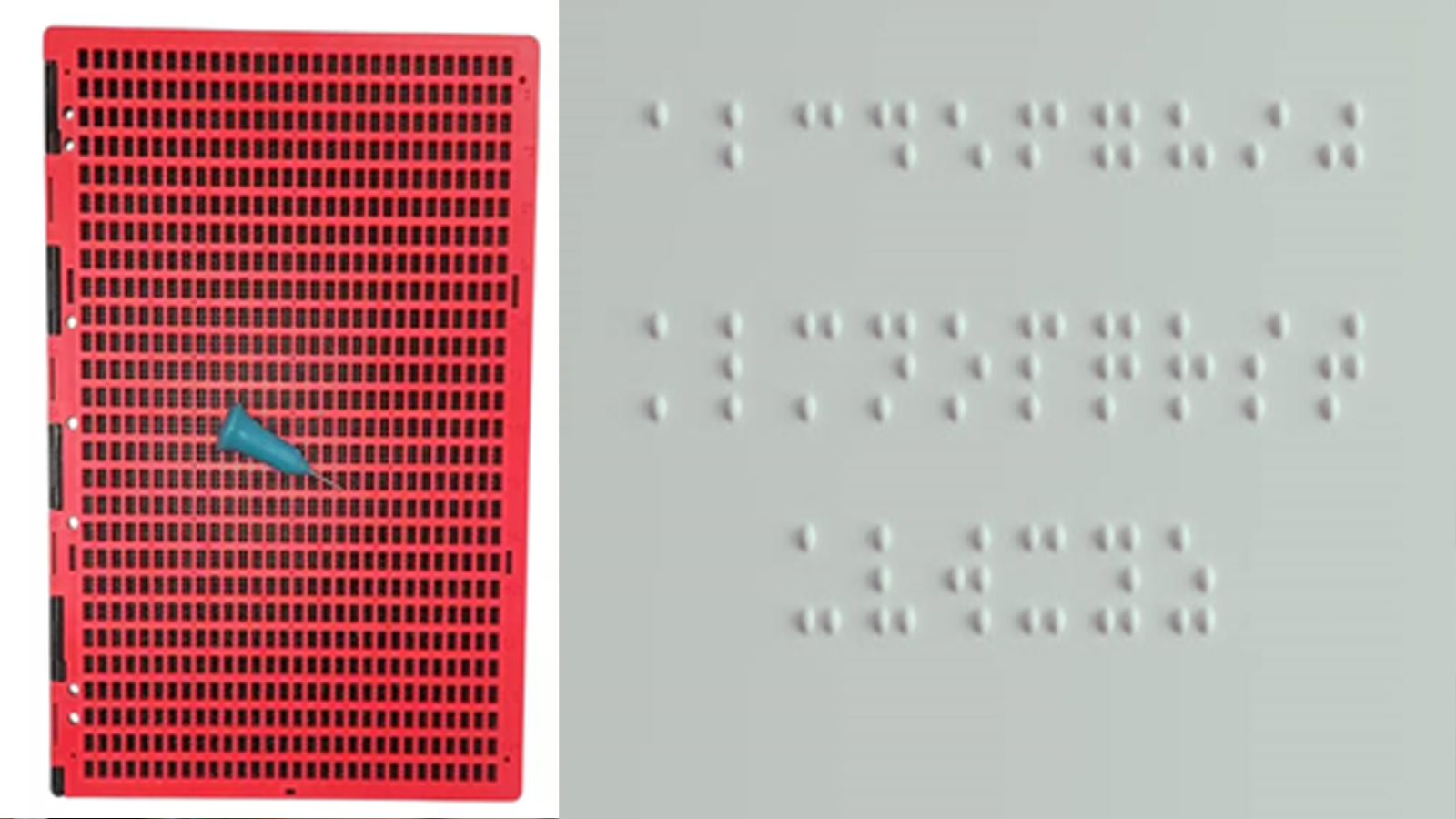
Undeterred by this tragedy, Braille went on to develop a system of reading and writing for persons with visual impairment. Braille is a tactile script in which letters are represented by combinations of raised dots. Each Braille cell consists of six dots arranged in a rectangle – three dots high and two dots wide. These six dots can form 63 distinct characters, with each dot assigned a specific number from one to six.
Braille is largely phonetic, making it adaptable across languages. Letters that sound the same in different languages share the same Braille representation. For example, the Hindi letter “ब” corresponds to the same dot pattern as “b” in English, and “न” corresponds to “n”. Beyond literary use, Braille also supports scientific and mathematical notation, music, and computer coding, making it a comprehensive medium of expression.
Traditionally, slate and stylus are used for writing Braille. While writing, visually impaired persons emboss dots from right to left, so that when the paper is turned over, the text can be read correctly from left to right. Reading is done by gently moving the fingertips across the raised dots. In modern times, technological advancements such as screen-reading software, refreshable Braille displays, and electronic note-takers have further expanded access to Braille.
The invention of Braille opened the doors to education, literacy, and empowerment for persons with visual impairment. It not only provided access to knowledge but also fostered self-confidence, dignity, and social and economic independence. Braille has transformed millions of lives worldwide and remains indispensable for meaningful education and inclusion of the blind. It plays a crucial role in enhancing employability and promoting social integration.
Globally, an estimated 285 million people live with visual impairment, including 39 million who are blind and 246 million with low vision. India alone accounts for nearly 15 million blind individuals, making up about one-third of the world’s blind population. The availability of Braille has enabled millions of visually impaired children to enroll in special and inclusive schools, helping them become active participants in mainstream society.
Under the Right to Education (Amendment) Act, 2012, every child between the ages of six and fourteen – including children with special needs (CwSN) – has the right to free and compulsory education. Today, more than 17,000 children with special needs, including those with visual impairment, are enrolled in Delhi Government regular schools alone. Textbooks are provided free of cost in Braille, and several magazines and journals are regularly published in Braille for the benefit of blind readers.
The growing importance of Braille is also evident beyond education. The Constitution of India is now available in Braille, marking a significant step toward inclusive governance. Religious texts such as the Bhagavad Gita and Ramcharitmanas have also been published in Braille, enabling spiritual access for visually impaired individuals.
In the public sector, Indian Railways has introduced several accessibility measures, including Braille signage, navigation maps, seat numbers, and coach layouts, ensuring safer and more convenient travel for visually impaired passengers.
Today, visually impaired individuals are actively contributing across professions – as teachers, professors, bankers, administrators, musicians, and civil servants – both in government and the private sector. The Braille Script has made the world more inclusive and humane.