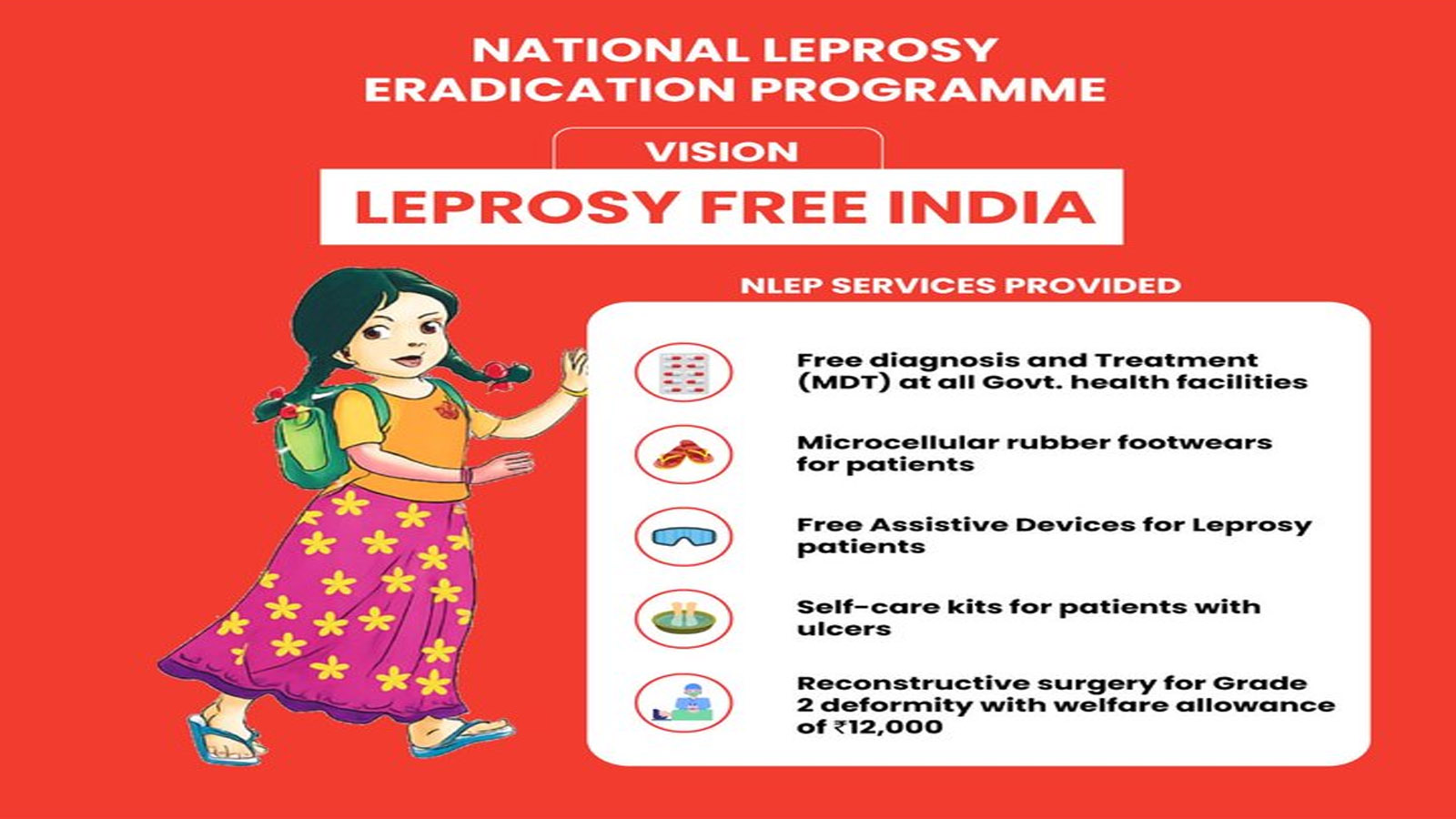
Free diagnosis and multi-drug treatment at public health facilities across the country are ensuring that India continues its progress towards becoming leprosy-free, the government said on Friday.
India observes National Leprosy Day annually on January 30, coinciding with the death anniversary of Mahatma Gandhi, in recognition of his lifelong service to people affected by the disease.
Highlighting ongoing efforts under the National Leprosy Eradication Programme (NLEP), the Ministry of Health and Family Welfare said that the government remains committed to eliminating the disease and associated stigma.
“Under the NLEP, India continues its efforts towards a Leprosy-Free India by ensuring free diagnosis, treatment, and care services at government health facilities nationwide. Let us work together to eliminate stigma and ensure dignity and care for all,” the Ministry said in a post on X.
Leprosy, also known as Hansen’s disease, is a chronic infectious disease caused by the bacterium Mycobacterium leprae. It primarily affects the skin, peripheral nerves, mucosa of the upper respiratory tract, and the eyes.
Beyond physical complications, people affected by leprosy often face stigma and discrimination. However, the disease is fully curable, and early diagnosis and treatment can prevent disability and long-term complications.
India achieved the elimination of leprosy as a public health problem at the national level in December 2005, defined as a prevalence rate of fewer than one case per 10,000 population.
As of March 2025, a total of 31 States and Union Territories and 638 districts have achieved this milestone, with the national prevalence rate declining to 0.57 per 10,000 population.
The NLEP has now set an ambitious target of “Zero Transmission, Zero Leprosy” by 2027, focusing on early case detection, free multidrug therapy (MDT), and sustained efforts to reduce stigma.
Under the programme, the government provides a range of free services, including diagnosis and MDT at all government health facilities, microcellular rubber footwear for patients, assistive devices, self-care kits for ulcer management, and reconstructive surgery for patients with Grade-2 deformities, along with a welfare allowance of ₹12,000.
All NLEP services are provided free of cost at public health facilities nationwide.
Health officials noted that if left untreated, leprosy can lead to progressive and permanent disabilities. The disease is transmitted through droplets from the nose and mouth during close and prolonged contact with untreated individuals.
Leprosy is classified as a neglected tropical disease (NTD) and remains endemic in over 120 countries, with approximately 2,00,000 new cases reported globally each year.
(With IANS inputs)