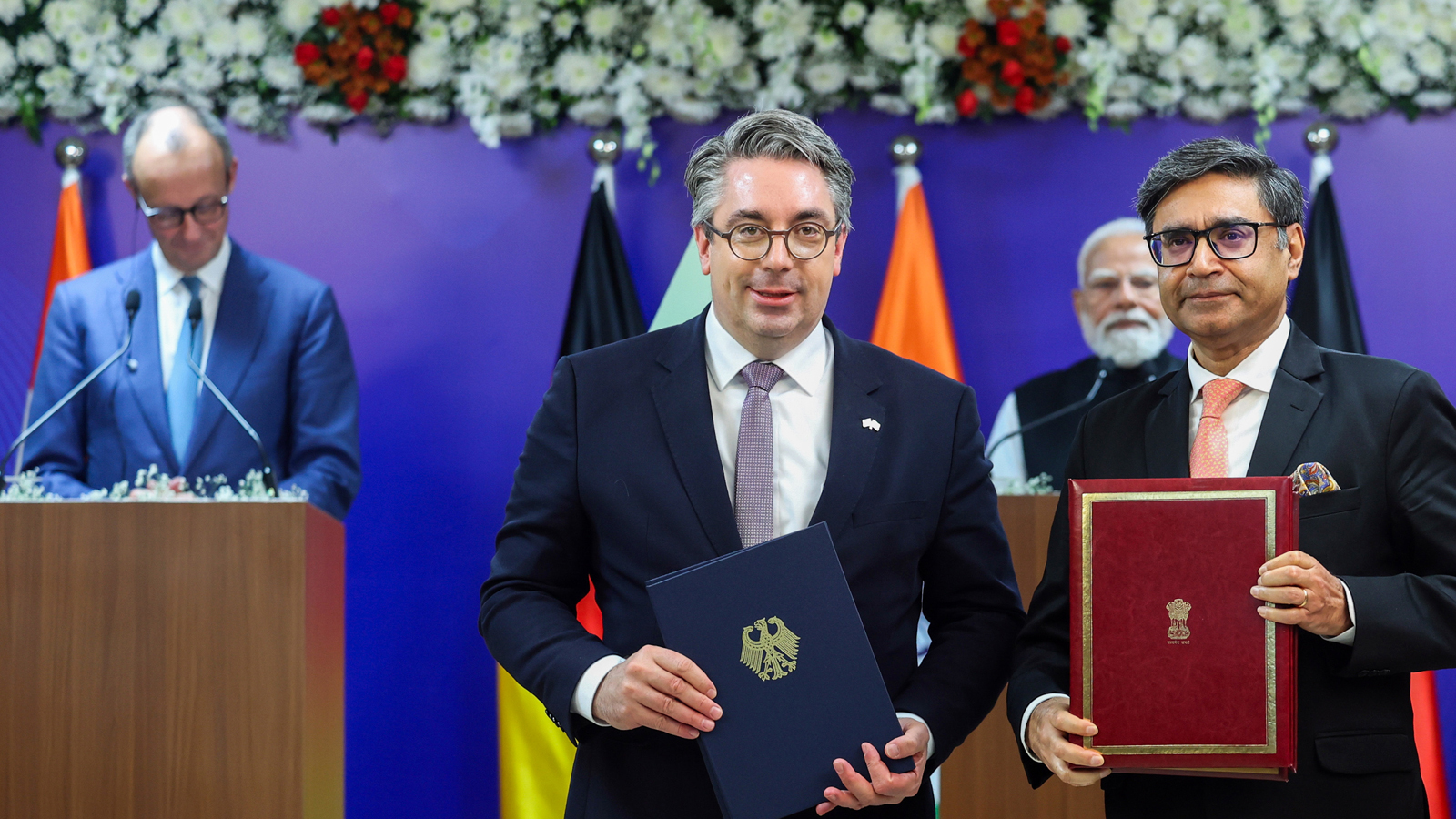
Prime Minister Narendra Modi and German Chancellor Friedrich Merz reaffirmed their commitment to significantly deepen bilateral ties across defence, economy, technology, climate action and people-to-people exchanges during Merz’s official visit to India, according to a joint statement issued on Monday.
Chancellor Merz, who was accompanied by a high-level delegation including 23 leading German CEOs and industry leaders, made his first official visit to India and his first trip to Asia since assuming office, underlining the priority Germany places on India as a key strategic partner in the Indo-Pacific. The visit came at a landmark moment in bilateral relations, with India and Germany having completed 25 years of Strategic Partnership in 2025 and marking 75 years of diplomatic relations in 2026.
PM Modi welcomed the German Chancellor in Ahmedabad, where the two leaders paid floral tributes to Mahatma Gandhi at the Sabarmati Ashram and participated in the International Kite Festival, highlighting the cultural dimension of the visit. They also jointly addressed the India-Germany CEOs Forum, engaging with business leaders to encourage greater investment and industrial collaboration. Chancellor Merz is scheduled to visit Bengaluru, with engagements focused on technology and innovation.
During restricted and delegation-level talks held on January 12, the two leaders reaffirmed shared democratic values, commitment to a rules-based international order and mutual respect as the foundation of the Strategic Partnership. They reviewed progress in bilateral relations and exchanged views on regional and global developments.
Defence and security cooperation
The leaders agreed to further strengthen defence and security cooperation, welcoming progress made through institutionalised staff talks, service-level exchanges and joint exercises. They endorsed deeper military-to-military cooperation, including training, port calls and senior-level exchanges, and welcomed the establishment of a new Track 1.5 Foreign Policy and Security Dialogue.
India welcomed Germany’s participation in major defence engagements, including Naval Exercise MILAN, the Indian Ocean Naval Symposium Conclave of Chiefs in February 2026, Air Combat Exercise TARANG SHAKTI later this year, and Germany’s decision to deploy a Liaison Officer to the Information Fusion Centre–Indian Ocean Region.
Both sides also welcomed the signing of a Joint Declaration of Intent to develop a Defence Industrial Cooperation Roadmap, aimed at promoting long-term collaboration through co-development, co-production and technology partnerships. The leaders reiterated their strong condemnation of terrorism in all its forms, including cross-border terrorism, and pledged to enhance cooperation in counter-terrorism, including through UN mechanisms.
Trade, economy and technology
Highlighting strong economic ties, the leaders noted that bilateral trade in goods and services surpassed USD 50 billion in 2024, accounting for over a quarter of India’s trade with the European Union. They reaffirmed support for concluding the India-EU Free Trade Agreement, describing it as a key outcome of the upcoming EU-India Summit and a catalyst for unlocking further economic potential.
Several agreements and declarations were signed to boost cooperation in semiconductors, critical minerals, telecommunications, digitalisation, artificial intelligence and innovation. The leaders welcomed plans to establish institutional dialogue across the semiconductor value chain and deepen collaboration in research and development.
Green and sustainable development
Both leaders reviewed progress under the Green and Sustainable Development Partnership (GSDP), noting that nearly €5 billion of Germany’s €10 billion commitment up to 2030 has already been utilised or earmarked for projects in renewable energy, green mobility, climate-resilient infrastructure and sustainable urban development. They welcomed new funding commitments and the launch of joint working groups on battery storage, solar manufacturing and wind energy.
The leaders also emphasised cooperation on green hydrogen, including alignment between India’s National Green Hydrogen Mission and Germany’s National Hydrogen Strategy, and welcomed a major green ammonia offtake agreement between Indian and German companies.
Global and regional issues
On global issues, India and Germany reiterated support for a free and open Indo-Pacific, respect for international law including UNCLOS, and announced a new bilateral Indo-Pacific consultation mechanism. They reaffirmed backing for the India-Middle East-Europe Economic Corridor and called for comprehensive reform of the UN Security Council.
The two leaders expressed concern over ongoing conflicts in Ukraine and Gaza, underscoring the need for dialogue, humanitarian access and peaceful resolution in line with international law. They also stressed the urgency of accelerated global climate action and enhanced climate finance to support developing countries.
Education, mobility and culture
People-to-people ties featured prominently, with both sides welcoming growing exchanges of students, researchers and skilled professionals. PM Modi thanked Chancellor Merz for Germany’s decision to allow visa-free transit for Indian passport holders, describing it as a boost to travel and exchanges.
The leaders also welcomed new agreements on higher education, skilling, renewable energy training, sports cooperation, maritime heritage and youth exchanges, further strengthening cultural and social links.
Chancellor Merz thanked PM Modi for the warm hospitality extended during the visit. Both leaders agreed that the next India-Germany Inter-Governmental Consultations will be held in Germany later in 2026, reaffirming their shared commitment to elevating the Strategic Partnership to new heights.