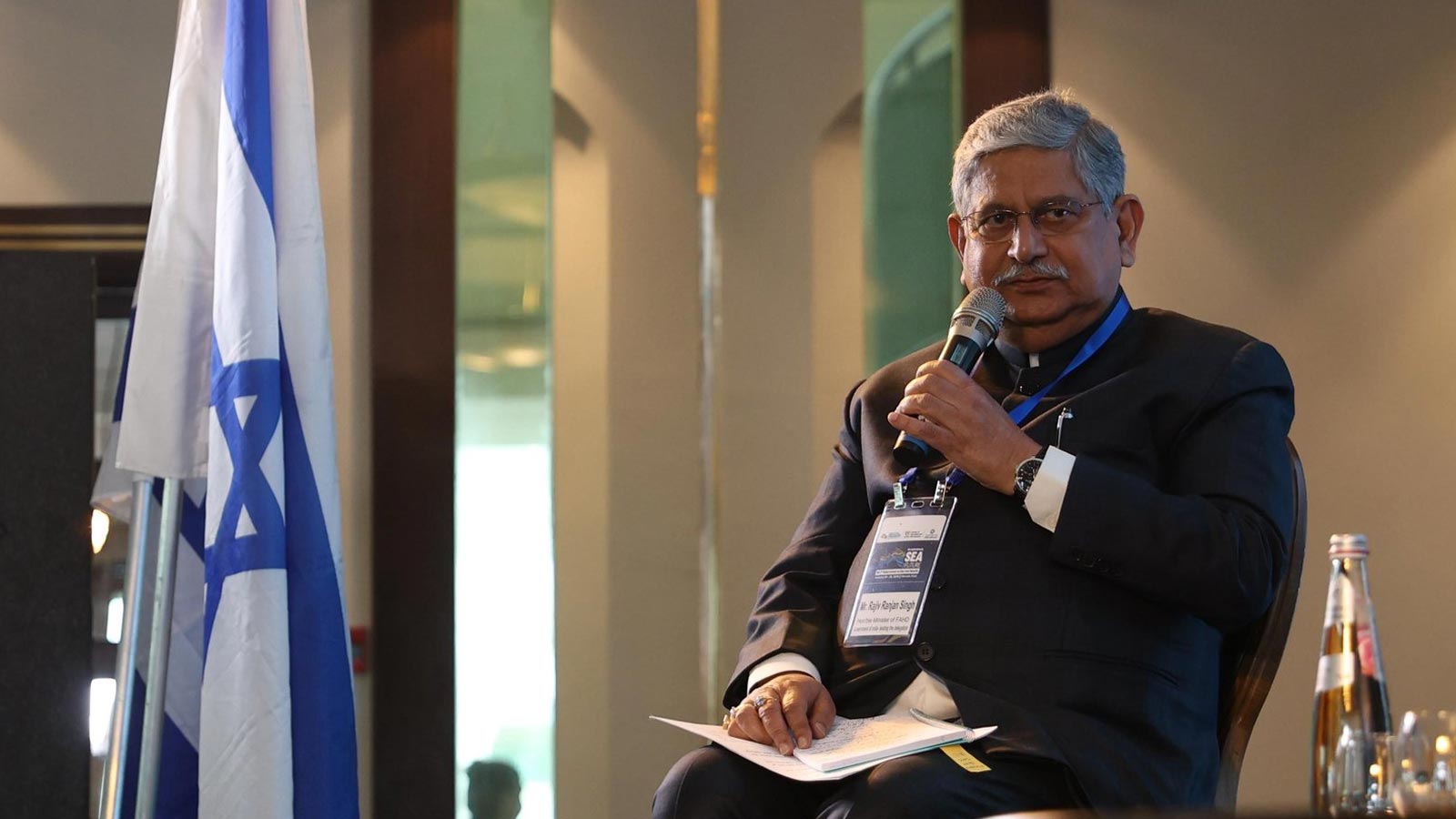
India and Israel on Wednesday signed a Joint Ministerial Declaration of Intent to strengthen bilateral collaboration in the fisheries and aquaculture sectors, marking a significant expansion of cooperation between the two strategic partners.
The declaration was signed during a high-level visit by an Indian delegation led by Union Minister for Fisheries, Animal Husbandry and Dairying and Panchayati Raj Rajiv Ranjan Singh, who was in Israel from January 13 to 15 to participate in the second global summit on “Blue Food Security: Sea the Future 2026” held in Eilat.
Acknowledging the long-standing partnership between India and Israel, the declaration reflects a shared vision for sustainable development and recognises the critical role of fisheries and aquaculture in ensuring food security, livelihoods and economic growth. It also draws on Israel’s advanced technologies in aquaculture, fisheries and water management, alongside India’s vast and diverse aquatic resources.
Under the agreement, both sides will collaborate on joint research and development in advanced aquaculture technologies, including recirculating aquaculture systems (RAS), biofloc, cage culture, aquaponics and aquarium systems such as oceanariums. Cooperation will also cover breeding of high-yield species, pathogen-free seed improvement strategies, broodstock development, genetic improvement programmes, mariculture and seaweed cultivation, as well as efficient water management using Israeli water-saving technologies.
The Ministry of Fisheries, Animal Husbandry & Dairying said that the declaration places strong emphasis on promoting start-ups and innovation in fisheries and aquaculture, with the broader objective of advancing the Blue Economy. It also underlines sustainable and responsible fishing practices aimed at conserving marine resources, reducing environmental impact and ensuring long-term resilience of fisheries.
To support evidence-based management, the two countries will work together on technology-driven fisheries monitoring and data collection systems to improve transparency and traceability, while addressing the socio-economic needs of fishing communities. Capacity building will be a key focus area, including initiatives in deep-sea fishing, vessel design, coastal aquaculture, marine resource conservation, modern fish processing, marketing and infrastructure development such as fishing harbours and fish landing centres.
The declaration also seeks to strengthen bilateral trade through dialogue to facilitate exports and imports, address tariff and non-tariff barriers, and promote technology-enabled traceability systems in the sector. In addition, both sides will explore the establishment of new Indo-Israel Centres of Excellence for Fisheries and Aquaculture, modelled on the existing network of 43 agricultural Centres of Excellence operating under Indo-Israel cooperation.
The Ministry said the agreement is expected to open new avenues for innovation, sustainability and economic growth in the fisheries and aquaculture sectors of both countries, reinforcing their shared commitment to food security and climate-resilient development.