India on Friday once again rejected Pakistan’s allegations regarding the treatment of minorities, asserting that Islamabad should first address its own record before commenting on others.
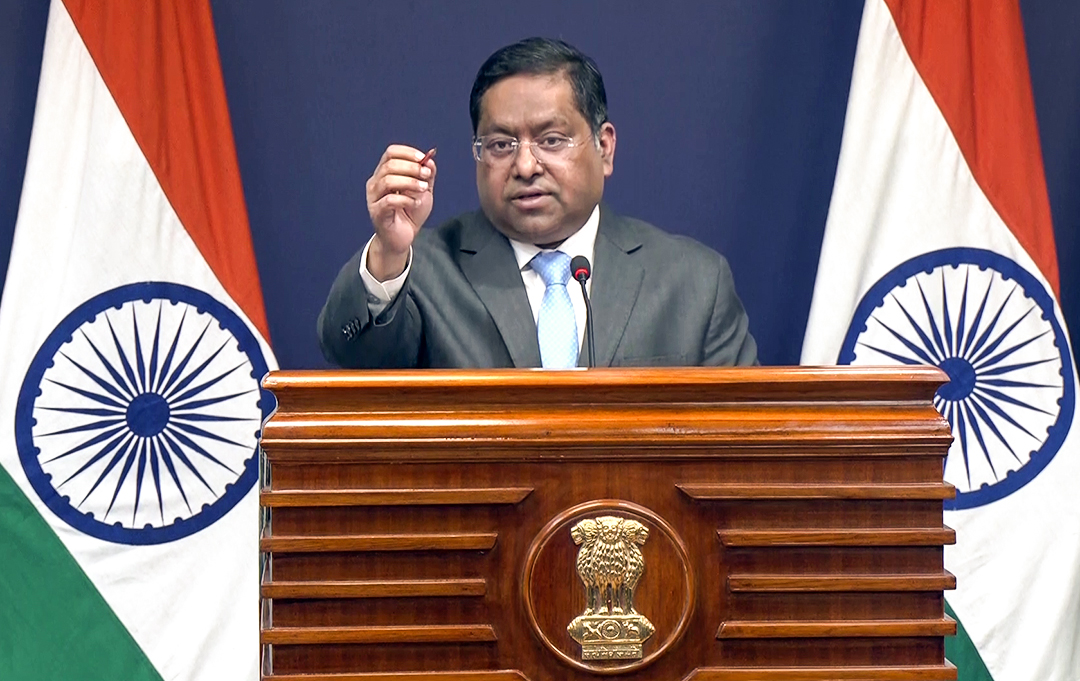
Responding to remarks by Pakistan’s Foreign Office, Ministry of External Affairs spokesperson Randhir Jaiswal said Pakistan has no standing to comment on minority issues given its domestic situation.
“I need not elaborate on the situation of minorities in that country. Those who make such comments should first look at their own record before commenting on others,” Jaiswal said during the weekly media briefing.
The remarks came in response to comments by Pakistan Foreign Office spokesperson Tahir Andrabi, who had criticised a demolition drive near the Faiz-e-Elahi Mosque in Delhi’s Turkman Gate area. Officials of the Municipal Corporation of Delhi said the drive was conducted to remove illegal encroachments, in compliance with directions of the Delhi High Court.
Last month, India had similarly rejected Pakistan’s remarks on alleged violence against minorities, describing Islamabad’s own record as “abysmal”. The MEA had said Pakistan’s systemic persecution of religious minorities is a well-established fact and cannot be obscured by external accusations.
In November, India had also dismissed Pakistan’s statements on flag hoisting at the Ram Janmabhoomi Temple in Ayodhya. At that time, Jaiswal had said Pakistan, given its “deeply stained record of bigotry, repression and systemic mistreatment of minorities”, has no moral authority to lecture others and should instead focus on its own human rights situation.
Separately, reports by the New Delhi-based International Centre for Peace Studies have highlighted persistent persecution of minorities in Pakistan, including the politicisation of religion and the framing of certain communities as outsiders.
Citing data from the Lahore-based Centre for Social Justice, the report noted that 344 blasphemy cases were documented in 2024, and that between 2021 and 2024 at least 421 minority women and girls — most of them Hindus and Christians — were subjected to forced conversions, with a majority being minors.
— IANS