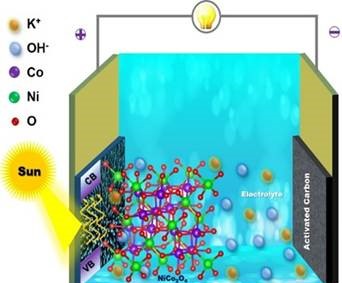
Indian scientists have developed an innovative sunlight-powered energy storage device that can both capture and store solar energy in a single unit, marking a major step towards clean, self-sustaining power solutions for portable, wearable and off-grid applications.
The device, known as a photo-capacitor, has been developed by researchers at the Centre for Nano and Soft Matter Sciences (CeNS), Bengaluru, an autonomous institute under the Department of Science and Technology (DST). Unlike conventional solar systems that require separate units for energy harvesting and storage, the new technology integrates both functions, significantly reducing system complexity, cost and energy losses.
Traditional solar energy setups rely on solar panels to capture energy and batteries or supercapacitors to store it, along with additional power management electronics to regulate voltage and current. This often increases device size and reduces efficiency, particularly for miniaturised and autonomous systems. The newly developed photo-rechargeable supercapacitor overcomes these limitations by seamlessly converting sunlight into electrical energy and storing it within the same architecture.
Developed under the guidance of Dr Kavita Pandey, the innovation uses binder-free nickel-cobalt oxide (NiCo₂O₄) nanowires grown directly on nickel foam through a simple in-situ hydrothermal process. These nanowires form a highly porous and conductive three-dimensional network that efficiently absorbs sunlight while storing electrical charge, allowing the material to function simultaneously as a solar energy harvester and a supercapacitor electrode.
During testing, the NiCo₂O₄ electrode showed a 54 per cent increase in capacitance under illumination, rising from 570 to 880 mF cm⁻² at a current density of 15 mA cm⁻². The electrode also demonstrated strong durability, retaining 85 per cent of its original capacity even after 10,000 charge-discharge cycles.
To assess real-world performance, researchers developed an asymmetric photo-supercapacitor using activated carbon as the negative electrode and NiCo₂O₄ nanowires as the positive electrode. The device delivered a stable output voltage of 1.2 volts and maintained 88 per cent capacitance retention after 1,000 photo-charging cycles. It also performed efficiently under varying light conditions, ranging from low indoor illumination to high-intensity sunlight.
The study shows that integrating sunlight harvesting and energy storage into a single device can enable self-charging power systems capable of operating even in remote areas without access to electricity grids, significantly reducing reliance on fossil fuels and conventional batteries.
Theoretical analysis carried out alongside experimental work revealed that nickel substitution in the cobalt oxide framework narrows the material’s band gap to about 1.67 eV and induces half-metallic behaviour. This rare dual property allows faster charge transport and higher electrical conductivity, making it particularly effective for photo-assisted energy storage.
Published in the journal Sustainable Energy & Fuels of the Royal Society of Chemistry, the research highlights the synergy between experimental and theoretical materials science and introduces a new class of smart, photo-rechargeable energy storage devices.
With further development, such integrated systems could play a key role in advancing India’s clean energy goals and supporting sustainable energy solutions globally.