Astronomers have identified a subtle solar eruption known as a Stealth Coronal Mass Ejection (CME) as the cause of an intense geomagnetic storm that impacted Earth in March 2023, highlighting new challenges in forecasting space weather events.
The study found that the CME travelled from the Sun to Earth through a coronal hole—an opening in the Sun’s magnetic field that allows high-speed solar wind to escape—enabling the otherwise weak eruption to reach Earth and trigger a powerful geomagnetic storm about three days later.
Coronal Mass Ejections are massive expulsions of plasma and magnetic fields from the Sun’s atmosphere and are known to disrupt satellites, communication systems, and power grids on Earth. However, scientists note that nearly 10 per cent of intense geomagnetic storms are not linked to visible large-scale solar eruptions, but instead originate from faint or “stealth” CMEs that often escape detection with existing observation tools.
In the recent study, astronomers examined a stealth CME that occurred on March 19, 2023, using data from multiple spacecraft, including NASA’s Solar Dynamics Observatory (SDO), Solar Orbiter (SolO), STEREO-A, and WIND. Despite lacking typical warning signs such as X-ray flares or radio bursts, the CME resulted in a strong geomagnetic storm on Earth.
The research was conducted by scientists at the Indian Institute of Astrophysics (IIA), an autonomous institution under the Department of Science and Technology. Lead author P. Vemareddy said such weak CMEs leave almost no detectable signatures on the Sun, making them extremely difficult to identify. “This stealthy eruption was likely aided by a nearby coronal hole, which allowed it to travel all the way to Earth instead of dissipating near the Sun,” he explained.
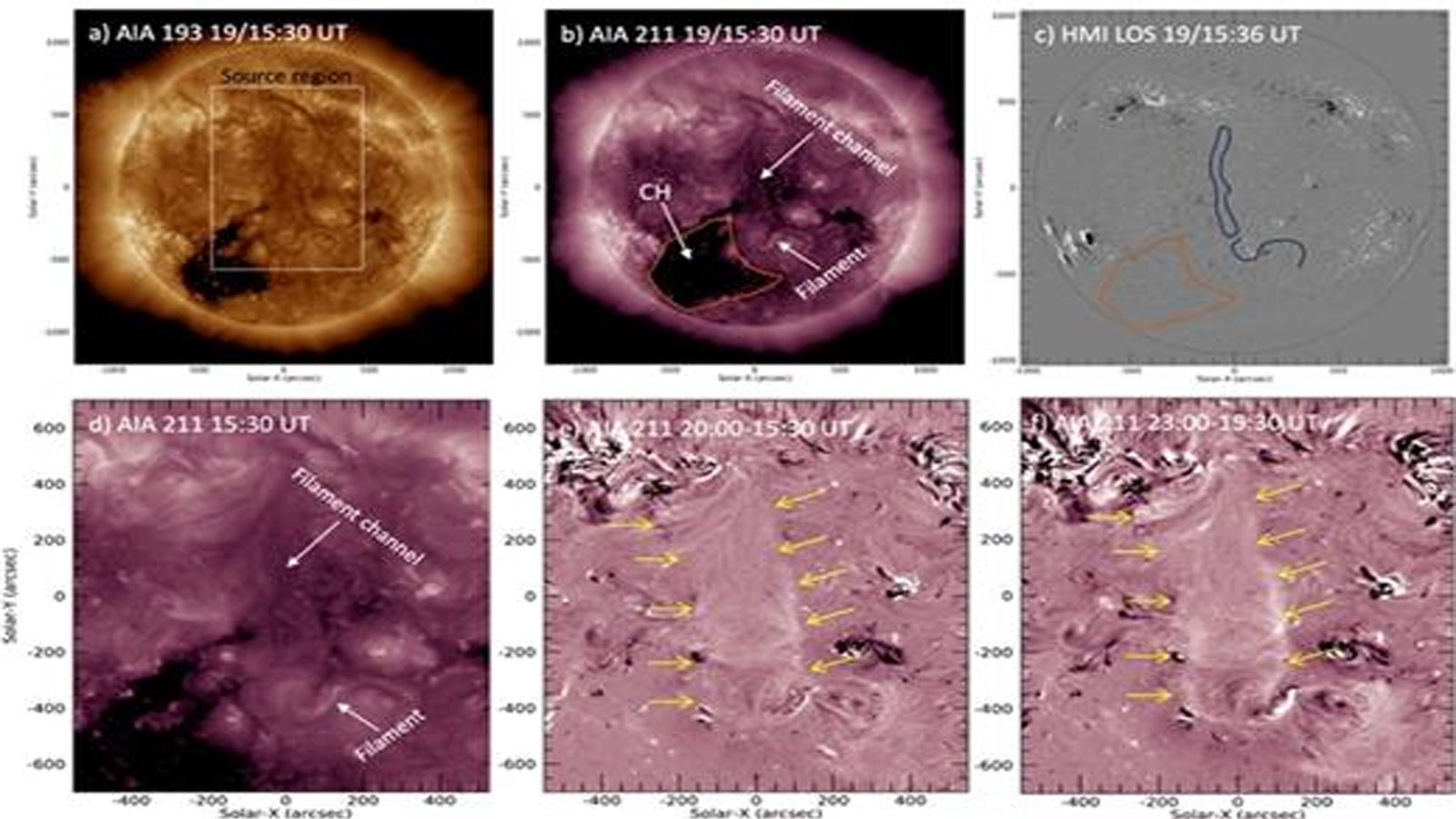
Extreme Ultraviolet images from SDO revealed the presence of a coronal hole close to the CME’s source region near the Sun’s centre. Scientists noted that CMEs erupting near coronal holes are often accelerated by high-speed solar wind streams, increasing their ability to propagate through space.
The study also tracked the evolution of the interplanetary CME (ICME) using near radially aligned spacecraft—SolO, STEREO-A, and WIND. The ICME travelled behind a high-speed solar wind stream and was detected without a clear shock or sheath, a feature commonly associated with stronger solar eruptions.
Observations showed the magnetic cloud within the ICME expanded as it moved outward, with its radial size increasing from 0.08 astronomical units (AU) at SolO to 0.18 AU at STEREO-A. The magnetic field displayed rotation during its journey, with a right-handed helicity consistent with its source region on the Sun. Enhanced plasma density was also observed near the boundaries of the magnetic cloud.
Researchers further modelled the geomagnetic storm using parameters such as solar wind velocity, plasma density, magnetic field strength, and electric fields. The modelled storm intensity closely matched observed geomagnetic indices, particularly when solar wind density and electric field variations were included.
The findings demonstrate that even inconspicuous solar eruptions, when combined with favourable solar wind conditions and southward magnetic fields, can generate intense geomagnetic storms on Earth. Scientists say this evolving and complex behaviour underscores the difficulty of predicting space weather effects arising from stealth CMEs.
The study has been published in The Astrophysical Journal under the title “An Intense Geomagnetic Storm Originated from Stealth Coronal Mass Ejection: Remote and In Situ Observations by Near Radially Aligned Spacecraft”. The paper was authored by P. Vemareddy of IIA and K. Selva Bharathi of IISER Tirupati, an MSc internship student at IIA.