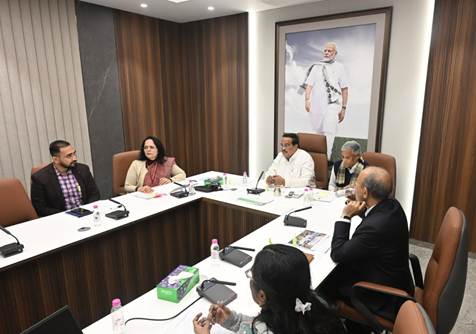
Union Jal Shakti Minister C R Patil on Tuesday interacted with States and Union Territories to review innovative and community-led Faecal Sludge Management (FSM) models being implemented under the Swachh Bharat Mission-Grameen (SBM-G).
The Ministry of Jal Shakti organised the virtual interaction to facilitate cross-learning and share scalable FSM practices from across the country, with a focus on strengthening sustainable rural sanitation beyond toilet construction.
The meeting was attended by Minister of State for Jal Shakti V Somanna, Secretary of the Department of Drinking Water and Sanitation Ashok K K Meena, Joint Secretary and Mission Director SBM-G Aishvarya Singh, along with District Collectors, Zilla Panchayat CEOs, Self-Help Group (SHG) members, Panchayat representatives and senior officials from States and UTs.
During the interaction, representatives from Gujarat, Sikkim, Madhya Pradesh, Karnataka, Odisha, Ladakh and Tripura presented field-level experiences showcasing a wide range of FSM models, including in-situ treatment systems, community-managed solutions, urban–rural linkages and effective operations and maintenance frameworks involving SHGs and Panchayats.
A notable model from Khordha district in Odisha highlighted a transgender-led SHG managing the operation and maintenance of a Faecal Sludge Treatment Plant (FSTP). The initiative was cited as an example of inclusive sanitation service delivery that promotes social inclusion while generating dignified livelihood opportunities.
Other models discussed included the large-scale adoption of twin-pit toilets in tribal areas of Dang district in Gujarat; retrofitting of single-pit toilets to twin-pit systems in the hilly regions of Mangan district in Sikkim; India’s first rural FSTP at Kalibillod Gram Panchayat in Indore district of Madhya Pradesh, where treated effluent is being reused for pisciculture; a cluster-based FSTP model in Dakshina Kannada district of Karnataka with strong SHG participation; ecosan toilets in the high-altitude and cold desert conditions of Leh district in Ladakh; and mobile bio-toilets managed by SHGs in Gomati district of Tripura.
Community members directly involved in implementing the FSM models also interacted with the minister, sharing their on-ground experiences in local languages.
Patil lauded the participants for showcasing innovative sanitation solutions that contribute to cleanliness while also generating income and employment opportunities at the community level. He said Faecal Sludge Management is a critical component of sustainable rural sanitation, essential for protecting public health and the environment.
Emphasising community participation, the minister said the involvement of SHGs, Panchayats and other stakeholders, along with the adoption of context-specific and appropriate technologies, is key to making FSM solutions inclusive, scalable and sustainable. He added that under the leadership of Prime Minister Narendra Modi, the Swachhata movement has gained nationwide momentum.