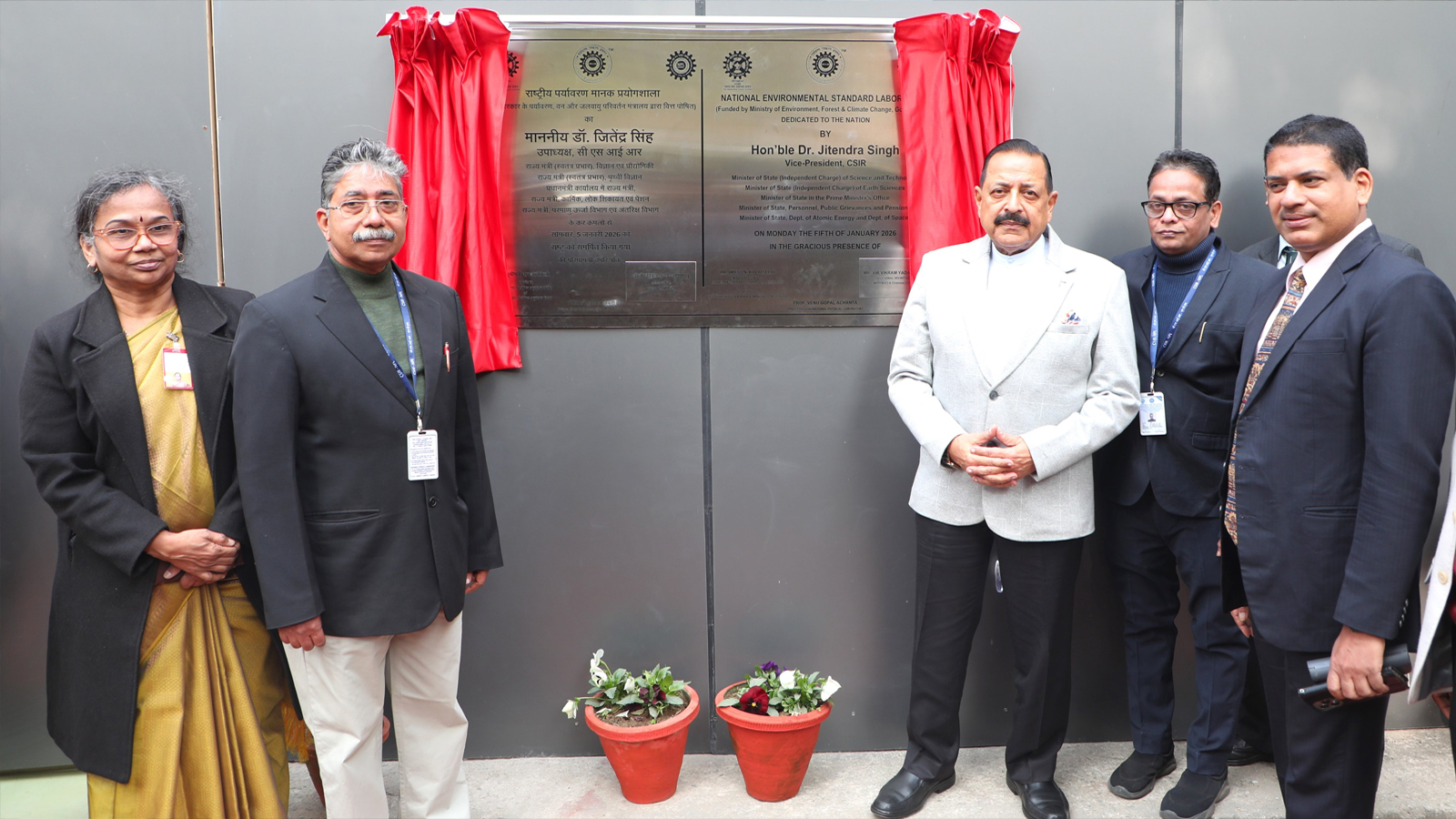
Union Minister of State (Independent Charge) for Science and Technology Dr Jitendra Singh on Monday inaugurated two apex national facilities at the CSIR-National Physical Laboratory (NPL), marking a significant milestone in India’s environmental governance and renewable energy ecosystem.
Addressing the 80th Foundation Day celebrations of CSIR–NPL, the Minister inaugurated the world’s second National Environmental Standard Laboratory and the world’s fifth National Primary Standard Facility for Solar Cell Calibration. He described the twin inaugurations as a major leap for India in environmental regulation and solar metrology, placing the country among a select group of global leaders in these critical domains.
Singh said the National Environmental Standard Laboratory would strengthen India’s environmental governance framework by enabling accurate, transparent and India-specific calibration and certification of air pollution monitoring systems. He noted that the facility would support regulators, industries and startups by ensuring monitoring instruments are tested under Indian climatic conditions, thereby improving compliance and enforcement under initiatives such as the National Clean Air Programme.
The Minister said the National Primary Standard Facility for Solar Cell Calibration makes India part of an elite global league in solar metrology. Developed in collaboration with Germany’s PTB, the facility uses a laser-based Differential Spectral Responsivity system with one of the lowest global uncertainties for reference solar cell calibration. He said the facility would reduce dependence on foreign certification agencies, save foreign exchange, shorten calibration timelines and boost investor confidence in India’s rapidly expanding solar sector.
Highlighting the legacy of CSIR-NPL, Singh described institutions like NPL as “monuments of New India” that embody the country’s scientific journey from the pre-Independence era to global technological leadership. Recalling its historic role, he said that for decades, millions of Indians synchronised their watches with the atomic clock housed at NPL, underscoring the laboratory’s contribution to establishing Indian Standard Time and quietly shaping everyday life across the country.
The Minister emphasised that science and technology reforms would be key drivers of India’s socio-economic future and called for greater collaboration between scientific institutions, industry, MSMEs and the private sector. He said that opening up such partnerships would help leverage India’s intellectual and infrastructural assets to directly contribute to economic growth and the vision of Atmanirbhar Bharat.
CSIR Director General N. Kalaiselvi, addressing the event, congratulated the NPL fraternity on completing 80 years of service to the nation. She highlighted that the laboratory now houses among the world’s leading facilities in environmental and solar calibration and stressed the strategic importance of NPL’s atomic clocks, particularly in ensuring national timekeeping during GPS-denied scenarios.
During the programme, 14 Phytochemical Bharatiya Nirdeshak Dravya (BNDs) jointly developed by CSIR-CIMAP and CSIR-NPL were released, along with two gas BNDs and one silica fume BND, strengthening India’s quality assurance and metrological traceability ecosystem. Several memoranda of understanding and technology transfer agreements were also signed to support indigenous manufacturing, startups and MSMEs.
Concluding his address, Singh said Indian scientific institutions are now central to national aspirations, expressing confidence that CSIR–NPL will continue to play a defining role in India’s journey towards technological leadership as the country moves towards 2047.