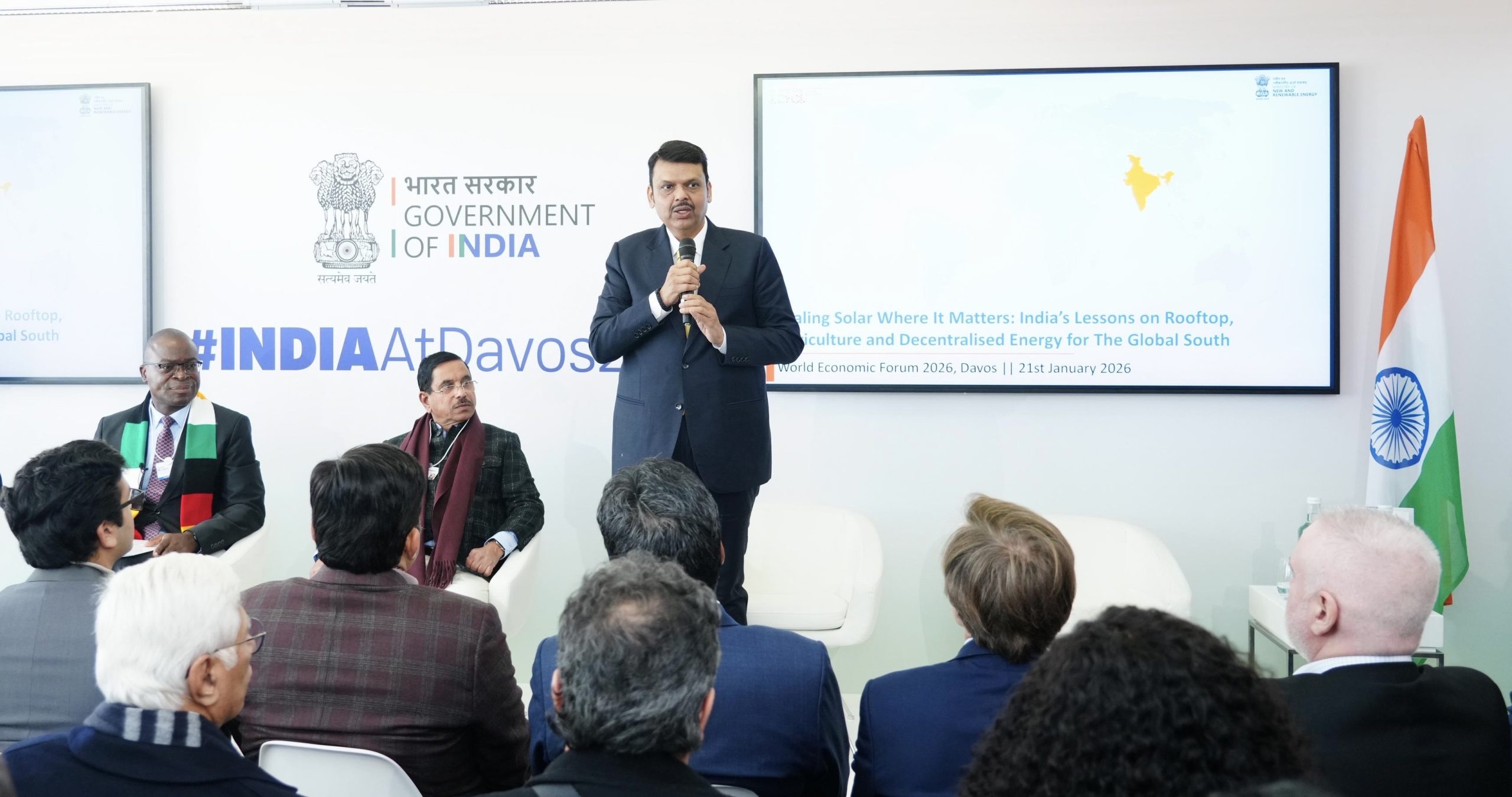
Maharashtra is set to build its first ‘Innovation City’ near Mumbai, aimed at attracting global investors and innovation ecosystems, Maharashtra Chief Minister Devendra Fadnavis said.
Speaking to ANI on the sidelines of the World Economic Forum (WEF) in Davos, Switzerland, Fadnavis said the proposal was presented under the AI and Innovation Ecosystem theme at the 2025 WEF conference before more than 400 investors. He added that the location has now been finalised and the project is expected to begin within the next six to eight months.
“The city will bring global innovation ecosystems to Mumbai, India. Our goal is to make Mumbai a hub where anyone in the world can easily access a plug-and-play innovation system. Tata Sons has committed USD 11 billion to develop the Innovation City, including a data centre. Following this announcement, international investors are showing serious interest in investing in the project. We are set to build India’s first innovation city near Mumbai,” Fadnavis added.
He said the state government has identified the location and prepared an initial outline of the project. “We have just identified the location and sketched the contours. Over the next six to eight months, we will move towards implementation,” he added.
According to the Chief Minister, Tata Sons will invest around USD 10 billion to build core infrastructure, including a data centre. “I discussed this idea with the Chairman of Tata Sons and sought his support. I am pleased that nearly a year later, we have officially announced the Innovation City in Davos before 400–450 international investors,” he said.
Apart from the Innovation City, Fadnavis said discussions at Davos also focused on energy transition, particularly under the framework of the International Solar Alliance. Ministers from Zimbabwe, along with Union ministers, participated in detailed deliberations on the subject.
He also noted that Maharashtra has signed memoranda of understanding with Indian and Russian companies to build Small Modular Reactors (SMRs) for deploying nuclear energy in smaller clusters across the state, following the passage of the SHANTI Bill in Parliament.
Meanwhile, Union Minister for Electronics and Information Technology Ashwini Vaishnaw outlined India’s broader strategy to emerge as a global leader in artificial intelligence. Speaking at the global summit, the Minister emphasised a shift away from big-tech-controlled resources towards a public-private partnership model.
“The whole world today, especially the AI industry, is appreciating the fact that India is working methodically across all five layers,” Vaishnaw said.
Explaining the technical framework, he said AI consists of five key elements: the application layer, the model layer, the semiconductor or chip layer, the infrastructure layer such as data centres, and the energy layer.
(ANI)