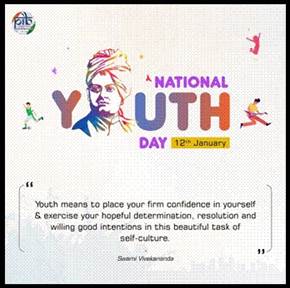
As India marks National Youth Day on January 12—observed annually to commemorate the birth anniversary of Swami Vivekananda—the occasion doubles as a moment to assess how the country is harnessing its demographic dividend. With over 65% of the population under the age of 35, the government has built a wide institutional framework that links civic participation, skilling, employment, entrepreneurship, and health in pursuit of a “Viksit Bharat @2047”.
This evolving youth ecosystem spans technology-enabled platforms, national service schemes, military pathways, flagship skilling missions, startup support, and financial inclusion programmes. Anchored by the Ministry of Youth Affairs and Sports, the broader framework integrates multiple ministries and state institutions, positioning youth not as passive beneficiaries but as co-participants in nation-building.
At the centre of civic engagement is Mera Yuva Bharat (MY Bharat), a digital platform launched in October 2023 and designed to connect young citizens with volunteering, leadership and skilling opportunities. The portal has recorded more than two crore registrations and hosts thousands of youth clubs, institutional partners and companies. With multilingual features, a dedicated app launched in 2025 and ongoing collaborations for a MY Bharat 2.0 upgrade, the platform aims to integrate AI-based tools, smart CV builders and mentorship networks. Complementing this is the National Service Scheme (NSS), which continues to deploy nearly four million student volunteers annually across universities and schools for community service, national integration camps, adventure programmes and the annual Republic Day Parade Camp.
The push for youth leadership is also visible in the reimagined Viksit Bharat Young Leaders’ Dialogue (VBYLD)—formerly the National Youth Festival—which now combines cultural participation with digital quizzes, innovation tracks and thematic policy pitches, drawing thousands of delegates from India and abroad.
On the education-to-employment front, the government is pursuing structured upskilling through initiatives like the Skill India Mission, Pradhan Mantri Kaushal Vikas Yojana (PMKVY) and the National Apprenticeship Promotion Scheme (NAPS). Since 2014, more than six crore youth have benefited from these interventions, which combine short-term skilling, on-the-job training and industry partnerships. PMKVY alone has trained over 1.6 crore candidates across multiple phases, gradually expanding into emerging technologies like robotics, drones and AI.
The broader vocational ecosystem has been strengthened through mission-driven programmes such as PM-SETU, a ₹60,000 crore scheme launched in October 2025 to modernise 1,000 Industrial Training Institutes under a hub-and-spoke model, and through complementary initiatives like Jan Shikshan Sansthan (JSS) for non-formal skilling in rural and low-income areas.
Economic empowerment forms the third pillar of the youth strategy. Through the Pradhan Mantri Viksit Bharat Rozgar Yojana, announced in August 2025 with a ₹1 lakh crore outlay, the government aims to create 3.5 crore jobs by incentivising employers and directly supporting newly employed youth. At the same time, the Startup India initiative has recognised nearly two lakh startups since 2016, many outside metropolitan centres, backed by seed funding, simplified compliance and incubation support. Financial inclusion schemes such as the Pradhan Mantri MUDRA Yojana—which provides collateral-free credit up to ₹20 lakh—have sanctioned over 53 crore loans, supporting first-generation entrepreneurs, particularly women.
Health and wellness form a parallel policy priority. Campaigns like the Fit India Movement promote behavioural change through school certification programmes, community fitness events and app-based self-assessments. Youth well-being initiatives under the Ministry of Health, along with platforms like the Youth Spiritual Summit and Kashi Declaration, emphasise mental health, nutrition, and substance-free living as essential pillars of long-term national productivity.
Together, these initiatives signal a long-haul approach to demographic advantage. National Youth Day 2026 thus arrives not just as a commemorative date, but as a checkpoint on India’s evolving youth strategy—one that seeks to equip the current generation with civic agency, employability, entrepreneurial pathways and holistic health as building blocks of Viksit Bharat @2047.