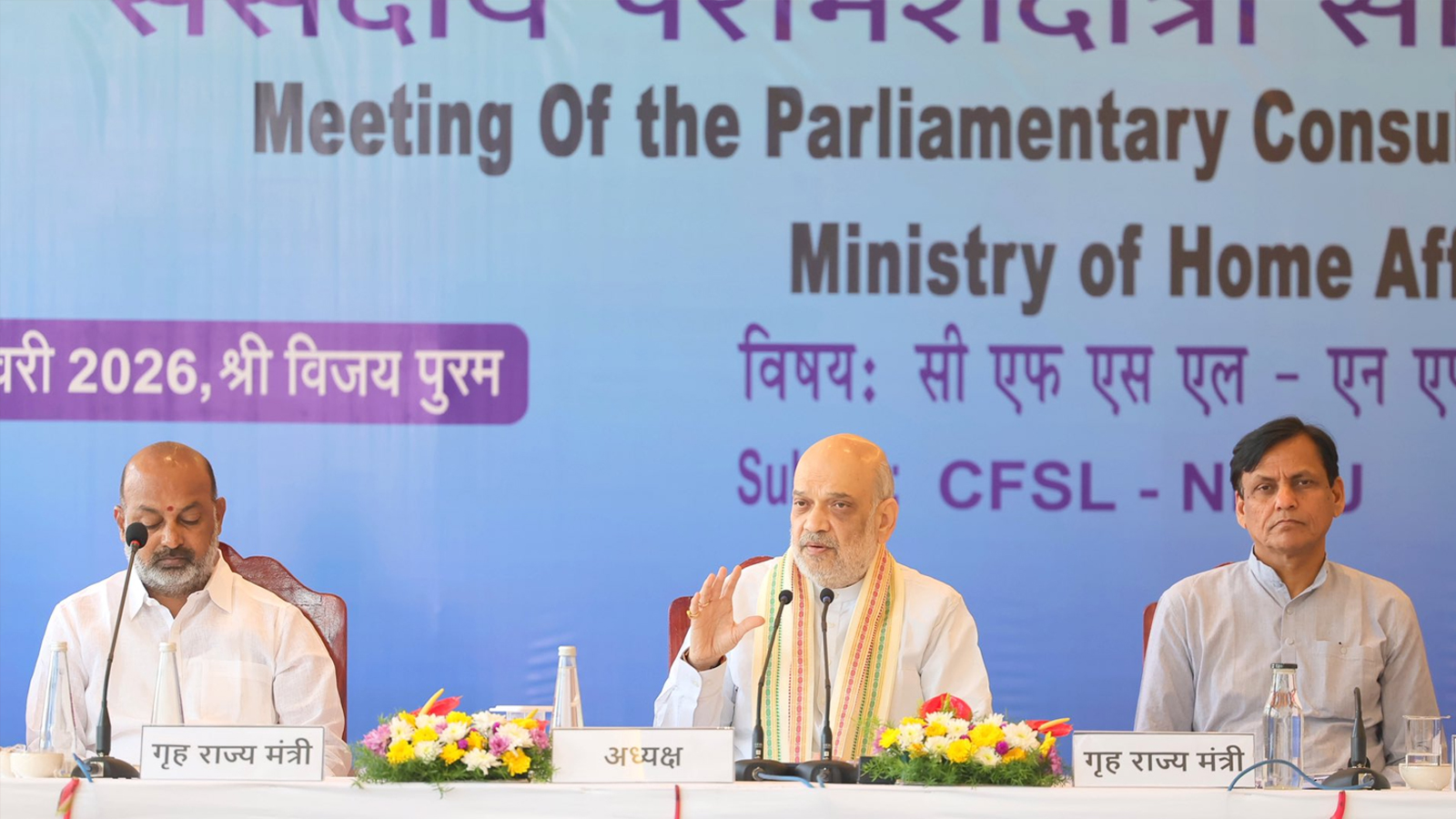
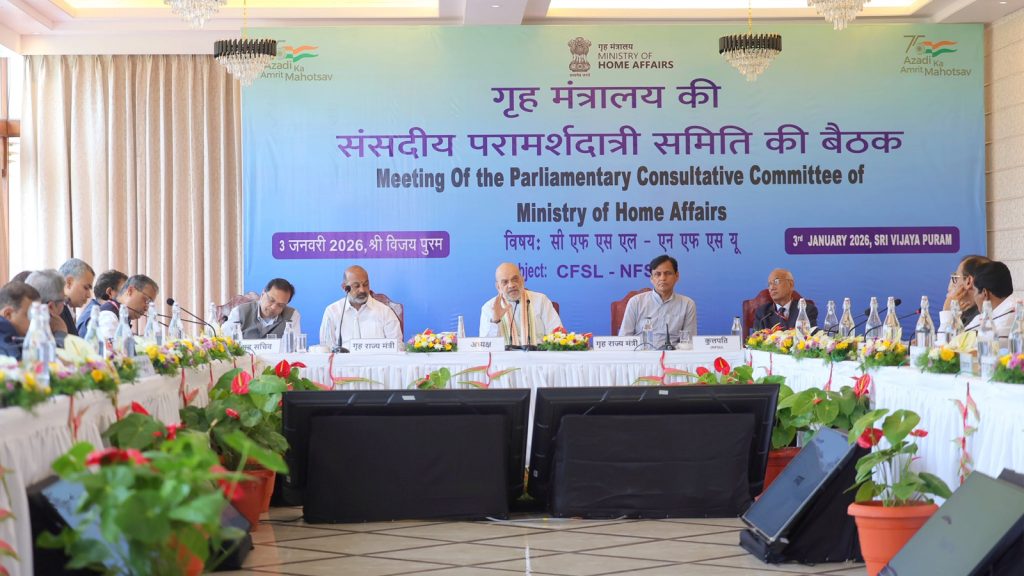
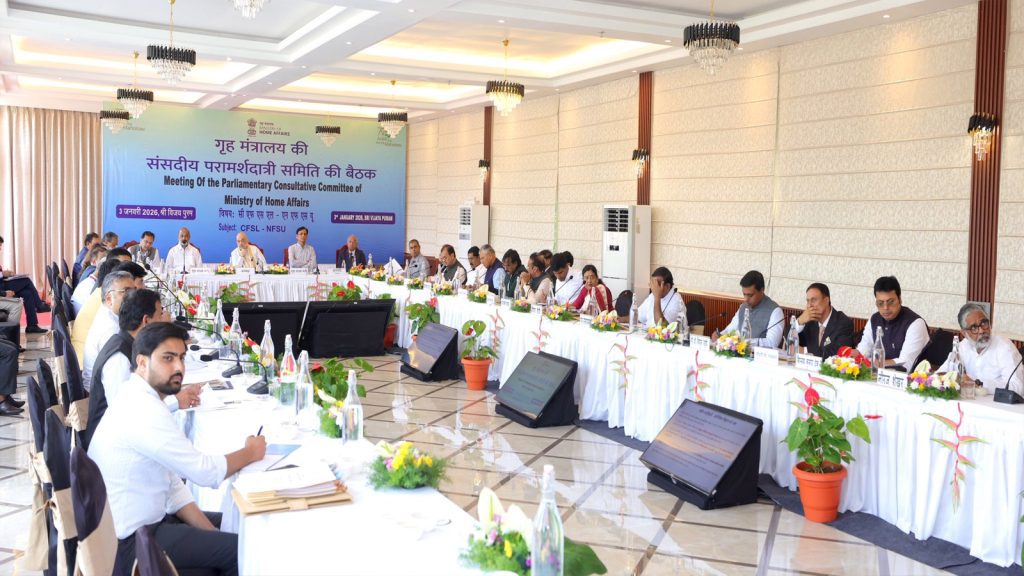

Union Home Minister Amit Shah on Saturday chaired a meeting of the Parliamentary Consultative Committee of the Ministry of Home Affairs at Sri Vijaya Puram in the Andaman and Nicobar Islands, underscoring the Centre’s push to strengthen forensic capabilities and deliver time-bound justice under the new criminal laws.
The meeting focused on the Central Forensic Science Laboratory (CFSL) and the National Forensic Sciences University (NFSU) and was attended by Union Ministers of State for Home Affairs Nityanand Rai and Bandi Sanjay Kumar, members of the Parliamentary Consultative Committee, Union Home Secretary Govind Mohan, senior officials, and experts from forensic institutions.
Addressing the committee, Shah said the three new criminal laws enacted under the leadership of Prime Minister Narendra Modi aim to ensure that the entire judicial process – from the filing of an FIR to the Supreme Court – is completed within three years by 2029. He said reforms initiated since 2022 are aligned with this vision, with the Ministry of Home Affairs carrying out comprehensive monitoring to plug gaps and strengthen implementation.
Shah noted that although the new criminal laws came into force in July 2024, the government had begun building forensic capacity as early as 2020. As a result, he said, investigations have become faster and conviction rates have improved. Citing examples, Shah said a case involving the rape of a minor in West Bengal led to a death sentence within 62 days, while in Bihar’s Siwan district, a triple murder case was decided within 50 days.
The Home Minister said the government plans to invest ₹30,000 crore over the next five years to establish a nationwide network of forensic laboratories. By 2029, every state and Union Territory will have either a forensic university or a Central Forensic Science Laboratory, he added. He also said that from having no mobile forensic laboratories in 2021, the country now has about 1,000 such units.
Highlighting systemic reforms, Shah said the Narendra Modi government has modernised all five pillars of the justice system – police, courts, prisons, forensics and prosecution – through technology-driven initiatives. These include e-FIR, zero FIR, e-Summons, e-Sakshya, integrated video conferencing between courts and prisons, and mandatory forensic examination in cases carrying punishment of seven years or more.
Shah said the new laws have clearly defined cybercrime, organised crime, terrorism and digital fraud, significantly reducing legal grey areas. Digital and electronic evidence has been given clear legal recognition, while videography of seizures and strengthened chain-of-custody norms have been introduced to enhance transparency and accountability.
On data integration, the Home Minister said all police stations are now connected to the Crime and Criminal Tracking Network and Systems (CCTNS), with every FIR available on a central server. He said databases under e-Courts, e-Prisons, e-Prosecution and e-Forensics now hold crores of records, aiding investigations and judicial efficiency. Data on all terrorism cases registered under the Unlawful Activities (Prevention) Act is also being separately maintained in the National Investigation Agency database.
Shah announced that a Modus Operandi Bureau would soon be established to enable crime mapping. He also highlighted the usefulness of indigenous forensic kits developed by NFSU for narcotics, sexual assault, cybercrime and food testing.
Referring to NFSU’s growth, Shah said the university has achieved 100 per cent placement so far and is expected to produce around 35,000 forensic experts by 2029. With 14 campuses, more than 100 training programmes and 46 registered patents, NFSU has also signed over 200 MoUs with governments and institutions in India and abroad.
Concluding his remarks, Shah said early results from the implementation of the new criminal laws indicate that India is moving decisively towards a faster, more transparent and technology-driven justice delivery system.