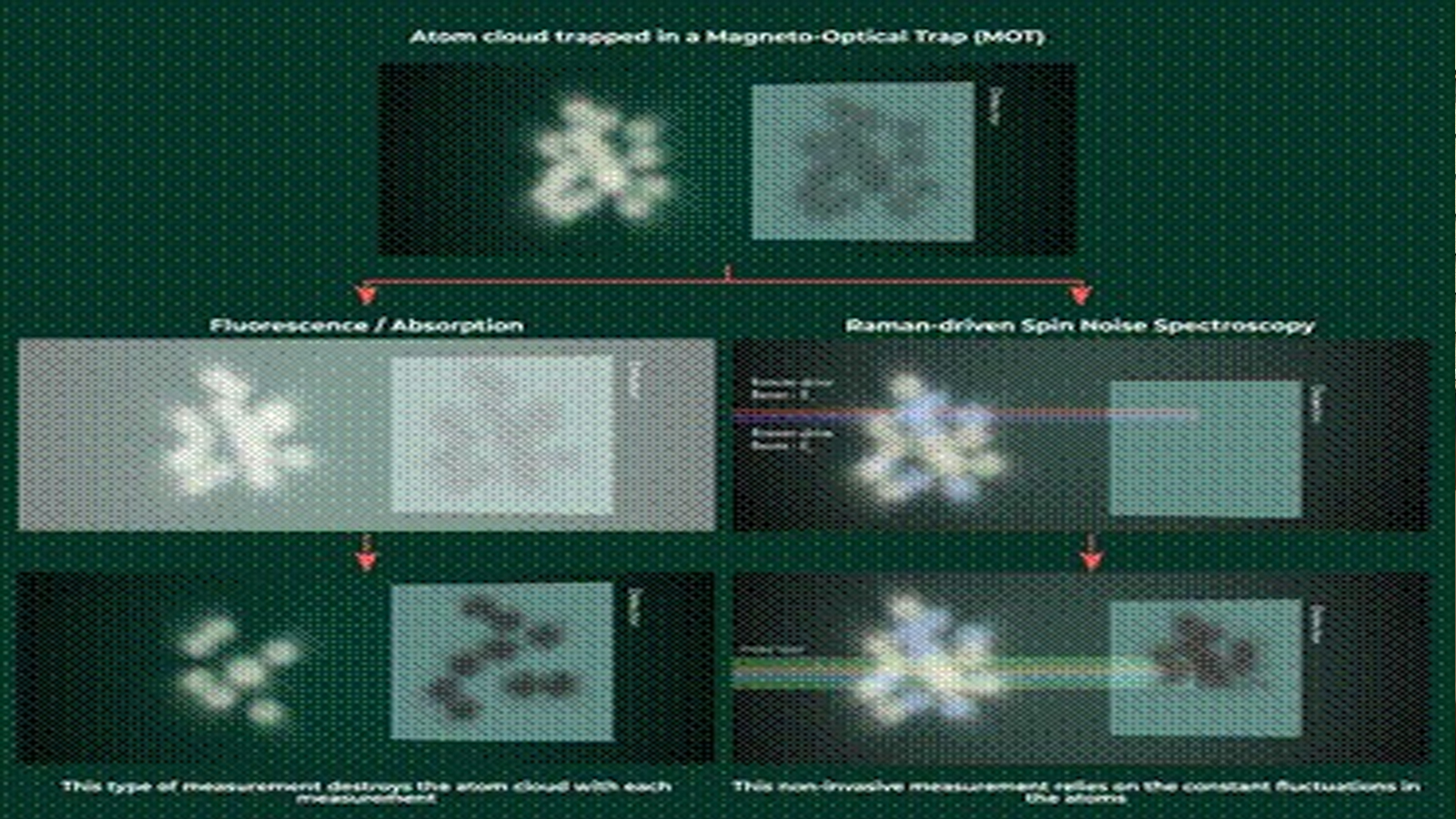
Scientists at the Raman Research Institute (RRI), Bengaluru, have developed a novel, non-invasive technique to measure the local density of cold atoms in real time without significantly disturbing their quantum state – an advance that could accelerate progress in quantum computing, quantum sensing and precision measurement technologies.
The method, known as Raman Driven Spin Noise Spectroscopy (RDSNS), overcomes key limitations of conventional atom-imaging techniques used in cold atom experiments. Cold atoms – cooled to temperatures close to absolute zero using laser cooling and trapping – exhibit pronounced quantum behaviour and are central to emerging quantum technologies. However, accurately detecting their quantum state and density has remained challenging.
Traditional approaches such as absorption and fluorescence imaging often interfere with the atoms being measured. Absorption imaging struggles with dense atomic clouds because probe light cannot penetrate deeply enough, while fluorescence imaging requires long exposure times and is typically destructive, altering the atomic state during observation.
Researchers at RRI, an autonomous institute under the Department of Science and Technology (DST), Government of India, have demonstrated that RDSNS can provide fast, precise and local density measurements while leaving the atomic system largely undisturbed. The technique combines spin noise spectroscopy—which detects natural fluctuations in atomic spins through polarisation changes in a laser beam passing through the sample—with two additional laser beams that coherently drive atoms between neighbouring spin states.
These Raman beams amplify the signal dramatically—by nearly a million times—allowing researchers to probe an extremely small volume of about 0.01 cubic millimetres. By focusing the probe beam to just 38 micrometres, the technique targets a tiny region containing roughly 10,000 atoms, providing a direct measure of local density rather than just the total number of atoms.
Using RDSNS, the team studied potassium atoms confined in a magneto-optical trap (MOT). They found that the central density of the atomic cloud saturated within one second, while the total atom count measured via fluorescence imaging took nearly twice as long to stabilise. This distinction highlights a major advantage of the new method: fluorescence reveals global atom numbers, whereas RDSNS captures how densely atoms are packed at specific locations.
“The technique is non-invasive, as the probe is far-detuned and operates at low power, allowing even microsecond-scale measurements to achieve accuracy within a few percent,” said Bernadette Varsha FJ and Bhagyashri Deepak Bidwai, research assistants at RRI’s Quantum Mixtures (QuMIX) laboratory.
Lead author Sayari, a PhD researcher at RRI, noted that real-time, non-destructive imaging methods such as RDSNS are promising candidates for quantum sensing and computing. “It uncovers many-body dynamics by capturing transient microscopic density fluctuations and can help benchmark theoretical models using spatially resolved data,” she said.
To validate the technique, the researchers compared RDSNS-derived local density profiles with results obtained from fluorescence images processed using the inverse Abel transform. The close agreement confirmed the accuracy of the new approach. Unlike the Abel transform, which assumes axial symmetry, RDSNS works reliably even with asymmetric or dynamically evolving atomic clouds.
The implications of this breakthrough extend across quantum technologies. Precise, rapid and non-invasive density measurements are essential for devices such as gravimeters, magnetometers and other quantum sensors that rely on accurate knowledge of atomic density. By enabling micron-scale probing without disrupting the system, RDSNS opens new avenues to study density wave propagation, quantum transport and non-equilibrium dynamics.
“We anticipate that this technique will find broad applications in real-time diagnostics of cold atom experiments, particularly in quantum computing with neutral atoms and quantum simulations,” said Prof. Saptarishi Chaudhuri, who leads the QuMIX lab at RRI.
Supported under India’s National Quantum Mission, the development positions the Raman Research Institute at the forefront of precision quantum measurement, demonstrating how gentler, smarter observation techniques can unlock deeper insights into the quantum world.