Union Minister for New and Renewable Energy Pralhad Joshi on Tuesday urged global investors to partner with India in its rapidly expanding clean energy sector, asserting that the country offers a unique combination of scale, resilience and policy stability in the global energy transition.
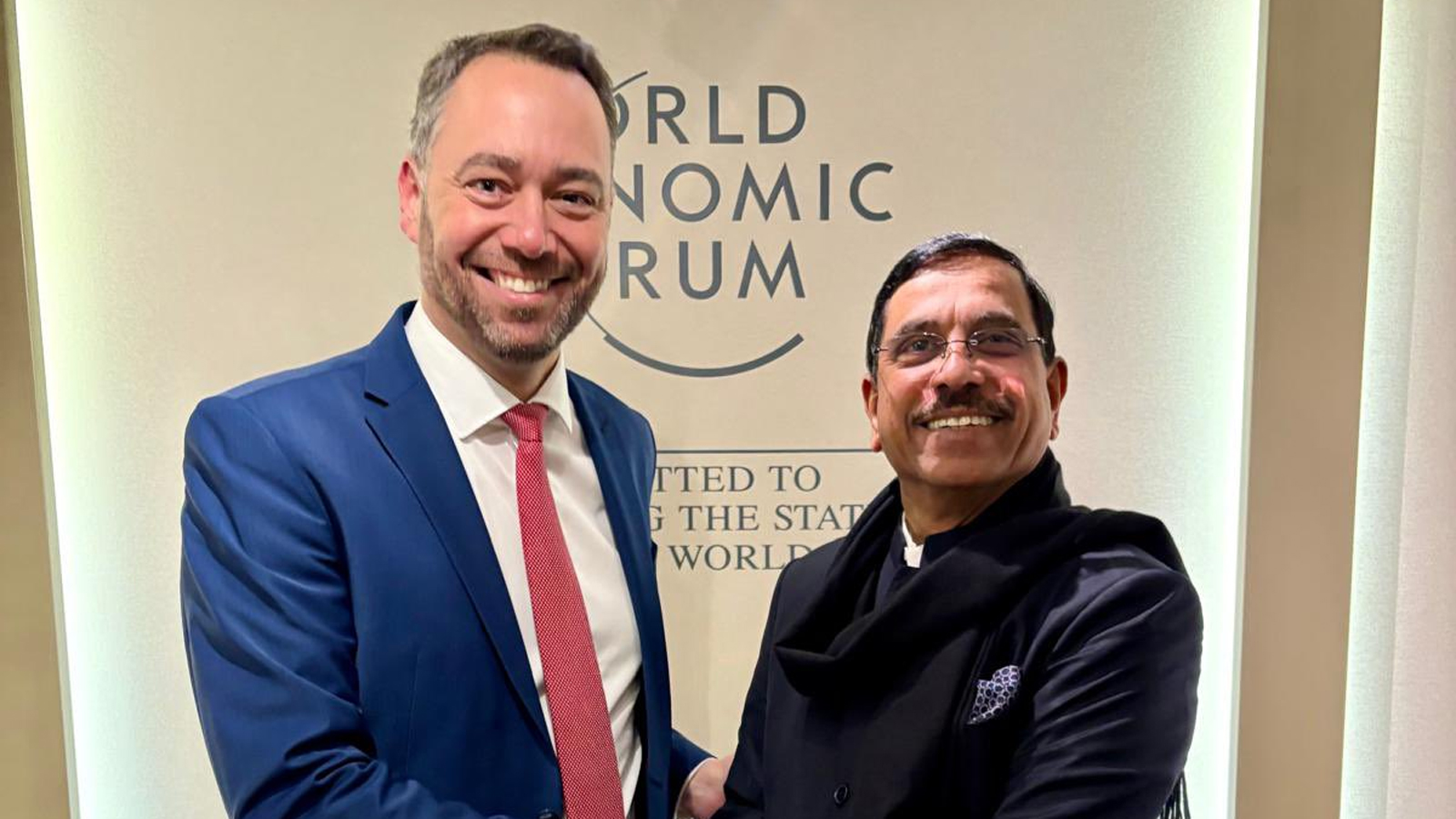
Speaking at the World Economic Forum (WEF) Annual Meeting 2026 in Davos, the Minister said the real challenge of the global energy transition lies in creating infrastructure that is resilient, scalable and investment-ready. Addressing the session titled “Resilient Infrastructure for Growth”, Joshi highlighted India’s success in combining large-scale deployment with system resilience.
He said India has achieved 267 GW of non-fossil fuel capacity as of December 2025 and is firmly on track to meet its 2030 climate and energy targets under the leadership of Prime Minister Narendra Modi. The progress, he noted, is backed by robust policy frameworks, domestic manufacturing, grid modernisation, energy storage solutions and emerging initiatives in geothermal and nuclear energy.
The Minister stressed the importance of patient capital, blended finance and closer collaboration among governments, private investors and multilateral development banks to accelerate a sustainable and inclusive energy transition globally.
Delivering the keynote address at the roundtable “Delivering Sustainability at Scale: Pathways for Global Transformation”, Joshi underlined that sustainability has moved to the core of economic growth and competitiveness. He said the defining challenge of the decade is not whether to transition, but how sustainability can be delivered at scale, at speed and in an economically strengthening manner.
Reiterating India’s commitment to achieving net-zero emissions by 2070, the Minister said the country’s energy transition is guided by the principle of Vasudhaiva Kutumbakam — One Earth, One Family, One Future. He described sustainability as a strategic transformation of society and the economy, rather than a purely technological shift.
On the sidelines of the WEF meeting, Joshi held a series of bilateral discussions to strengthen international cooperation in clean energy. In a meeting with Dr Said Mohammed Ahmed Al Saqri, Economic Advisor to the Deputy Prime Minister for Economic Affairs of Oman, the Minister highlighted India’s capabilities in scaling solar, wind, green hydrogen and energy storage solutions, including in arid and desert conditions. The two sides discussed collaboration in manufacturing, hydrogen hubs, integrated energy projects and port-based export infrastructure, leveraging the India–Oman CEPA and cooperation under the International Solar Alliance and the One Sun One World One Grid initiative.
Joshi also met Belgium’s Deputy Prime Minister and Foreign Minister Maxime Prévot, reaffirming the strength of the India–Belgium partnership based on mutual trust and shared democratic values. In another meeting with Kuwait’s Minister of Electricity, Water and Renewable Energy Subaih Abdul Aziz Al-Mukhaizeem, discussions focused on potential investments in India’s renewable energy sector.
The Union Minister held talks with Charles Emond, President and CEO, and Sarah Bouchard, COO of La Caisse, encouraging the institution to scale up long-term climate investments in India. He highlighted alignment between India’s clean energy ambitions and La Caisse’s plan to invest USD 400 billion in climate action by 2030.
In a separate interaction, Joshi met Juvencio Maeztu, CEO and President of the Ingka Group, which operates IKEA’s retail business. The group expressed strong interest in entering India’s renewable energy sector, particularly in solar, wind and hybrid projects. The Minister encouraged deeper engagement, citing India’s stable policies and investor-friendly ecosystem.
Joshi also attended the inauguration of the India Pavilion at WEF 2026, alongside several Union Ministers and Chief Ministers, including Andhra Pradesh Chief Minister N. Chandrababu Naidu and Assam Chief Minister Himanta Biswa Sarma. During the event, he launched a Green Investment Handbook titled “The India Story”.
The India Pavilion showcases the country as a reliable and future-ready destination for global investment, highlighting strengths across manufacturing, infrastructure, renewable energy, technology and innovation, aligned with the vision of Viksit Bharat 2047.
Concluding, the Minister said that even amid global slowdowns and supply-chain disruptions, India has continued to grow by building resilience and long-term capacity. He emphasised that India is emerging as a trusted global partner, offering stable returns, policy certainty and sustained opportunities for innovation and value creation.