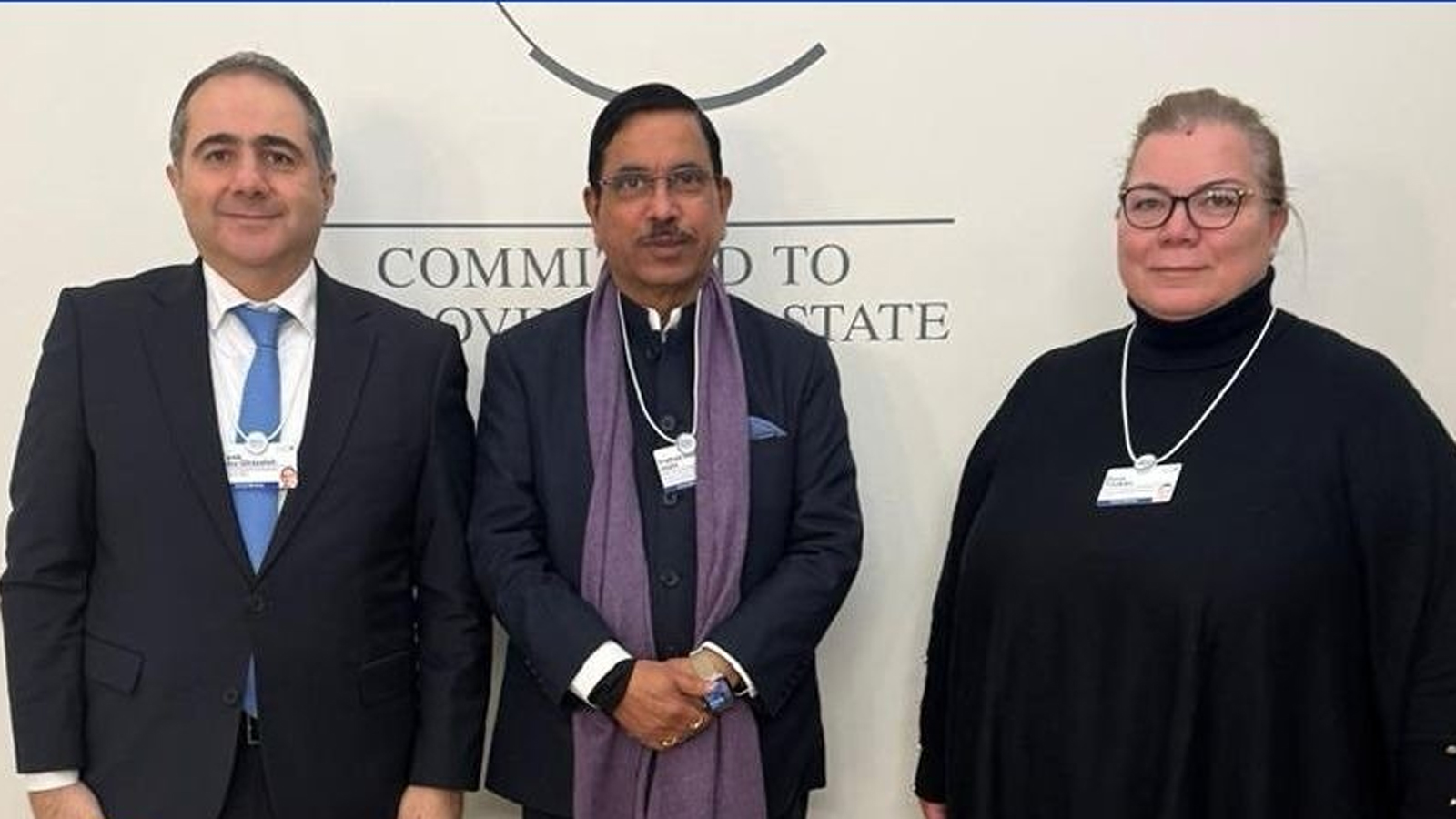
Union Minister for New and Renewable Energy Pralhad Joshi on Thursday said that India’s energy transition has been consciously designed as a driver of industrialisation, job creation and global competitiveness, offering a replicable model for emerging economies.
Addressing a high-level session on “Energy: The Great Funding Gap” at the World Economic Forum (WEF) Annual Meeting 2026 in Davos, the minister said that under the leadership of Prime Minister Narendra Modi, India has transformed clean energy from a climate obligation into a people-centric development movement. He underlined that the transition has strengthened energy security while simultaneously lowering costs for industry and consumers.
Joshi noted that India has already achieved 267 GW of installed non-fossil fuel energy capacity, with renewables accounting for about 52 per cent of the country’s total installed power capacity – well ahead of earlier targets. He emphasised that India views the energy transition not merely as an environmental necessity, but as a growth enabler supporting rapid industrialisation and affordable electricity.
Highlighting flagship decentralised renewable energy initiatives, the minister said the PM Surya Ghar: Muft Bijli Yojana has enabled rooftop solar installations in 2.7 million households over the past two years, with a target of covering 10 million households and generating around 30 GW of power. Under the PM-KUSUM scheme, more than 2.1 million farmers have solarised their irrigation pumps, reducing dependence on subsidised grid power and enabling farmers to earn additional income by selling surplus electricity.
“These programmes are turning consumers into ‘prosumers’, boosting household incomes and rural livelihoods,” Joshi said.
The minister also pointed out that renewable energy has played a key role in lowering electricity tariffs. Solarisation of agricultural power supply has reduced subsidy burdens on distribution companies, allowing savings to be passed on in the form of lower tariffs for industry and households. He described this as a historic shift in India’s power sector.
On manufacturing, Joshi said India has rapidly built a domestic clean energy manufacturing ecosystem. The country now has 144 GW of solar module manufacturing capacity, while solar cell capacity stands at 27 GW and is expected to expand to around 50 GW soon. India is also moving towards completing the full manufacturing cycle, with plans to begin wafer and ingot production. He added that parallel expansion in wind energy, battery storage and pumped storage solutions is strengthening grid reliability, creating jobs and enhancing industrial competitiveness.
Addressing concerns about grid stability, the minister said India is pursuing an integrated energy strategy combining renewables with storage, pumped storage hydropower and nuclear energy. Legal and policy reforms are also underway to expand nuclear capacity and strengthen base-load power.
Joshi said India’s experience demonstrates that energy security, affordability and sustainability are not competing priorities and can be achieved together through coherent policy design, scale and domestic manufacturing. He added that India’s clean energy journey offers valuable lessons for other emerging economies.
On the sidelines of the WEF meeting, the minister held several bilateral discussions to advance clean energy investments and international cooperation. He met Jordan’s Minister of Investment Dr Tareq Abu Ghazaleh and Minister of Planning and International Cooperation Zeina Toukan to explore investment partnerships, and held talks with Zimbabwe’s Foreign Affairs and International Trade Minister Amon Murwira on strengthening cooperation in renewable energy, including decentralised solar solutions and green hydrogen.
Joshi also met International Energy Agency Executive Director Fatih Birol to discuss India-specific data, policy analysis and innovative financing to lower the cost of capital. In meetings with global industry leaders, including Acciona’s José Entrecanales Carrión and ENGIE CEO Catherine MacGregor, he encouraged deeper investments in India’s expanding renewable energy sector, highlighting the country as a leading destination for long-term clean energy investments.
Further discussions with S&P Global President Dave Ernsberger focused on developing robust frameworks for credit assessment, ESG standards and price discovery in renewables, while talks with Bloom Energy’s Aman Joshi explored distributed power solutions such as fuel cell technologies for industrial clusters and data centres.
The minister said the next decade belongs to India, as the country scales integrated clean energy manufacturing and positions itself as a global leader in the energy transition.