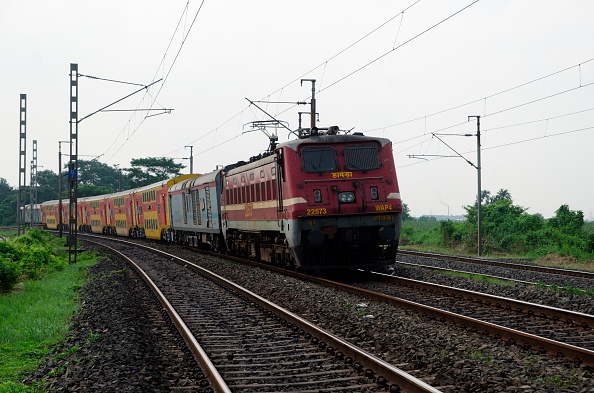
India’s Railways, under the Ministry of Railways, has emerged as one of the world’s most extensively electrified rail networks, with about 99.2% of its broad-gauge network electrified by November 2025. The ambitious “Mission 100% Electrification” is transforming the nation’s rail system from a diesel-dependent network into a fast, efficient, and environmentally sustainable backbone of transport. Beyond modernisation, this mission reduces pollution, strengthens energy security, and reflects India’s commitment to a cleaner infrastructure while supporting faster, greener, and more reliable train operations.
A Century of Electrification: From Bombay to Nationwide
India’s journey with electric trains began in 1925, when the first electric train ran between Bombay Victoria Terminus and Kurla Harbour using a 1500 Volt DC system. Though modest, covering only 388 route kilometres (RKMs) by independence, it marked a historic shift towards energy-efficient rail transport. Electrification progressed gradually over the decades, but the pace accelerated dramatically in the last decade. Between 2004 and 2014, electrification expanded at just 1.42 km per day, while from 2019 to 2025, the rate surged to over 15 km per day. By November 2025, a total of 69,427 RKMs had been electrified, including 46,900 RKMs added since 2014, bringing the network to near-total electrification.
State-Wise Electrification Status: Wiring the Final Miles
India’s broad-gauge network spans 70,001 RKMs, and 25 states and Union Territories are now fully electrified with no remaining routes pending. Only five states — Rajasthan, Tamil Nadu, Karnataka, Assam, and Goa — have residual sections under electrification, totaling 574 RKMs or just 0.8% of the network. Rajasthan leads with 93 RKMs remaining, followed by Tamil Nadu with 117 RKMs, Karnataka 151 RKMs, Assam 197 RKMs, and Goa 16 RKMs. Completing these final stretches will mark the culmination of nearly a century-long transformation, ensuring faster, cleaner, and more efficient train operations nationwide.
Why Electrification Matters: Cleaner, Faster, Smarter
Railway electrification is central to India’s sustainable transport and economic strategy. Electric traction reduces greenhouse gas emissions, lowers operational costs, and decreases dependence on imported fossil fuels, strengthening energy security. Electrified routes also catalyse industrial and rural growth along railway corridors, enhancing regional connectivity and supporting inclusive development. For passengers and freight alike, electrification brings higher speeds, quieter operations, and improved reliability, making Indian Railways both a greener and a more efficient network.
India on the Global Map: A Leader in Electrified Rail
With 99.2% of its network electrified, India now ranks among the world’s leading railway systems. Globally, Switzerland maintains 100% electrified railways, China 82%, Spain 67%, Japan 64%, France 60%, Russia 52%, and the United Kingdom 39%. India’s achievement not only demonstrates a century-long commitment to modernisation but also positions the country as a benchmark for sustainable and efficient railway infrastructure on the global stage.
Solar Power Integration: Lighting the Tracks
Electrification is complemented by a massive expansion of renewable energy. Indian Railways’ solar power capacity surged from 3.68 MW in 2014 to 898 MW by November 2025, nearly a 244-fold increase. Of this, 629 MW (about 70%) supports traction power for electric trains, reducing dependence on conventional grid electricity, while 269 MW powers station lighting, service buildings, workshops, and railway quarters. Solar installations now span 2,626 stations nationwide, demonstrating a strategic commitment to clean, sustainable, and cost-effective energy use.
Modern Construction Techniques: Faster, Safer, Efficient
Technological innovation has accelerated electrification projects. Cylindrical mechanised foundations have replaced traditional labour-intensive overhead electrification (OHE) supports, saving time and reducing manual effort. Automatic Wiring Trains simultaneously install catenary and contact wires with precise tension control, speeding up completion and ensuring uniform quality. Mechanisation and modern engineering methods have transformed electrification from a slow, manual process into an efficient, reliable system capable of meeting ambitious national targets.
Operational Impact: Greener, Quieter, More Economical
The electrification of Indian Railways has tangible operational benefits. Electric traction is approximately 70% more economical than diesel, reducing fuel costs while lowering carbon emissions. Passengers experience faster, smoother, and quieter journeys, while freight movement becomes more reliable. The integration of solar power further strengthens energy efficiency, cutting operational costs and enabling Indian Railways to align its operations with the country’s climate and sustainability goals.
Completing the Mission: Towards 100% Electrification
With only 574 RKMs pending, Indian Railways is on the verge of achieving its century-long goal. Completing these final stretches will establish one of the largest, most modern, and environmentally responsible railway networks in the world. Mission 100% Electrification represents decades of investment, planning, and technological adoption, and it reinforces the vision of a greener, faster, and more connected India.