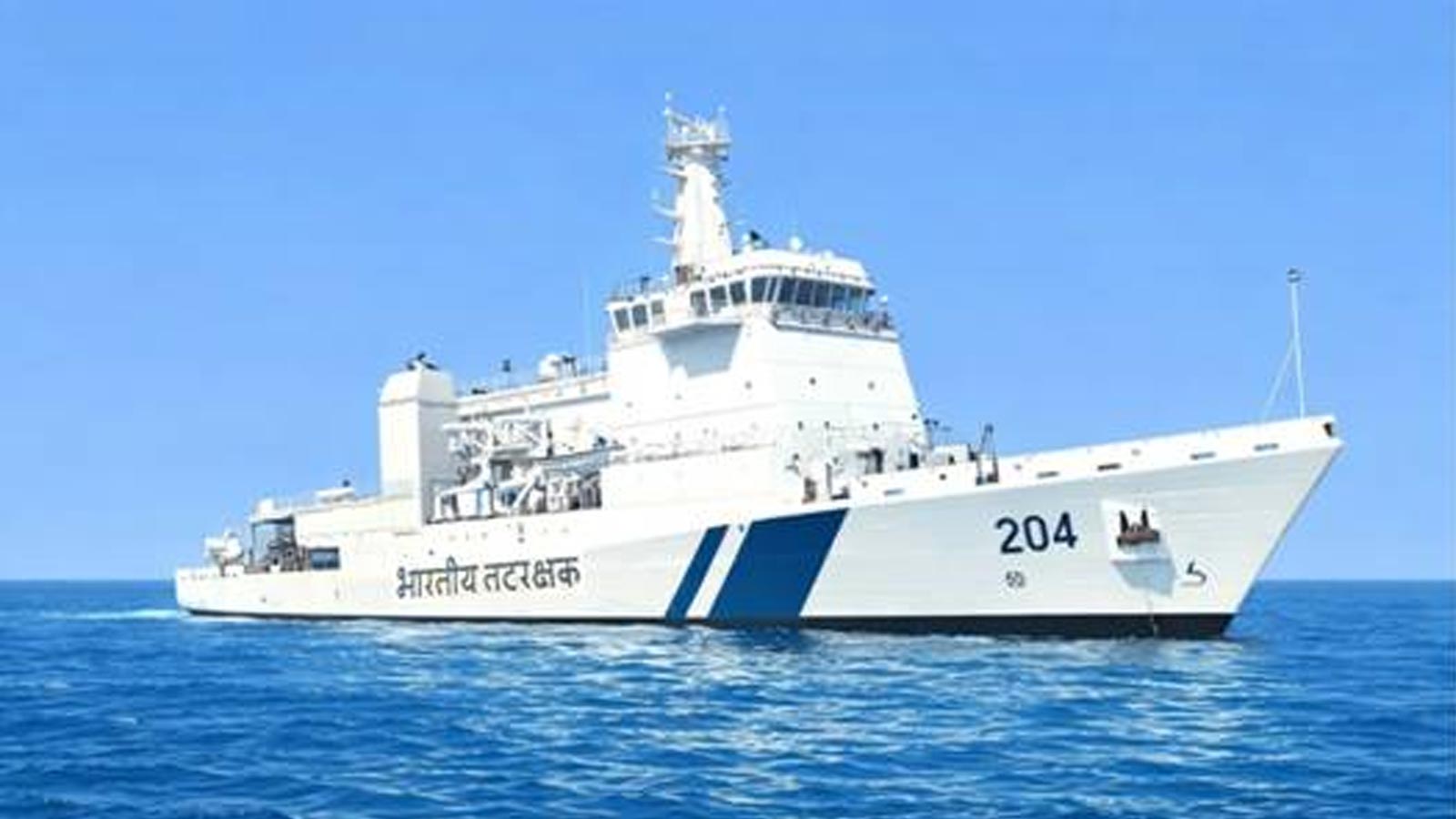
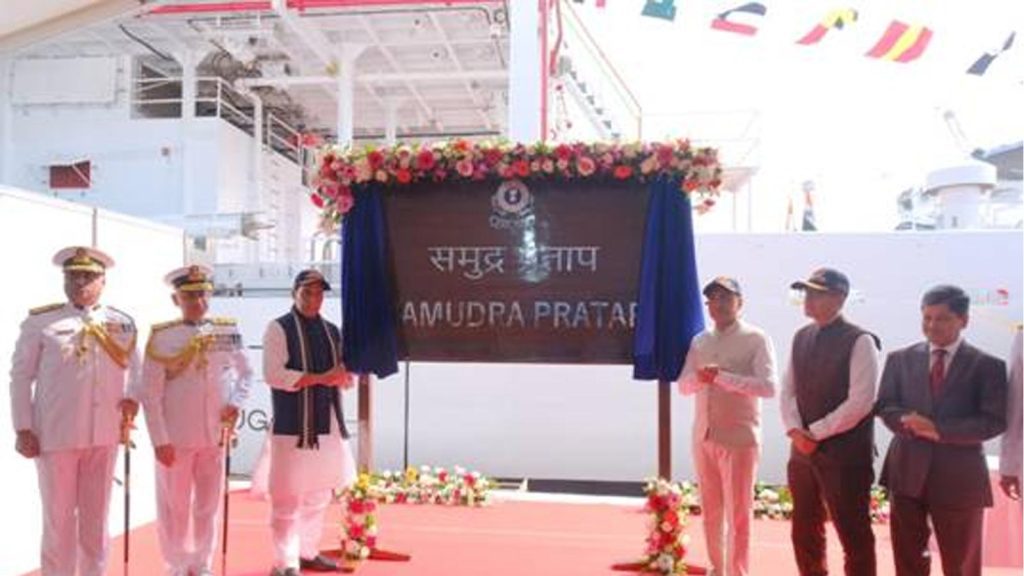
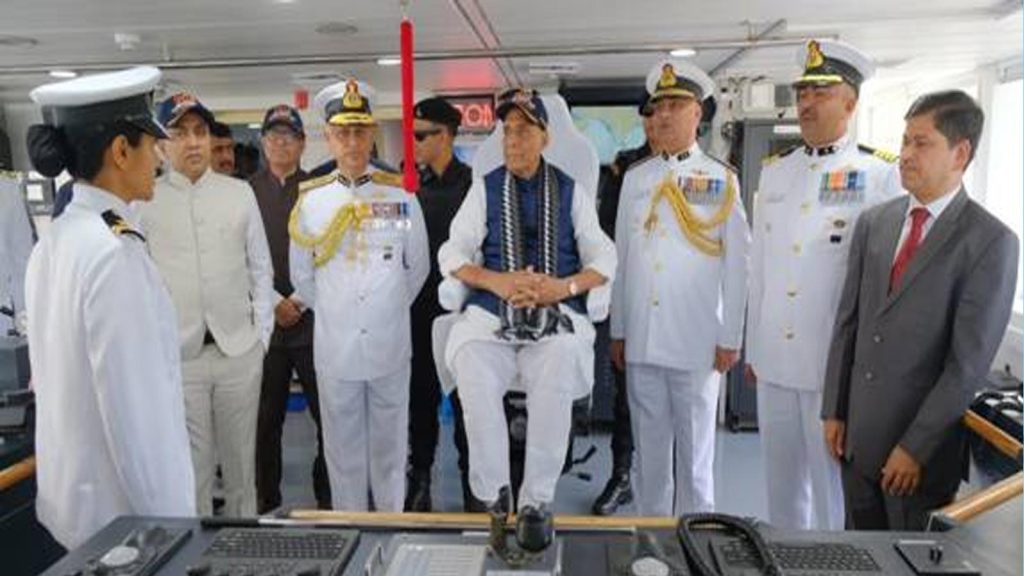
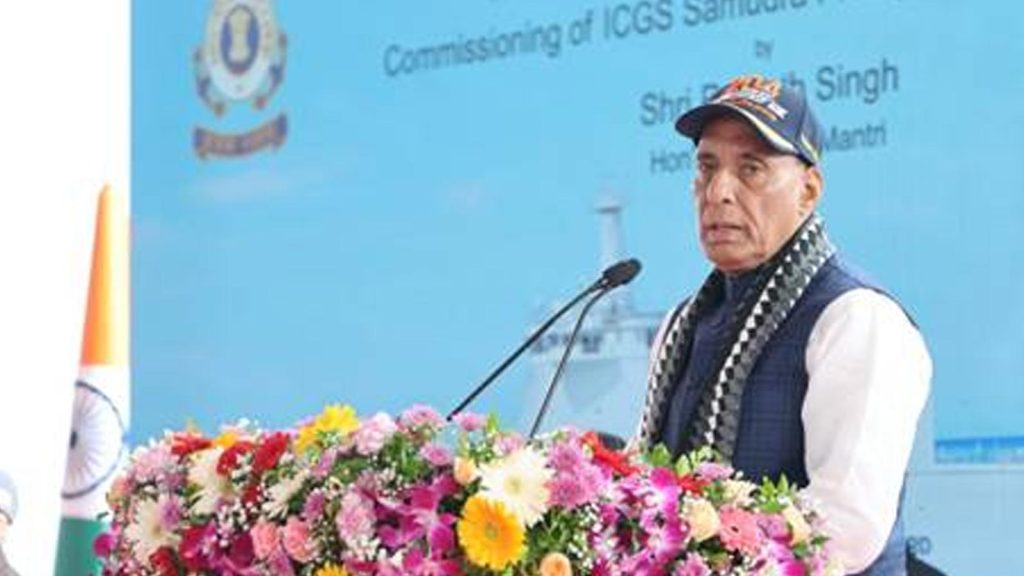
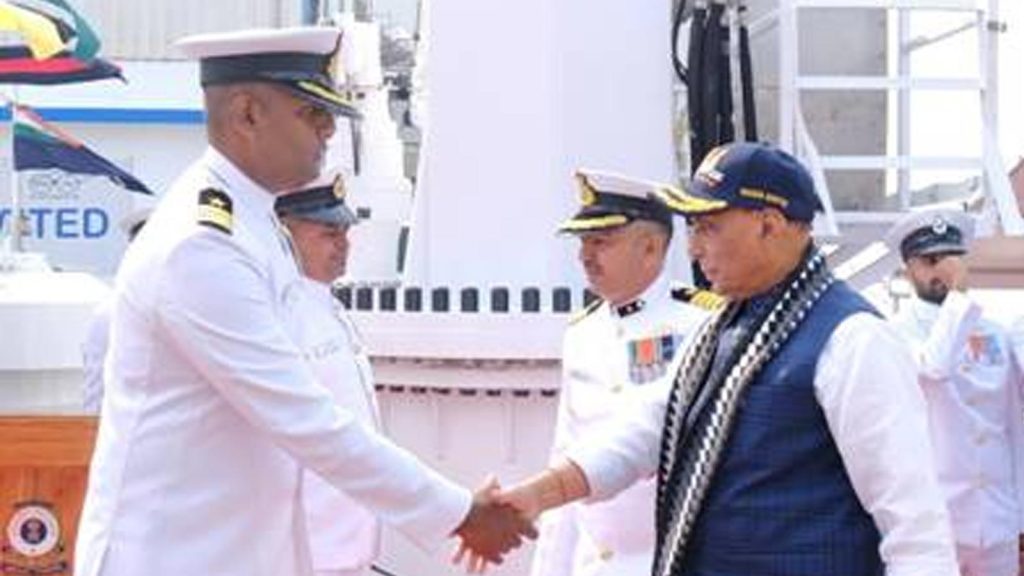
Defence Minister Rajnath Singh on Monday commissioned Indian Coast Guard Ship (ICGS) Samudra Pratap, India’s first indigenously designed Pollution Control Vessel, marking a major milestone in the country’s drive towards self-reliance in shipbuilding and maritime capability development. Built by Goa Shipyard Limited (GSL), the vessel was commissioned in Goa.
With over 60 per cent indigenous content, Samudra Pratap is the largest ship in the Indian Coast Guard’s (ICG) fleet and the first of two pollution control vessels being constructed by GSL. The ship significantly enhances India’s capability in marine pollution response, fire-fighting, maritime safety and environmental protection, while also strengthening coastal patrol and long-range surveillance across the country’s maritime zones.
Describing the vessel as an embodiment of India’s mature defence industrial ecosystem, Singh said Samudra Pratap reflects the modern, flexible and technology-driven approach adopted by Indian shipyards to address contemporary maritime challenges. He added that consistent efforts are underway to increase indigenous content in warships to nearly 90 per cent.
“Though designed primarily for pollution control, the vessel integrates multiple capabilities on a single platform, making it effective for coastal patrol and maritime safety operations as well,” the Defence Minister said. He emphasised that the Indian Coast Guard’s multi-dimensional role – from pollution response and search-and-rescue to law enforcement – has sent a clear message that any misadventure against India’s maritime interests will be met with a bold and befitting response.
Equipped with advanced pollution detection systems, dedicated pollution response boats, modern fire-fighting equipment, and aviation facilities including a helicopter hangar, Samudra Pratap can operate effectively even in rough sea conditions. The Defence Minister said these capabilities would enable timely control of pollution incidents, protecting marine ecosystems, coastal livelihoods and the blue economy.
Highlighting marine environmental protection as both a strategic necessity and moral responsibility, Rajnath Singh said India now ranks among a select group of nations with advanced environmental response capabilities. He added that clean seas ensure safe trade, secure lives and a stable maritime environment, reinforcing India’s role as a responsible maritime power committed to peace and stability in the Indo-Pacific region.
The Defence Minister reiterated the government’s commitment to strengthening the Indian Coast Guard amid emerging technology-driven and multi-dimensional threats. He stressed the need for the force to evolve from a platform-centric organisation to one that is intelligence-driven and integration-centric, while developing specialised expertise in areas such as maritime law enforcement, environmental protection and maritime cyber security.
In a first for a frontline Coast Guard ship, Samudra Pratap will have two women officers on board. Applauding this step, Singh said the move reflects the ICG’s progress towards an inclusive and gender-neutral work environment, with women increasingly serving as pilots, observers, air traffic controllers and frontline operational officers.
Praising the Coast Guard’s contribution to the Aatmanirbhar Bharat initiative, the Defence Minister said indigenous manufacturing, servicing and repair of ships and aircraft have now become standard practice, strengthening India’s defence preparedness and export potential.
Goa Chief Minister Pramod Sawant, Defence Secretary Rajesh Kumar Singh, Director General Coast Guard Paramesh Sivamani, GSL Chairman and Managing Director Brajesh Kumar Upadhyay, and senior officials from central and state governments were present at the commissioning ceremony.
Named Samudra Pratap – meaning “Majesty of the Seas” – the vessel has a displacement of 4,170 tonnes, a length of 114.5 metres and a top speed exceeding 22 knots. Powered by indigenously developed propulsion systems, it has an endurance of 6,000 nautical miles. The ship is equipped with state-of-the-art pollution response systems, advanced automation and navigation technologies, and modern armament for maritime security roles. It will be based at Kochi under the operational control of Coast Guard District Headquarters No. 4 (Kerala & Mahe).