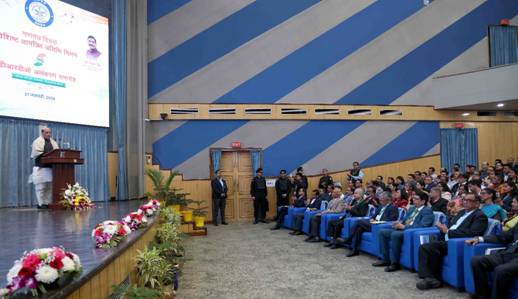
Defence Minister Rajnath Singh on Tuesday said ‘Operation Sindoor’ demonstrated how indigenous defence systems are enhancing India’s operational preparedness, while stressing that self-reliance has now become a “national mindset” under Prime Minister Narendra Modi’s leadership.
Addressing DRDO’s Best Performing Scientists and Technical Personnel, who attended the 77th Republic Day Parade as Special Guests, Singh said DRDO’s technologies were effectively used during Operation Sindoor, indicating the rapid pace of indigenisation in the defence sector.
Calling for faster innovation in a technology-driven battlefield, the Defence Minister said countries must adopt the principle of “survival of the fastest” instead of only the “survival of the fittest”. He noted that technology changes swiftly, often becoming obsolete within a few years, and that the nation which thinks, decides and deploys technology faster gains a strategic advantage.
Singh urged DRDO to reduce the time between research, prototyping, testing and deployment, stressing that timely induction of systems into the armed forces should be the primary benchmark for performance. He also suggested adopting co-development models with industry to bridge the gap between design and production, as followed in advanced defence manufacturing ecosystems globally.
Highlighting the importance of collaboration, he said DRDO must engage more deeply with public sector undertakings, private players, MSMEs, start-ups and academia. Citing the Light Combat Aircraft Tejas as an example of successful knowledge-sharing between DRDO and HAL, he said such partnerships are crucial to achieving the vision of an Aatmanirbhar Bharat in defence.
Singh noted that India’s defence exports have surged from less than ₹1,000 crore in 2014 to nearly ₹24,000 crore today, and added that the government aims to increase exports to ₹50,000 crore by 2029-30. He said DRDO should consider export markets from the design stage, particularly in sectors such as drones, radars, electronic warfare systems and ammunition.
The Defence Minister also emphasised the need to empower young scientists, provide them leadership responsibilities, and allow space for calculated risks, adding that failures in research should be viewed as opportunities for learning.
During the event, awards under the DRDO Award Scheme 2024 were presented to outstanding scientists and technologists. The Dr Bhagavantam Technology Leadership Award was conferred on BV Paparao, Director of the Advanced Systems Laboratory, Hyderabad, for his leadership in developing Agni missile-related technologies and Multiple Independently Targetable Re-Entry Vehicle capabilities. The Dr Nagchaudhuri Lifetime Achievement Award was presented to former CVRDE scientist Dr Balaguru V for his contributions to platforms such as MBT Arjun MK-1 and the Indian Light Tank ‘Zorawar’. Several other recognitions for scientific and technical excellence were also announced.
A book titled “The Unprecedented Success Story of the First Indigenous Supersonic Multi-Target Surface-to-Air Missile System – AKASH” was released on the occasion. Authored by Padma Shri awardees Dr G Chandramouli and Dr Prahlada Ram Rao, the publication traces the missile’s journey from conceptualisation to operational deployment and highlights its role in advancing indigenous defence capabilities.