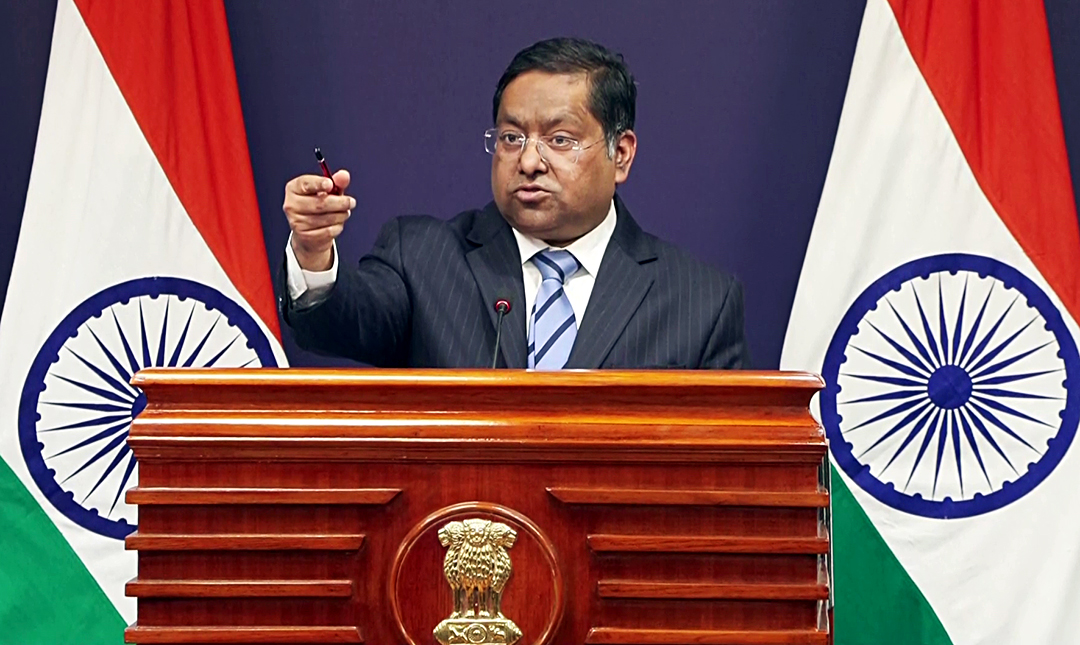
India on Friday rejected what it described as Chinese efforts to change the ground reality in the Shaksgam Valley and reiterated that it reserves the right to take necessary measures to safeguard its interests in the region.
At a regular media briefing in New Delhi, Ministry of External Affairs (MEA) spokesperson Randhir Jaiswal said India has never recognised the so-called China-Pakistan Boundary Agreement of 1963, through which Pakistan attempted to cede the area to China. He also reiterated New Delhi’s non-recognition of the China-Pakistan Economic Corridor (CPEC), saying it passes through territory that is “forcibly and illegally occupied” by Pakistan.
“Regarding Chinese infrastructure buildup via CPEC as also in the Shaksgam Valley, which is Indian territory. We have never recognised the so-called China-Pakistan boundary agreement of 1963. We have consistently maintained that the agreement is illegal and invalid. We do not recognise the so-called China-Pakistan Economic Corridor (CPEC) either, which passes through Indian territory that is under forcible and illegal occupation of Pakistan,” Jaiswal said.
He reiterated New Delhi’s position that the entire Union Territories of Jammu and Kashmir and Ladakh are “an integral and inalienable part of India,” and said this view has been conveyed to Pakistani and Chinese authorities on multiple occasions. “We have consistently protested with the Chinese side against attempts to alter the ground reality in the Shaksgam Valley. We further reserve the right to take necessary measures to safeguard our interests,” he added.
The remarks follow broader framing by External Affairs Minister S. Jaishankar, who in July 2025 described the “two-front” challenge posed by Pakistan and China as a long-standing structural reality rather than a recent development. Jaishankar traced what he characterised as six decades of military, economic and diplomatic alignment between Islamabad and Beijing—citing Pakistan’s cession of the Shaksgam Valley to China in 1963, the onset of nuclear cooperation in the 1970s, Gwadar’s transfer in 2013, and the formal launch of CPEC thereafter.
“The person who said (two front threat) it, must have missed the history lesson from school,” Jaishankar quipped during that address, noting the partnership between the two countries has developed over decades. “We are getting warnings now,” he said, “but this collaboration has been going on for 60 years.”
–IANS